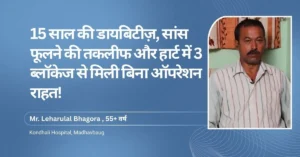
15 Years of Diabetes and 3 Heart Blockages – Recovery Without Surgery
After facing 15 years of diabetes and 3 heart blockages, Leherulal Bhagora struggled with breathlessness and daily fatigue. Doctors advised




Most people with type 2 diabetes don’t suddenly “catch” it. Long before the diagnosis, a slow process is going on in the body:
Your body still produces insulin, but your cells stop responding properly. To push glucose into the cells, the pancreas releases more and more insulin – a state called hyperinsulinemia.
High insulin levels disturb fat metabolism. This leads to dyslipidemia – raised triglycerides, low HDL (“good” cholesterol), and small dense LDL particles, which are more likely to enter artery walls and form plaque.
The inner lining of every blood vessel is called the endothelium. Constant exposure to high blood sugar and high insulin causes: Oxidative stress, Inflammation, Reduced nitric oxide (the natural “relaxing” chemical of blood vessels).
Over time, this endothelium damage leads to stiff, less elastic arteries and disturbed vascular function.
So the chain looks like this:
Diabetes → Insulin resistance → Hyperinsulinemia → High cholesterol & dyslipidemia → Endothelial damage → Vascular health problems → Loss of elasticity & hardening of arteries. This is the foundation on which hypertension and heart disease develop.
Once the endothelial lining is injured, several things start happening in the background:
Damaged endothelium allows LDL particles to sneak into the vessel wall. The immune system reacts, forming fatty streaks and then plaques. This process is called atherosclerosis.
Fat deposition in artery → plaque formation → narrowing (“blockage”) of arteries. This affects large arteries (macrovascular damage) – like those of the heart, brain and legs – and small vessels (microvascular damage) – eyes, kidneys, nerves.
When arteries are stiff, they cannot relax easily. The heart has to pump harder to push blood through. Over time this leads to hypertension (high BP). Research shows that insulin resistance and diabetes promote arterial stiffness and activate systems (like RAAS – renin–angiotensin–aldosterone system) that raise blood pressure. So the same chain continues: Micro & macro vascular damage → Hardening & narrowing of arteries → High BP (hypertension).
High blood sugar increases the viscosity (“thickness”) of blood and makes platelets more “sticky,” promoting clots. Combined with plaque-narrowed arteries, this increases chances of: Heart attack (clot in coronary artery), Stroke (clot in brain artery), Sudden worsening of peripheral artery disease
Over time, diabetes and high BP together: Thicken the heart muscle, Reduce blood flow through tiny coronary vessels (microangiopathy), Increase scarring and stiffness of heart tissue This weakens the pumping power of the heart and can lead to heart failure – a condition where the heart cannot supply enough blood to meet the body’s needs.
So the full chain now looks like: Diabetes → Insulin resistance → Hyperinsulinemia → High cholesterol → Endothelium damage → Vascular problems & hardening → Fat deposition & plaque → Micro & macro vascular damage → High BP + “thick” blood → Clots → Heart attack → Heart muscle damage → Weakened heart.
Diabetes is often called a “silent killer” because damage occurs quietly for years before any pain or symptom appears. Large population studies have shown that for every 1% increase in HbA1c (your 3-month average blood sugar), there is roughly a 10–20% increase in the risk of cardiovascular events like heart attack and stroke.
Some analyses report about a 13% higher risk of coronary heart disease for each 1% rise in HbA1c – clearly showing a strong relationship between poor sugar control and heart attacks.
That’s why cardiologists and diabetologists today focus not just on “sugar control” but on total cardio-metabolic health – sugar, BP, cholesterol, weight, smoking, sleep and stress.
Studies suggest that more than half of people with type 2 diabetes also have hypertension, and the two conditions share several mechanisms:
Together, they cause overlapping complications:
This is why your doctor insists on tight blood pressure control even if your sugars look “okay” – because BP and sugar multiply each other’s harm.
The “diabetes–hypertension–heart disease connection” may not cause symptoms early. But if you already have diabetes, pay attention if you notice:
These don’t automatically mean heart disease or uncontrolled BP, but they deserve a prompt check-up – especially if you are diabetic, overweight, smoke, or have a family history of heart disease.
The good news: the chain can be slowed or partially reversed if root causes are addressed early.
Your doctor may recommend:
Regular monitoring of:
Early, consistent treatment significantly lowers the risk of heart attack, stroke and heart failure.
Many people now look for a more holistic, natural support system alongside modern care. Under the guidance of a qualified Ayurvedic physician, ayurvedic treatment for diabetes may include: Individualised diet plans based on prakriti and agni Panchakarma-based detox therapies where appropriate Herbal formulations aimed at improving metabolism, digestion and insulin sensitivity Lifestyle guidance (dinacharya, ritucharya, yoga, pranayama, meditation).
Integrative care works best when your Ayurveda doctor and modern physician are in communication, so that medicines (especially insulin and BP tablets) can be adjusted safely as your health parameters improve.
If you already have diabetes, consider asking your doctor:
These questions turn your consultation into a partnership, instead of a one-way instruction. Think of diabetes, hypertension and heart disease as one connected cardio-metabolic disease – the “diabetes–hypertension–heart disease connection silent trio.” The earlier you act on all three, the better your chances of living a long, active, complication-free life.
If you’re living with diabetes today, the best time to protect your heart and blood vessels was yesterday.
The second-best time is right now – with informed choices, regular check-ups, and a holistic, evidence-based treatment plan.
Madhavbaug has earned national recognition for its contributions to non-surgical cardiac care and lifestyle-based disease reversal. The organization has been featured across major media for its clinical research and high-impact public health initiatives.
In 2018, Madhavbaug achieved a prestigious India Book of Records milestone by successfully conducting 661 live GTT assessments across multiple clinics in a single day — an achievement covered by leading news platforms.
In 2023, Madhavbaug further strengthened its clinical authority by training 65 government medical officers in Uttarakhand on evidence-based, Ayurveda-integrated disease reversal protocols.
With over 200+ awards for healthcare excellence, innovation, and patient outcomes, Madhavbaug continues to be one of India’s most trusted names in heart blockage treatment without surgery.

After facing 15 years of diabetes and 3 heart blockages, Leherulal Bhagora struggled with breathlessness and daily fatigue. Doctors advised
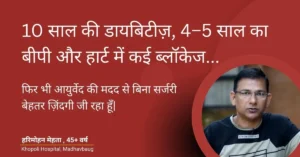
10 साल की डायबिटीज़ (10 years of diabetes), कई वर्षों का हाई ब्लड प्रेशर और हार्ट में मल्टीपल ब्लॉकेज के