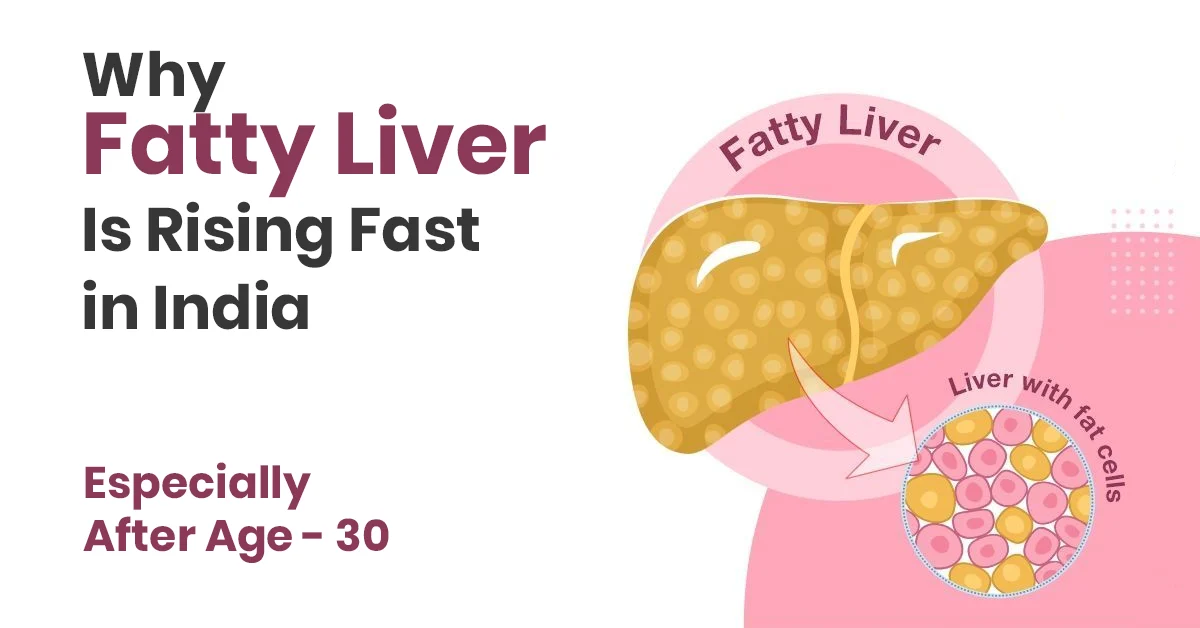
Fatty Liver Disease has silently emerged as one of the fastest-growing lifestyle disorders in India. What was once associated mainly with alcohol consumption is now increasingly diagnosed in non-alcoholic individuals—working professionals, homemakers, and even people who appear physically fit.
After the age of 30, metabolic efficiency naturally declines. Combined with sedentary habits, high-carbohydrate diets, stress, and poor sleep, the liver begins accumulating fat—often without warning signs.
Why the Liver Matters More Than You Think
The liver functions as the body’s metabolic control center. It regulates blood sugar, cholesterol, hormones, digestion, and detoxification. When fat accumulates inside liver cells, these processes become inefficient, increasing the risk of:
- Type 2 Diabetes
- High Blood Pressure
- Heart Disease
- Obesity and metabolic syndrome
What Is Fatty Liver Disease?
Fatty liver, medically known as Hepatic Steatosis, occurs when fat accumulation exceeds 5–10% of the liver’s weight.
Types of Fatty Liver Disease
1️⃣ Non-Alcoholic Fatty Liver Disease (NAFLD)
- Occurs without alcohol intake
- Linked to insulin resistance, obesity, diabetes, and sedentary lifestyle
- Highly prevalent in Indians due to carbohydrate-rich diets
2️⃣ Alcoholic Fatty Liver Disease
- Caused by regular or binge alcohol consumption
- Alcohol interferes with fat metabolism in liver cells
Important: NAFLD is now more common in India than alcohol-related fatty liver.
Common Symptoms That Are Often Ignored
Fatty liver is called a “silent disease” because early symptoms are subtle.
Early Signs
- Persistent fatigue
- Heaviness or mild pain in the right upper abdomen
- Bloating, gas, indigestion
- Difficulty losing weight
Advanced Warning Signs
- Increasing belly fat
- Rising blood sugar or blood pressure
- Darkening of skin around the neck
- Abnormal liver enzymes in blood reports
Many people discover fatty liver only after developing diabetes or heart disease.
How to Check for Fatty Liver
Early detection is simple and affordable.
- Ultrasound Abdomen: Most common screening test
- Liver Function Test (LFT): ALT, AST levels
- FibroScan: Measures fat and liver stiffness
- Blood Tests: Triglycerides, HbA1c
Anyone above 30 years with belly fat, diabetes, BP, or thyroid issues should consider screening.
Why Fatty Liver Is Not Harmless
If ignored, fatty liver can progress gradually:
- Simple fatty liver
- Inflammation (NASH)
- Fibrosis (scarring)
- Cirrhosis
- Liver failure or cancer
Medical studies associate fatty liver with a significantly higher risk of diabetes, heart attacks, and hypertension.
How Lifestyle Accelerates Fatty Liver in Indians
- Sedentary desk jobs
- High sugar and refined carbohydrate intake
- Late-night meals
- Stress and inadequate sleep
- Weekend alcohol binge patterns
- Lack of muscle-building activity
How Fatty Liver Triggers Diabetes, BP & Heart Disease
Fatty liver worsens insulin resistance, leading to high blood sugar despite normal insulin levels. It also increases bad cholesterol and arterial inflammation, contributing to heart disease and high blood pressure.
Can Fatty Liver Be Reversed?
The encouraging fact is that fatty liver is reversible in early stages with timely lifestyle correction and metabolic management.
Ayurveda’s View on Fatty Liver
Ayurveda describes fatty liver as Yakrit Meda Dushti—a condition involving fat accumulation and toxin overload in liver channels.
Ayurvedic management focuses on:
- Improving digestion (Agni)
- Clearing metabolic toxins (Ama)
- Enhancing bile secretion
- Mobilizing stored fat
Commonly Used Ayurvedic Herbs
- Bhumi Amla
- Kalmegh
- Kutki
- Punarnava
- Haritaki
Note: Herbal remedies should only be used under medical supervision.
Dietary Principles That Support Liver Health
Recommended
- Fresh, warm meals
- High-fiber vegetables
- Adequate protein
- Early dinner
To Avoid
- Sugary foods and beverages
- Refined flour products
- Alcohol
- Late-night eating
Final Health Message
Fatty liver is not just a liver condition—it is the body’s early warning system. Acting early can help prevent serious lifestyle diseases and support long-term metabolic health.
Scientific Evidence: Why Fatty Liver Is a Serious Cardiometabolic Risk
1. Fatty Liver Doubles Cardiovascular Risk in People With Diabetes
Evidence from Meta-analysis
Large-scale meta-analyses published in peer-reviewed medical journals show that individuals with both non-alcoholic fatty liver disease (NAFLD) and diabetes have approximately double the risk of developing cardiovascular disease compared to diabetic patients without fatty liver.
This increased risk includes coronary artery disease, heart attacks, and other major cardiovascular events. The findings highlight that fatty liver is not merely a liver condition but a powerful amplifier of cardiovascular risk in people with impaired glucose metabolism.
Medical literature consistently emphasizes NAFLD as an independent cardiovascular risk factor in diabetes.
2. Strong Association With Hypertension, Diabetes & Dyslipidemia
Scientific Review Evidence
Multiple scientific reviews describe NAFLD as the hepatic (liver) manifestation of metabolic syndrome. Metabolic syndrome is characterized by the clustering of:
-
High blood pressure (hypertension)
-
High blood sugar (type 2 diabetes)
-
Dyslipidemia (abnormal cholesterol levels)
Clinical data show that fatty liver frequently coexists with all three conditions, significantly increasing the long-term risk of heart disease and stroke. This explains why NAFLD is commonly detected in patients already diagnosed with BP, diabetes, or cholesterol imbalance.
3. Fatty Liver Significantly Raises Risk of Cardiovascular Diseases
Extensive Clinical Reviews
Comprehensive clinical reviews report that patients with NAFLD have a substantially higher prevalence of coronary heart disease, hypertension, and other cardiovascular conditions compared to individuals without fatty liver.
Importantly, cardiovascular disease—not liver failure—has emerged as the leading cause of death in patients with NAFLD. This underscores the need to treat fatty liver as a systemic metabolic disorder, not a localized liver issue.
4. Higher Risk of Heart Attacks & Major Cardiovascular Events
Research-Based Evidence
Research summaries indicate that NAFLD is associated with an increased risk of:
-
Coronary heart disease
-
Myocardial infarction (heart attack)
-
Cardiac arrhythmias
-
Heart failure
-
Stroke and cardiovascular mortality
Crucially, these associations persist independent of traditional risk factors such as age, obesity, and smoking, reinforcing the role of fatty liver as an independent driver of cardiovascular risk.
5. NAFLD and High Blood Pressure (Hypertension)
Meta-Analysis Findings
Large meta-analyses show that individuals with NAFLD have approximately a 1.6-fold higher risk of developing hypertension compared to those without fatty liver.
Emerging evidence also suggests that fatty liver may actively contribute to the development and progression of high blood pressure, through mechanisms such as vascular stiffness, hormonal imbalance, and altered sodium regulation.
6. NAFLD and Type 2 Diabetes: A Strong Two-Way Relationship
Scientific Reviews & Cohort Studies
The relationship between NAFLD and type 2 diabetes is bidirectional:
-
Fatty liver increases insulin resistance, raising diabetes risk
-
Diabetes accelerates liver fat accumulation and inflammation
Clinical studies further show that greater liver fat severity predicts higher future diabetes risk, even after adjusting for body weight and other known risk factors. This highlights fatty liver as an early metabolic warning sign, not a late complication.
7. Fatty Liver and Cholesterol Abnormalities
Clinical & Metabolic Evidence
Fatty liver is closely linked with abnormal lipid metabolism, including:
-
High triglycerides
-
Elevated LDL (“bad cholesterol”)
-
Low HDL (“good cholesterol”)
These lipid abnormalities accelerate atherosclerosis (artery plaque formation), significantly increasing the risk of heart attacks and cardiovascular disease. Medical consensus recognizes fatty liver as a core component of metabolic dysfunction, rather than an isolated liver finding.
Key Medical Takeaway
Fatty liver is not just a liver condition—it is a central driver of metabolic and cardiovascular disease.
Scientific evidence consistently shows its strong association with diabetes, hypertension, cholesterol imbalance, heart attacks, and cardiovascular mortality.
Early identification and metabolic correction of fatty liver can play a crucial role in preventing diabetes progression, stabilizing blood pressure, and reducing heart disease risk.