

A real, doctor-supervised recovery, documented with before-and-after clinical results.
Quick Summary
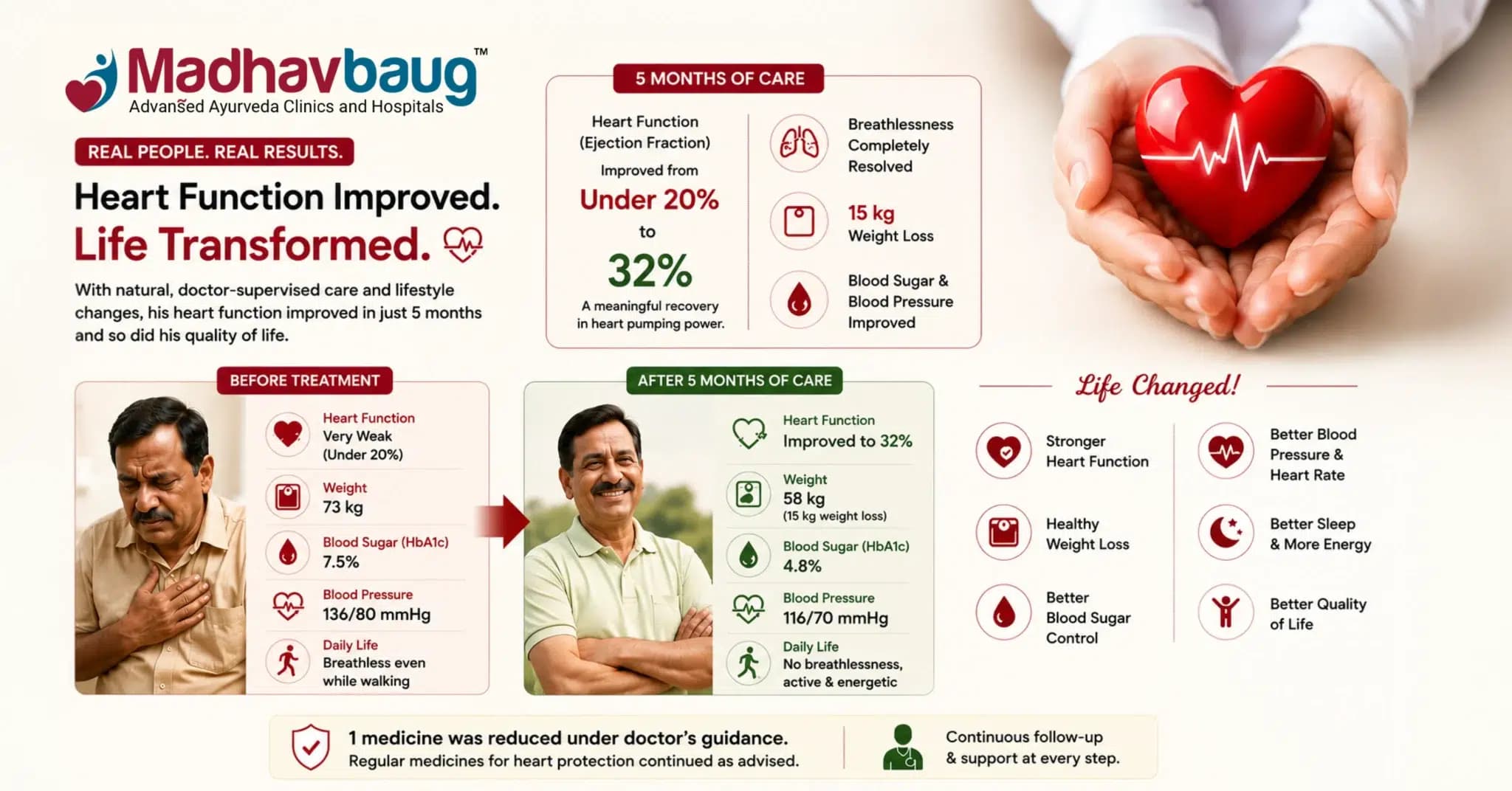
A 58-year-old man with severely reduced heart pumping function (ejection fraction under 20%) and breathlessness that limited his daily life underwent five months of doctor-supervised, non-surgical cardiac care at Madhavbaug. The result: his ejection fraction rose to 32%, his breathlessness resolved completely, and he lost 15 kg while improving his blood pressure, resting heart rate, and blood sugar control.
| Parameter | Before Treatment | After Treatment |
| Ejection Fraction (LVEF) | Under 20% | 32% |
| Weight | 73 kg | 58 kg |
| BMI | 29.2 | 24.6 |
| HbA1c | 7.5% | 4.8% |
Patient at a Glance
| Field | Details |
| Patient | Mr. Sandip Powar |
| Age & Location | 58 years, Male (Kolhapur city) |
| Primary Diagnosis | Congestive Heart Failure (Ischemic Heart Disease / CAD) |
| Main Concerns | Breathlessness on exertion, generalised weakness, insomnia |
| Care Setting | Madhavbaug Clinic, Crusher Corner, Kolhapur |
| Duration | Approximately 5 months (December 2025 – May 2026) |
| Key Result | Ejection fraction improved from under 20% to 32% |
| Current Status | Continues under regular cardiac follow-up |
The Patient’s Story
Mr. Sandip Powar, a rickshaw driver, had been experiencing breathlessness while walking since 2023, along with persistent weakness and insomnia. Worried about how his declining health would affect his ability to keep working, he began looking for a structured, medically supervised way to manage his heart condition.
Why He Chose Ayurvedic Treatment Over Surgery
After being diagnosed with heart disease, Mr. Powar was advised to undergo an operative procedure. Concerned about the risks of surgery, he chose not to proceed with the operative approach. Instead, he opted for non-invasive Ayurvedic management with Panchakarma therapy, under continuous medical supervision.
Symptoms and Their Impact on Daily Life
Since 2023, Mr. Powar experienced severe breathlessness on exertion, which caused significant psychological distress. He grew anxious about his health and his ability to continue working as a rickshaw driver, his primary source of livelihood.
Medical History Before Treatment
Mr. Powar’s diagnosis was confirmed in November 2023. Relevant contributing factors included obesity (BMI 29.2 at baseline) and elevated HbA1c (7.5%), both known cardiovascular risk factors. He had not undergone any invasive treatment before coming to Madhavbaug, and his breathlessness and severely reduced ejection fraction remained unresolved at the time of presentation.
Clinical Assessment and Treatment Goals
Echocardiography confirmed global left ventricular hypokinesia with all four cardiac chambers dilated and a severely reduced ejection fraction of under 20%. Contributing metabolic factors, including obesity and impaired glycaemic control, were also identified as cardiovascular risk drivers.
Given his history and clear preference to avoid surgery, the treatment goals were to:
- Support cardiac pumping function
- Relieve breathlessness on exertion
- Achieve safe, sustained weight reduction
- Improve blood sugar control
- Maintain continuous medical supervision so cardio-protective and antiplatelet medicines could be reviewed and adjusted as needed
Personalised Ayurvedic Care Plan for Heart Failure
| Care Component | What Was Prescribed | Frequency / Duration | Purpose |
| Clinical Assessment & Follow-Up | Diagnosis and follow-up for CAD | Ongoing since 2023 | To increase ejection fraction |
| Panchakarma Therapy | Snehana (oleation), Swedana (vasodilation), Basti (per-rectum drug administration) | Twice a week | To improve heart-pumping function |
| Diet Plan | Reverse Diet Kit | Daily | Weight and glycaemic control |
| Activity / Rehabilitation | Breathing exercises, aerobic exercise | Daily | Improve functional capacity and exertional tolerance |
| Medicine Coordination | Dytor 10 mg withdrawn; Cidmus and Ecosprin 75 mg continued | As advised by treating doctor | Safe de-escalation under medical supervision |
Mr. Powar’s care plan was built around his specific starting point — a severely reduced ejection fraction, obesity, elevated HbA1c, and a firm preference to avoid surgery. Structured Panchakarma therapy was given twice a week, alongside a Reverse Diet Kit followed daily. Breathing and aerobic exercise were introduced gradually to rebuild exertional tolerance without over-stressing a recovering heart. His cardiac medications were reviewed and adjusted by his treating doctor throughout, after which Dytor 10 mg was eventually withdrawn, while Cidmus and Ecosprin 75 mg were continued for cardioprotection.
Progress Over Time
| Time Point | Symptoms/Function | Objective Findings |
| Baseline | Breathlessness on exertion present | LVEF <20%; Weight 73 kg; BMI 29.2; BP 136/80 mmHg; HR 82/min; Abdominal girth 102 cm; HbA1c 7.5% |
| Latest Follow-Up | No breathlessness on exertion | LVEF 32%; Weight 58 kg; BMI 24.6; BP 116/70 mmHg; HR 71/min; Abdominal girth 90 cm; HbA1c 4.8% |
Before-and-After Results
| Parameter | Before | After | What Changed |
| Ejection Fraction (LVEF) | Under 20% | 32% | Cardiac pumping function moved from severely reduced to moderately reduced systolic function |
| Weight | 73 kg | 58 kg | 15 kg weight loss, supporting reduced cardiac workload |
| BMI | 29.2 | 24.6 | Moved from obese range to near-normal |
| Blood Pressure | 136/80 mmHg | 116/70 mmHg | Improved blood pressure control |
| Heart Rate | 82/min | 71/min | Resting heart rate improved, consistent with better cardiac conditioning |
| Abdominal Girth | 102 cm | 90 cm | Reduced, consistent with documented weight loss |
| HbA1c | 7.5% | 4.8% | Improved long-term blood glucose control |
What These Results Meant for the Patient
The most significant outcome was the recovery in heart-pumping function in which ejection fraction rose from severely reduced (under 20%) to moderately reduced (32%) over roughly five months. Alongside this, his exertional breathlessness resolved completely, he lost 15 kg with BMI normalising, and his blood pressure, heart rate, abdominal girth, and HbA1c all improved. One blood-pressure-lowering medicine (Dytor) was withdrawn under medical supervision, while cardioprotective and antiplatelet medicines were continued.
His latest echocardiogram still shows a regional wall motion abnormality with LAD-territory akinesia and moderate pulmonary hypertension, so he remains under active cardiac follow-up.
NOTE: This is an individual case and should not be read as a guaranteed or typical outcome for others.
Doctor’s Clinical Note
The documented records show a meaningful recovery in left ventricular systolic function, with ejection fraction improving from under 20% to 32% alongside complete resolution of exertional breathlessness over approximately five months of structured, physician-supervised care. The patient also achieved substantial weight loss, improved blood pressure, heart rate, and glycaemic control, with one antihypertensive medicine safely withdrawn under supervision.
The latest echocardiogram continues to show a regional wall motion abnormality with LAD-territory akinesia and moderate pulmonary hypertension, so ongoing cardiac monitoring remains necessary. This is an individual case, and outcomes for other patients with similar presentations may differ depending on their overall condition, adherence, and risk factors.
— Dr. Smita Patil (B.A.M.S.)
Conclusion
Mr. Powar began treatment with severely reduced heart function (ejection fraction under 20%) and breathlessness that limited his daily activity. With a personalised, doctor-supervised care plan, he achieved measurable weight loss, better blood pressure and blood sugar control, and most importantly, a meaningful recovery in heart pumping function to 32%, alongside complete resolution of exertional breathlessness. He continues under regular cardiac follow-up given the residual wall motion abnormality and pulmonary hypertension on his latest echo.
If you or a loved one are managing a similar heart condition, an individual assessment can help clarify what a suitable care plan may look like. To book your appointment, visit the nearby Madhavbaug Clinic.
Frequently Asked Questions
What was the patient’s ejection fraction before and after treatment?
Baseline echocardiography showed an ejection fraction of under 20%. A follow-up echo about five months later showed it had improved to 32%, reflecting a meaningful recovery in heart-pumping function under doctor-supervised care.
How long did it take to see improvement?
The results shown here were measured about five months after the start of care. Individual timelines vary, and a doctor can advise on what to realistically expect based on a person’s own reports.
Were any tests used to confirm the improvement?
Yes, improvement was confirmed with serial 2D echocardiography and colour Doppler studies performed at accredited cardiac centres, alongside routine vitals and HbA1c monitoring.
Did the patient stop any heart medicines?
One medicine (Dytor 10 mg) was withdrawn under medical supervision, while cardio-protective and antiplatelet medicines were continued. Any medicine changes should only be made under a doctor’s guidance, never self-adjusted.

 Locate a Centre
