

Opening Summary
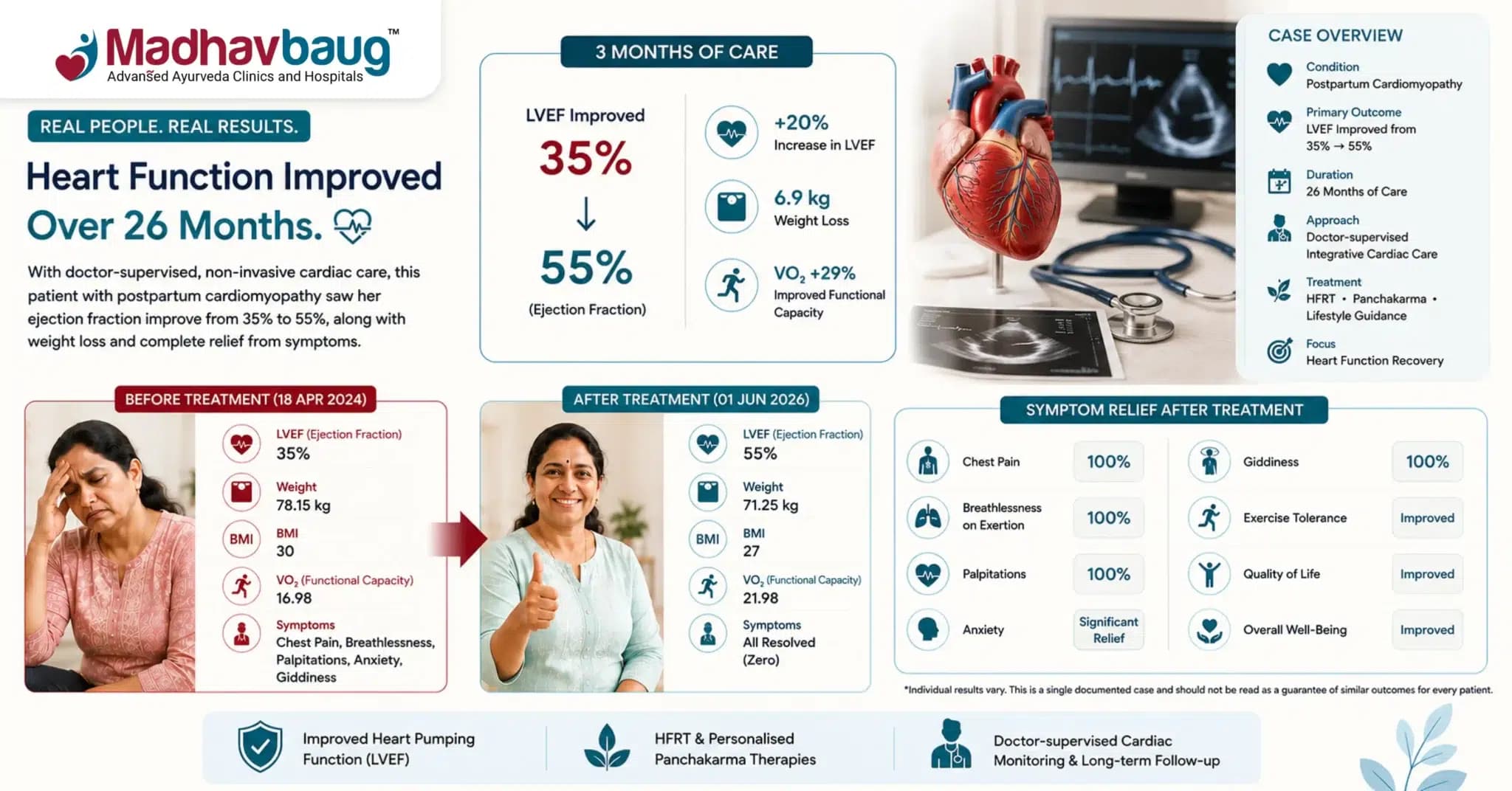
Sunita Yemul, a 41-year-old woman, was diagnosed with postpartum cardiomyopathy, a severely reduced ejection fraction of 35%, global hypokinesia of the left ventricle and a dilated left atrium alongside chest pain, breathlessness on exertion, palpitations, anxiety and giddiness that had continued for nearly two years. She began a doctor-supervised, non-invasive cardiac care plan at Madhavbaug, coordinated with her treating cardiologists.
Over more than two years of monitored care, her ejection fraction improved from 35% to 55%, her weight reduced from 78.15 kg to 71.25 kg, and her presenting complaints resolved completely. She continues under periodic cardiac follow-up.
Note: individual results vary. This is a single documented case and should not be read as a guarantee of similar outcomes for every patient.
Outcome
| Patient | Sunita Yemul |
| Age and city | 41 years at baseline (18 Apr 2024) | Solapur |
| Primary diagnosis | Postpartum cardiomyopathy, concentric LVH, dilated left atrium, global LV hypokinesia, LVEF 35% (confirmed on 2D Echo, 18 Apr 2024) |
| Main symptoms | Chest pain, breathlessness on exertion (Grade I), palpitations, anxiety, giddiness |
| Care plan | Madhavbaug non-invasive cardiac care programme with periodic clinical and diagnostic monitoring, coordinated with treating cardiologists’ medicine management |
| Duration | Approximately 26 months (18 Apr 2024 baseline to 01 Jun 2026 latest follow-up) |
| Key measured result | LVEF: 35% (18 Apr 2024) → 55% (01 Jun 2026) |
| Current status | Adequate LV function on the latest echo, complaints resolved (“Zero”), continuing periodic follow-up |
The Patient’s Story
Sunita Yemul, 41, conceived through IVF and became a mother. Soon after delivery, she was diagnosed with postpartum cardiomyopathy leading to heart failure. Alongside the physical symptoms, the diagnosis affected her emotionally: coming so soon after the IVF journey, it shook her confidence, and she gradually developed anxiety. She carried this combination of physical limitation and emotional strain for close to two years before starting her care plan at Madhavbaug.
Symptoms and Impact on Daily Life
| Symptom / limitation | Since when? | Severity / frequency | Daily-life impact |
| Chest pain | ~2 years (from diagnosis) | Moderate | Hampered daily routine; quality of life decreased |
| Breathlessness on exertion (DOE) | ~2 years | Grade I | Hampered daily routine; quality of life decreased |
| Palpitations | ~2 years | Severe | Hampered daily routine; quality of life decreased |
| Anxiety and giddiness | ~2 years | Severe | Hampered daily routine; quality of life decreased |
Medical History and Care Before Madhavbaug
Confirmed diagnosis of postpartum cardiomyopathy, made approximately 2 years before the Madhavbaug baseline record, reconfirmed on 2D Echo dated 18 Apr 2024 (concentric LVH, dilated LA, global hypokinesia of LV, LVEF 35%, trivial MR) at Apex Superspeciality Hospital & Research Centre, Solapur, under Dr Rizwan ul Haque.
Medicines at entry: Sacutan 50 mg BD, Dapazol 10 mg OD, Dompsn SR OD, Nebicip 2.5 mg HS, Aldactone 25 mg OD.
Why the Patient Chose Madhavbaug
Given the severity of her diagnosis, Sunita wanted a structured, closely monitored programme rather than medicine management alone. She came to Madhavbaug looking for hope, drawn by its cardiac care programme built over nearly two decades of work in cardiac disease reversal and the encouraging results reported by other patients with similar heart conditions. From her first consultation, she found the doctor patient in listening to her concerns and consistent in monitoring her condition, which gave her the confidence that recovery was possible.
Baseline Diagnostic Findings
| Parameter / test | Baseline value | Reference / target |
| LVEF (2D Echo) | 35%, global hypokinesia | Normal ≥ 55% |
| BMI | 30 | 18.5–22.9 (Asian) |
| Weight | 78.15 kg | N.A. |
| HbA1c | 5.5% | <5.7% (non-diabetic) Within normal range |
| Blood Pressure | 122/78 mmHg | <120/80 mmHg |
| Heart Rate | 90 bpm | 60–100 bpm Within normal range |
| VO2 (functional capacity) | 16.98 | N.A. |
| NT-proBNP | 274 pg/mL | Age/sex-specific cut-off |
| GLS | 13.5 (05 Aug 2024) | N.A. |
| Serum Creatinine | 0.9 mg/dL | 0.6–1.1 mg/dL Within normal range |
Personalised Care Plan
| Care component | What was prescribed | Frequency / duration | Purpose / monitoring |
| Diagnosis and follow-up | Periodic clinical review with 2D Echo reassessment | Echo repeated at ~4 months and again at ~26 months | Tracked LVEF, chamber size and valve function over time |
| Panchakarma / therapy | HFRT 3 Panchakarma therapy | Twice weekly | To increase cardiac functional capacity |
| Diet plan | Madhashakti atta with a customised diet chart | Daily | Supported the weight reduction from 78.15 kg to 71.25 kg |
| Activity / rehabilitation | MIB Pulse app-guided exercise | Daily | Supported the rise in VO2 from 16.98 to 21.98 |
| Medicine coordination | Coordinated with the treating cardiologist; medicines adjusted over follow-up | As advised by the treating doctor | Doctor-supervised titration alongside clinical improvement |
Care-Plan Narrative
Sunita’s care plan combined HFRT 3 Panchakarma therapy, given twice a week to increase her cardiac functional capacity, with a customised diet built around Madhashakti atta and a personalised diet chart. She also followed daily MIB Pulse app-guided exercise as part of her activity plan. Alongside this, her allopathic cardiac medicines continued to be managed and adjusted by her treating cardiologist as her clinical picture changed. Periodic clinical review and repeat 2D Echo assessment were used to track how her heart function was responding over time. Together, this combination supported the rise in her functional capacity (VO2) from 16.98 to 21.98, her weight loss from 78.15 kg to 71.25 kg, and the improvement in her ejection fraction from a severely reduced 35% toward the normal range.
Progress and Measured Results
Recovery Timeline
| Time point | Symptoms / function | Objective measure | Treatment / adherence | Doctor action |
| Baseline18 Apr 2024 | Chest pain, DOE, palpitations, anxiety, giddiness | LVEF 35%, global hypokinesia, dilated LA (Apex Hospital, Dr Rizwan ul Haque) | Care plan started; allopathy medicines as listed above | Baseline confirmed; care plan initiated |
| Interim05 Aug 2024 | DOE and chest pain completely reduced; palpitations occasional | LVEF 44% (GLS –13.5), mild global LV dysfunction, mild TR, Grade I diastolic dysfunction (Sai Heart & Maternity Care, Dr Sunil Shewale) | HFRT continued | Care plan and assessment, monitoring continued |
| Latest follow-up 01 Jun 2026 | Complaints recorded as “Zero” | LVEF 55%, no regional wall motion abnormality, adequate LV function, mild TR, normal PA pressures (Sai Heart & Maternity Care, Dr Sunil Shewale) | Allopathic medicine tapered; HFRT completed | Assessment and monitoring continued |
Before-and-After Results
| Parameter | Before | After | Change |
| LVEF | 35% (18 Apr 2024) | 55% (01 Jun 2026) | +20 points, moved from severely reduced to within the normal range |
| Weight | 78.15 kg | 71.25 kg | −6.9 kg (−8.8%) |
| BMI | 30 | 27 | −3 points Obese to overweight range |
| HbA1c | 5.5% | 4.4% | −1.1 points Remained non-diabetic |
| VO2 (functional capacity) | 16.98 | 21.98 | +5.0 (+29.4%) |
| Serum Creatinine | 0.9 mg/dL | 0.6 mg/dL | −0.3 mg/dL Remained normal |
| Blood Pressure | 122/78 mmHg | 123/86 mmHg | Diastolic +8 mmHg Remained within normal range |
| Heart Rate | 90 bpm | 89 bpm | −1 bpm Essentially unchanged |
| Presenting complaints | Chest pain, DOE, palpitations, anxiety, giddiness | Zero | Full resolution reported |
Results Narrative
The strongest verified result in this case is the recovery of left ventricular function: ejection fraction rose from a severely reduced 35% at baseline to 55% within the normal range, with no regional wall motion abnormality on the latest echocardiogram. By the interim review, chest pain and breathlessness on exertion had reduced completely, and palpitations had become occasional; by the latest follow-up, all presenting complaints were recorded as fully resolved. HFRT therapy continued through the interim phase and was completed by the latest follow-up, and her allopathic cardiac medicines were tapered under her treating cardiologist’s supervision as her condition improved. Body weight fell by 6.9 kg and BMI by 3 points over the follow-up period, and functional capacity (VO2) rose by close to 30%. Blood pressure remained within the normal range throughout. The patient continues on periodic cardiac assessment and monitoring; this single case does not predict another patient’s outcome.
What Changed in Everyday Life?
Exercise tolerance increased, and she is now able to walk for longer periods without difficulty. Breathlessness on exertion and chest pain reduced completely. She reports feeling more confident, and her overall quality of life improved.
Trust and Clinical Validation
Patient Testimonial
“My journey has been one of the most challenging phases of my life. After undergoing IVF treatment, I was blessed with motherhood, but soon after delivery, I was diagnosed with cardiomyopathy leading to heart failure. I experienced severe breathlessness on exertion, chest pain, and constant fatigue. Along with my physical health, my emotional well-being also suffered. Having already gone through the financial and emotional burden of IVF, this diagnosis shattered my confidence, and I gradually developed anxiety.
When I came to Madhavbaug, I was looking for hope. From my very first consultation, the doctors patiently listened to my concerns, guided me with compassion, and closely monitored my condition throughout my treatment journey. Their continuous support and encouragement gave me the confidence to believe that recovery was possible.
With the structured Heart Failure Reversal Therapy, I started noticing significant improvements. Today, my breathlessness and chest pain have completely resolved, my confidence has returned, and my anxiety has reduced considerably. My dependence on allopathic medicines has also decreased under medical supervision.
The biggest milestone has been the improvement in my heart function. My ejection fraction has improved remarkably from 35% to 55%, and I can now perform my daily activities comfortably with a much better quality of life.
I am sincerely grateful to the entire Madhavbaug team for their dedicated care, constant guidance, and unwavering support. They didn’t just treat my heart, they helped me regain my life and confidence.”
Conclusion
Sunita Yemul entered Madhavbaug’s care with postpartum cardiomyopathy, a severely reduced ejection fraction of 35% and symptoms that had limited her for nearly two years. Through a doctor-supervised, non-invasive cardiac care plan coordinated with her treating cardiologists, monitored over more than two years, her ejection fraction improved to 55%, her weight and BMI reduced, her functional capacity improved, and her presenting complaints resolved. She remains under periodic follow-up to sustain these gains. Every patient’s condition and response are different; if you or a loved one is managing a similar diagnosis, speak with a Madhavbaug doctor about an individual assessment.
Understand What the Right Care Plan Could Look Like for You
Every patient’s condition and response are different. Book an assessment with a Madhavbaug doctor to discuss your reports, symptoms and suitable next steps.
Frequently Asked Questions
- Can ejection fraction really improve after postpartum cardiomyopathy?
In this case, ejection fraction improved from 35% to 55% over about two years of doctor-supervised, non-invasive care coordinated with the patient’s cardiologist. Recovery varies by individual, and any treatment plan should be guided by your own treating doctor based on your reports.
- How long did this recovery take?
This patient’s ejection fraction was reassessed at roughly 4 months (44%) and again at about 26 months (55%) from her baseline echocardiogram. Timelines differ for each patient depending on the severity and response to treatment.
- What tests were used to track progress?
Progress was tracked mainly through 2D echocardiography (ejection fraction, wall motion, valve function) along with weight, BMI, blood pressure, HbA1c and kidney function (serum creatinine) at intervals.
- Did the patient stop her cardiology medicines?
No. Medicine changes shown in this case were made and supervised by her treating cardiologist. No reader should stop or change any heart medicine without medical supervision.


 Locate a Centre
