

 Add to Preferred Sources
Key Takeaways
|
Heart blockage is one of the most common reasons for hospital admissions in India and cardiovascular diseases are estimated to cause around 28% of all deaths in the country (India State Level Disease Burden Initiative CVD Collaborators, 2018) so it is not surprising that a large number of families sit in front of a cardiologist and hear the words angioplasty or bypass surgery for their loved one.
Most patients feel scared and confused at this point because both the procedures sound serious and very few people explain clearly why one is chosen over the other. The angioplasty vs bypass question does not have one right answer for everyone since it depends on how many arteries are blocked, where the blockage is, how strong your heart pump is and whether you also have diabetes or any other health problem.
In this blog we explain the angioplasty vs bypass differences in easy terms, how long the angioplasty recovery time and the bypass surgery recovery time are, what life after bypass surgery looks like and how Madhavbaug’s comprehensive heart care can support you before and after the procedure.
Confused about your heart blockage report?
What Is Angioplasty?
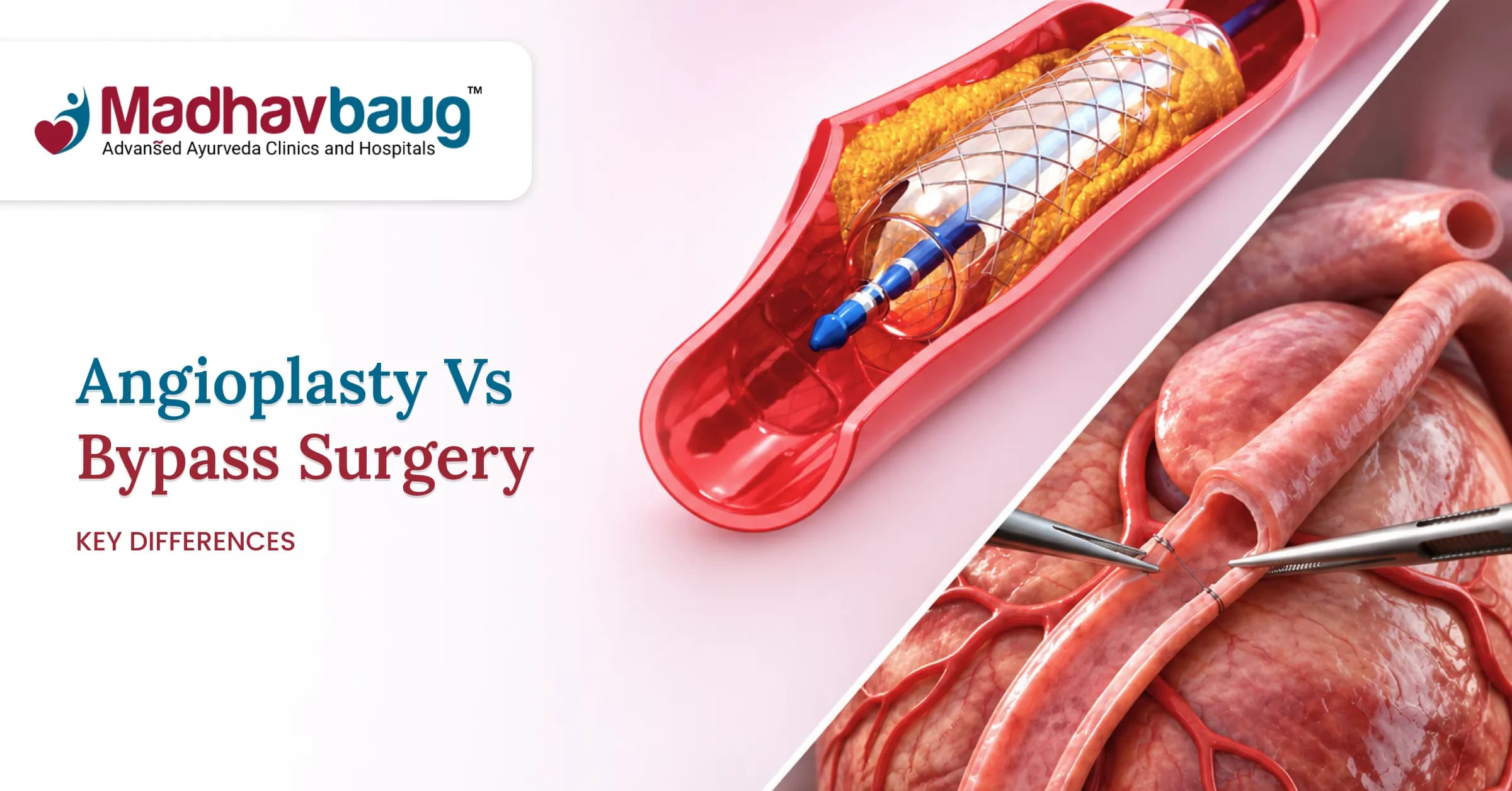
Angioplasty is a procedure in which a blocked heart artery is opened from the inside using a small balloon and in most cases a tiny metal mesh tube called a stent may also be placed. This procedure is also called as percutaneous coronary intervention or PCI.
To understand it in easy terms, firstly the doctor makes a small puncture in the artery of your wrist or sometimes the groin and passes a thin tube called a catheter up to the blocked heart artery. Now a balloon at the tip of this tube is inflated to push the fatty plaque against the wall of the artery and then a stent is placed so that the artery stays open.
The procedure is done with local anaesthesia so you stay awake and it usually takes anywhere between 30 minutes and 2 hours. Angioplasty is also the first choice during a heart attack because opening the artery quickly can save the heart muscle from damage.
What Is Bypass Surgery?
Bypass surgery is an open heart operation in which the surgeon makes a new path for the blood to flow around the blocked part of the heart artery and it is also called as coronary artery bypass grafting or CABG.
For this the surgeon takes a healthy blood vessel from your leg, chest or arm and joins one end above and the other end below the blockage so that the blood reaches the heart muscle without crossing the blocked area.
The surgery is done under general anaesthesia and takes around 3 to 6 hours and depending on how many arteries are bypassed it is called as a single, double or triple bypass. In most cases the heart is stopped for a short time and a heart lung machine does its work but in some patients the surgeon operates on the beating heart which is called off-pump surgery.
Difference Between Angioplasty and Bypass Surgery
The angioplasty vs bypass differences can be understood easily from the following table which tells you what each procedure means for you.
| Point | Angioplasty | Bypass surgery |
| How it is done | The doctor opens your blocked artery from inside with a balloon and a stent through a small puncture in the wrist or groin | The chest is opened and a new path is made around your blockage using a blood vessel taken from your leg, chest or arm |
| Time taken | You may be on the table for around 30 minutes to 2 hours | The surgery usually takes around 3 to 6 hours |
| Hospital stay | Most people go home in 1 or 2 days | You may stay for around 5 to 7 days including a day or two in the ICU |
| Recovery | You may be back to light work in about a week | You may need around 6 to 12 weeks to recover and for rehabilitation. |
| Main risks | Bleeding or bruising at the puncture site, injury to the artery and rarely a clot inside the stent, which is why blood thinners must not be missed | Wound infection, bleeding, an irregular heartbeat, kidney problems and a small risk of stroke, as with any major operation |
| May suit you if | You have one or two blocked arteries or a heart attack is going on | You have many blocked arteries, a blockage in the main left artery, diabetes or a weak heart pump |
| Chance of a repeat procedure | The stented artery can narrow again in future so some people may need another procedure | The new vessels usually work for many years but they can also block if risk factors are not controlled |
Angioplasty vs Bypass Surgery – Which One Is Right for You?
If the doctor has to choose between angioplasty vs bypass for you then the answer depends on your arteries and your overall health and it is something that your cardiologist and heart surgeon decide together after seeing your angiography. Studies say that in patients with diabetes who had blockages in many arteries bypass surgery gave better results than angioplasty with stents with fewer heart attacks and deaths over five years although the risk of stroke was a little higher with the surgery (Farkouh et al., 2012). In the same way, for blockages in all three main arteries, especially complex ones, bypass surgery gave better results over five years, while for blockages in the main left artery the results of both procedures were similar unless the blockages were complex (Mohr et al., 2013). Current guidelines also recommend bypass surgery for a significant main left artery blockage, while angioplasty can be a reasonable option in selected patients with less complex blockages (Lawton et al., 2022).
Nevertheless, angioplasty is not a weaker option. It is usually better during a heart attack, in one or two blockages and in older patients or those who are not fit for a big operation. Also, not every blockage needs a procedure at once because in patients with stable heart disease and no heart attack going on, adding a procedure to good medicines did not reduce heart attacks or deaths in most patients over about three years (Maron et al., 2020) so your doctor may first suggest medicines and lifestyle changes and keep the procedure for later.
Angioplasty Recovery Time
Angioplasty recovery time is short and most people are able to walk within a few hours of the procedure and go home in a day or two. In the first week you may notice a mild pain or a small bruise at the wrist or groin and you may feel a little tired. Following are the general tips about angioplasty recovery time which your doctor may change according to your condition.
- You may return to light desk work in around one week but heavy work and strenuous exercise should wait until your doctor says it is fine which is usually after 1 to 2 weeks.
- Avoid lifting heavy things with the hand that was used for the procedure for about a week.
- Take your antiplatelet tablets such as aspirin along with clopidogrel or ticagrelor regularly, usually for 6 to 12 months, and do not skip even a single day because the stent can get blocked suddenly.
- Keep a watch on the puncture site and meet the doctor if you notice swelling, bleeding or increasing pain.
- Do walk a little more each day and join a cardiac rehabilitation programme if your doctor advises.
Bypass Surgery Recovery Time
Bypass surgery recovery time is much longer than angioplasty because the breastbone needs time to join again and your body needs time to get over a major operation. You may stay in the hospital for around 5 to 7 days including a day or two in the ICU and after that the recovery continues at home for the next few weeks (Hillis et al., 2011). Following are the points that explain what you may expect.
- In the first 2 weeks you may feel pain in the chest and the leg wound, tiredness, loss of appetite and trouble in sleeping and you should hug a pillow to your chest while coughing or sneezing.
- Till around 6 weeks do not lift anything heavier than 4 to 5 kg, do not push or pull heavy things and do not drive unless the doctor allows.
- Most people are able to return to desk work in around 6 to 8 weeks and the complete bypass surgery recovery time may go up to 3 months.
- Make sure you walk for short distances several times a day and slowly increase the distance as your doctor advises.
- Keep the chest and leg wounds clean and dry and look for swelling of the leg because it is common after the vessel has been taken from there.
It is also common to feel low, worried or tearful for a few weeks after the surgery and this usually settles with time and support from the family. However if you notice fever, redness or discharge from the wound, a clicking feeling in the breastbone, sudden breathlessness or a fast irregular heartbeat you should contact your doctor at once.
Life After Bypass Surgery
Life after bypass surgery can be normal and active and most people are able to go back to their work, travel, attend family functions and even do light exercise once they have recovered. However bypass surgery treats the blockages which are present today and it does not treat the reason why they formed so the habits you follow after the surgery decide how long your new vessels will keep working.
“Patients and families usually ask me which one is better, angioplasty or bypass but I feel the better one is the one which suits your arteries, your sugar levels and the strength of your heart. What I always tell them is that the procedure is only a beginning and what they eat, how much they walk and whether they take their tablets on time will decide how they feel after five years.”
– Dr. Bipin Gond, Zonal Medical Head, Madhavbaug
With this, you should make sure to take your medicines such as the blood thinner, cholesterol tablet and blood pressure tablets regularly and never stop them because you feel better. You should also eat less salt and less oily and fried food and have more vegetables, fruits, dal and whole grains. You can start daily activity but with small activities like walking and then increase the activity slowly under the guidance of a doctor or a cardiac rehabilitation team. It is also important for you to talk to your family and your doctor if you feel low or worried because the mind also needs time to recover after a big surgery.
Questions to Ask Your Doctor Before Angioplasty or Bypass Surgery
Before you agree to angioplasty or bypass surgery you should ask your doctor a few questions so that you clearly understand why that particular procedure is being advised for you. Following are some questions which you may carry along to your appointment.
- How many of my arteries are blocked and how severe are the blockages?
- Why do you recommend angioplasty and not bypass surgery or the other way round?
- Can I try medicines and lifestyle changes first or do I need the procedure right now?
- What are the risks of the procedure in my case considering my age, sugar levels and kidney function?
- How long will the hospital stay and the recovery time be and when can I go back to work?
- Which medicines will I need after the procedure and for how long?
- Will I need another procedure in future?
It is completely fine to take a second opinion from another cardiologist if the situation is not an emergency but if you are having a heart attack then do not delay and go to the hospital immediately.
How Madhavbaug Can Help You Before and After Angioplasty or Bypass Surgery
Heart blockage is one condition caused by years of unhealthy lifestyle leading to cholesterol buildup and unhealthy heart. The treatment should ideally include lifestyle changes to lower the chance of the blockage coming back.
| Clinical Insight “In my experience, many patients think that the procedure has solved the problem completely and they slowly go back to their old habits within a few months. At Madhavbaug, we look at the patient’s reports, symptoms, food habits, sugar levels and overall health before planning the care. Along with regular monitoring, our Ayurvedic therapies and diet guidance are meant to work together with the treatment given by your cardiologist or surgeon and not to replace it. If you have been advised angioplasty or bypass surgery, discuss your questions with your doctor and do not delay the treatment.” Dr. Pravin Jayram Ghadigaonkar, BAMS, MD, PhD (Scholar) Preventive Cardiology 20+ Years of Clinical Experience, Head Medical Operations & Patient Improvement, Madhavbaug |
Madhavbaug offers comprehensive heart care through sampurna hridaya shuddhi in which the root cause of the blockage is analysed. This approach includes understanding your prakriti and then planning Ayurvedic therapies including panchakarma with hridayadhara along with herbs, a heart-friendly diet kit, a safe exercise plan and regular follow-ups so that your progress can be tracked at every visit.
If you have already had angioplasty or bypass surgery or you have been advised one and want to know how to take care of your heart in a proper and organised way you can visit your nearest Madhavbaug clinic today.
Looking for guidance after your heart procedure?
Frequently Asked Questions
Angioplasty vs bypass which is better?
Neither is better for everyone. Angioplasty is usually preferred in a heart attack and in one or two blockages while bypass surgery is often preferred when many arteries or the main left artery are blocked or when you have diabetes or a weak heart pump so your cardiologist will decide after your angiography.
Is angioplasty safer than bypass surgery?
Angioplasty is a smaller procedure with a quicker recovery so the immediate risk is generally lower. However in some patients bypass surgery gives longer lasting results so the safer choice is the one that suits your heart and your doctor has to decide that.
How long is the bypass surgery recovery time?
Bypass surgery recovery time is usually around 6 to 12 weeks. Most people return to desk work in 6 to 8 weeks and the complete recovery may take up to 3 months.
What is the angioplasty recovery time?
Angioplasty recovery time is usually around one week for light work. Heavy work and strenuous exercise may need 1 to 2 weeks or as your doctor advises.
How is life after bypass surgery?
Life after bypass surgery can be normal and active when you take your medicines regularly, eat a heart friendly diet, exercise safely and keep your sugar, blood pressure and cholesterol in control.
How long can one live after bypass surgery?
Many people live for many years after bypass surgery and often for more than a decade. It depends on your age, the strength of your heart pump, diabetes and how well you control the risk factors.
Can the blockage come back after angioplasty or bypass surgery?
Yes it can because both the procedures treat the blockages and not the reason behind them. Medicines and healthy habits lower the chances of this happening.
Do all blockages need angioplasty or bypass surgery?
No. Patients with stable symptoms may be managed with medicines and lifestyle changes while a heart attack or severe blockages need a procedure on time and your doctor will guide you after the required tests.
Do I need to take medicines for life after angioplasty or bypass surgery?
Blood thinners after a stent are usually taken for 6 to 12 months while medicines for cholesterol, blood pressure and sugar are often needed for a long time. Never stop any of them on your own.
References
Farkouh ME, et al. (2012). Strategies for multivessel revascularization in patients with diabetes. New England Journal of Medicine, 367(25).
Hillis LD, et al. (2011). 2011 ACCF/AHA Guideline for Coronary Artery Bypass Graft Surgery. Circulation, 124(23).
India State Level Disease Burden Initiative CVD Collaborators. (2018). The changing patterns of cardiovascular diseases and their risk factors in the states of India. The Lancet Global Health, 6.
Lawton JS, et al. (2022). 2021 ACC/AHA/SCAI Guideline for Coronary Artery Revascularization. Circulation, 145(3).
Maron DJ, et al. (2020). Initial invasive or conservative strategy for stable coronary disease. New England Journal of Medicine, 382(15).
Mohr FW, et al. (2013). Percutaneous coronary intervention versus coronary artery bypass grafting in patients with three vessel disease and left main coronary disease, 5 year follow up of the randomised clinical SYNTAX trial. The Lancet, 381(9867).



 Locate a Centre

