
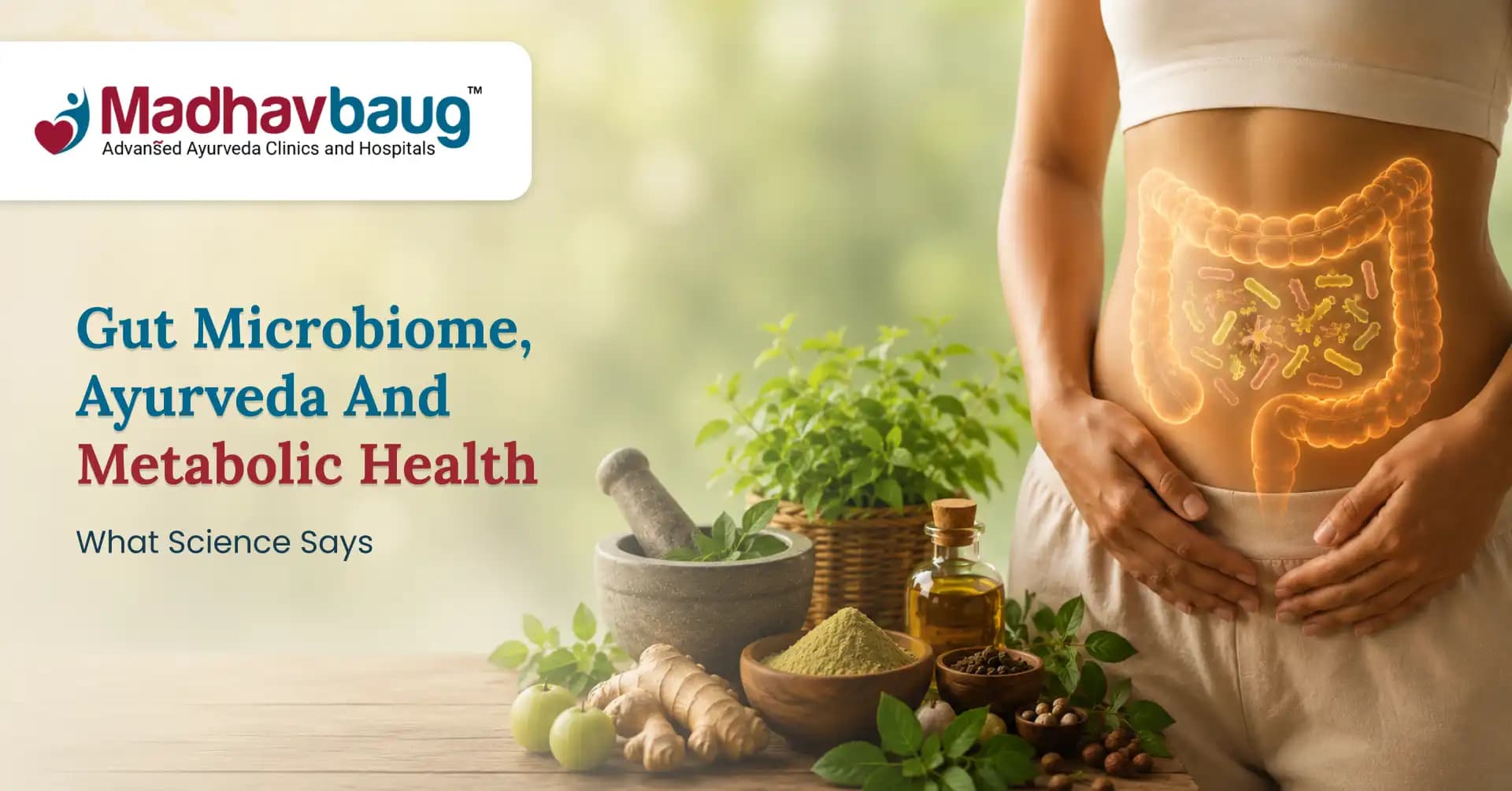

Our human intestine contains several microorganisms, such as bacteria, viruses, fungi, and archaea, that remain throughout one’s life (Hoffmann C, 2013). These gut microbiomes and metabolic health are interlinked since they contribute to immune function, which has an effect on most of the physiological functions of the body (Shreiner AB, 2015).
Gut microbiomes are actually passed on from mother to child; however, our dietary habits and gut health affect the composition of microbiomes (Maurice CF,2012).
The earlier studies suggested that certain bacteria are associated with certain Prakriti (physical-psychological constitution of an individual, also referred to as genotype) in healthy individuals, which suggests that these gut bacteria may be Prakriti-specific and useful for an individual’s health (Chauhan NS, 2018).
On the other hand, the gut microbiota is established later, and its composition depends on the transfer of microbiota from the mother, environmental factors and food habits. These bacteria seem to be responsible for having different responses to similar types of food; thus, the blood glucose of a person varies with food. (Zeevi D, 2015)
Madhavbaug aims to improve one’s metabolic health through a holistic approach, especially by working on lifestyle changes, including exercise and dietary corrections. Explore more on how the gut microbiome and metabolic health are interlinked and how they are connected to diabetes and obesity.
Microbiome and Metabolic Health
| Healthy Gut Microbiome | Unhealthy Gut Microbiome (Dysbiosis) |
| Increase in good bacteria, balanced gut flora. | Decrease in good bacteria and increase in bad bacteria |
| ⬇ | ⬇ |
| Increased number of short-chain fatty acids (SCFA) and a strong gut barrier | Decreased SCFA and improper gut barrier |
| ⬇ | ⬇ |
| Decreased inflammation and ideally sensitive to insulin | Inflammation increases less sensitive to insulin, thus insulin resistance |
| ⬇ | ⬇ |
| Healthy glucose and fat metabolism | Impaired glucose and fat metabolism |
| ⬇ | ⬇ |
| Good Metabolic Health | High Risk Metabolic Disorders such as Obesity, Type 2 Diabetes etc. |
Gut Microbiome and Obesity
The gut consists of millions of bacteria that have an essential role in processing food, storing fat, and controlling hunger. When these bacteria are replaced by bad bacteria and opportunistic bacteria(streptococci etc), a condition develops known as gut dysbiosis. This triggers many processes due to which the body starts to take more calories from the same food and mainly causes inflammation, which leads to obesity. It is mentioned in detail as follows:
Gut Health and Diabetes
The gut bacteria play an essential role in controlling blood sugar. When there is an imbalance in the gut bacteria, some fatty acids called short-chain fatty acids (SCFAs) do not sufficiently develop. This decreases insulin sensitivity, increases inflammation, and affects the pancreas’s ability to generate insulin properly. Over time, these changes can lead to insulin resistance, pre-diabetes, and ultimately type 2 diabetes.
Ayurveda and Gut Health
Ayurvedic principles, when followed regularly, lead to good gut health. According to Ayurveda, all the cells that get nutrition start from the gut. It follows the following theory:
When a person eats (Ahara), it produces Anna Rasa, which leads to the development of the first dhatu (essential element of the body) called Rasa Dhatu. This Rasa then converts to Rakta, then Mamsa, and so on; all the dhatus get developed, leading to proper nutrition of the body.
This shows that proper food leads to good gut health and proper nourishment of the body. Madhavbaug follows an integrated approach, including a personalised lifestyle modification plan. To know more, book a consultation with Madhavbaug.
Some Ayurvedic principles for good gut health:
- Eat shadrasatmak food which means food that consists of all six rasas (It should be balanced in terms of Sweet, Sour, Salt, Spicy, Bitter and Astringent.)
- According to Acharya Sharangdhara, some ginger and salt should be consumed before meals maintain gut health
- One should follow the 12 dietary rules and eat food, like eating warm food, eating unctuous food, etc.
- One should consume meals regularly on a timely basis and avoid late night meals consumption.
- One should also avoid daytime sleeping to promote healthy digestion and good gut health.
Madhavbaug for Diabetes and Obesity
Madhavbaug focuses on holistic healing through an integrated approach that combines modern diagnostic tools along with traditional Ayurvedic treatment. This includes a combination of Panchakarma, diet kits, and herbal medicines along with continuous monitoring through the mibPulse app and PowerMAP technology. With this lifestyle, corrections are also necessary, which leads to developing better and healthy habits in order to stay healthy after the reversal of the diseases and their treatment in order to maintain good health.
To read more about Madhavbaug’s treatment for Diabetes and Obesity, please visit:
Consult Madhavbaug
Today, people eat an endless amount of medicines in order to control blood sugar levels. However, Madhavbaug aims to reverse the conditions as much as possible such that the dependency on the medicines decreases. It happens through Panchkarma, lifestyle modifications, and much more, which also includes changing habits in order to adopt healthy ones. This can help you improve the condition you are suffering from as well as help you build a healthy routine to prevent future development of diseases. To improve your gut health, book a consultation with Madhavbaug today.
Frequently Asked Questions
Q.1 What kills gut bacteria naturally?
You cannot “get rid of” all gut bacteria nor would you want to, as you need them for digestion and immunity. Instead, you should aim to naturally eliminate bad bacteria while encouraging good bacteria to create a balanced microbiome.
Q.2 How do you increase microbes in your gut?
Prebiotic and probiotic foods like whole grains, onions, garlic, fermented foods, miso and yoghurt feed the good bacteria in your gut. A diet rich with fibre and prebiotics ensures that the bacteria grow.
Q.3 What are the 5 Rs of gut healing?
The 5R framework, Remove, Replace, Reinoculate, Repair, and Rebalance, is a functional medicine approach designed to restore digestive health at the root level.
Q.4 What are the 4 pillars of gut health?
The 4 pillars of gut health are fundamental lifestyle factors that shape your microbiome: diet, exercise, stress management, and sleep.
Q.5 What are signs of an unhealthy gut?
An unhealthy gut frequently manifests as chronic digestive distress (like bloating, gas, or irregular bowel movements), unexpected weight changes, persistent fatigue, sleep disturbances, and new skin irritations or food intolerances.
References
- Hoffmann C, Dollive S, Grunberg S, Chen J, Li H, Wu GD, et al. Archaea and fungi of the human gut microbiome: Correlations with diet and bacterial residents. PLoS One. 2013;8:e66019. doi: 10.1371/journal.pone.0066019.
- Shreiner AB, Kao JY, Young VB. The gut microbiome in health and in disease. Curr Opin Gastroenterol. 2015;31:69–75. doi: 10.1097/MOG.0000000000000139.
- Goodrich JK, Waters JL, Poole AC, Sutter JL, Koren O, Blekhman R, et al. Human genetics shape the gut microbiome. Cell. 2014;159:789–99. doi: 10.1016/j.cell.2014.09.053.
- David LA, Maurice CF, Carmody RN, Gootenberg DB, Button JE, Wolfe BE, et al. Diet rapidly and reproducibly alters the human gut microbiome. Nature. 2014;505:559–63. doi:10.1038/nature12820.
- Maurice CF, Haiser HJ, Turnbaugh PJ. Xenobiotics shape the physiology and gene expression of the active human gut microbiome. Cell. 2013;152:39–50. doi: 10.1016/j.cell.2012.10.052.
- Chauhan NS, Pandey R, Mondal AK, Gupta S, Verma MK, Jain S, et al. Western Indian rural gut microbial diversity in extreme Prakriti Endo-phenotypes reveals signature microbes. Front Microbiol. 2018;9:118. doi: 10.3389/fmicb.2018.00118.
- Chauhan A, Semwal DK, Mishra SP, Semwal RB. Ayurvedic concept of Shatkriyakala:A traditional knowledge of cancer pathogenesis and therapy. J Integr Med. 2017;15:88–94. doi: 10.1016/S2095-4964(17)60311-X.
- Zeevi D, Korem T, Zmora N, Israeli D, Rothschild D, Weinberger A, et al. Personalized nutrition by prediction of glycemic responses. Cell. 2015;163:1079–94. doi:10.1016/j.cell.2015.11.001.
- Dey S, Pahwa P. Prakriti and its associations with metabolism, chronic diseases, and genotypes:Possibilities of new born screening and a lifetime of personalized prevention. J Ayurveda Integr Med. 2014;5:15–24. doi: 10.4103/0975-9476.128848




 Locate a Centre
