
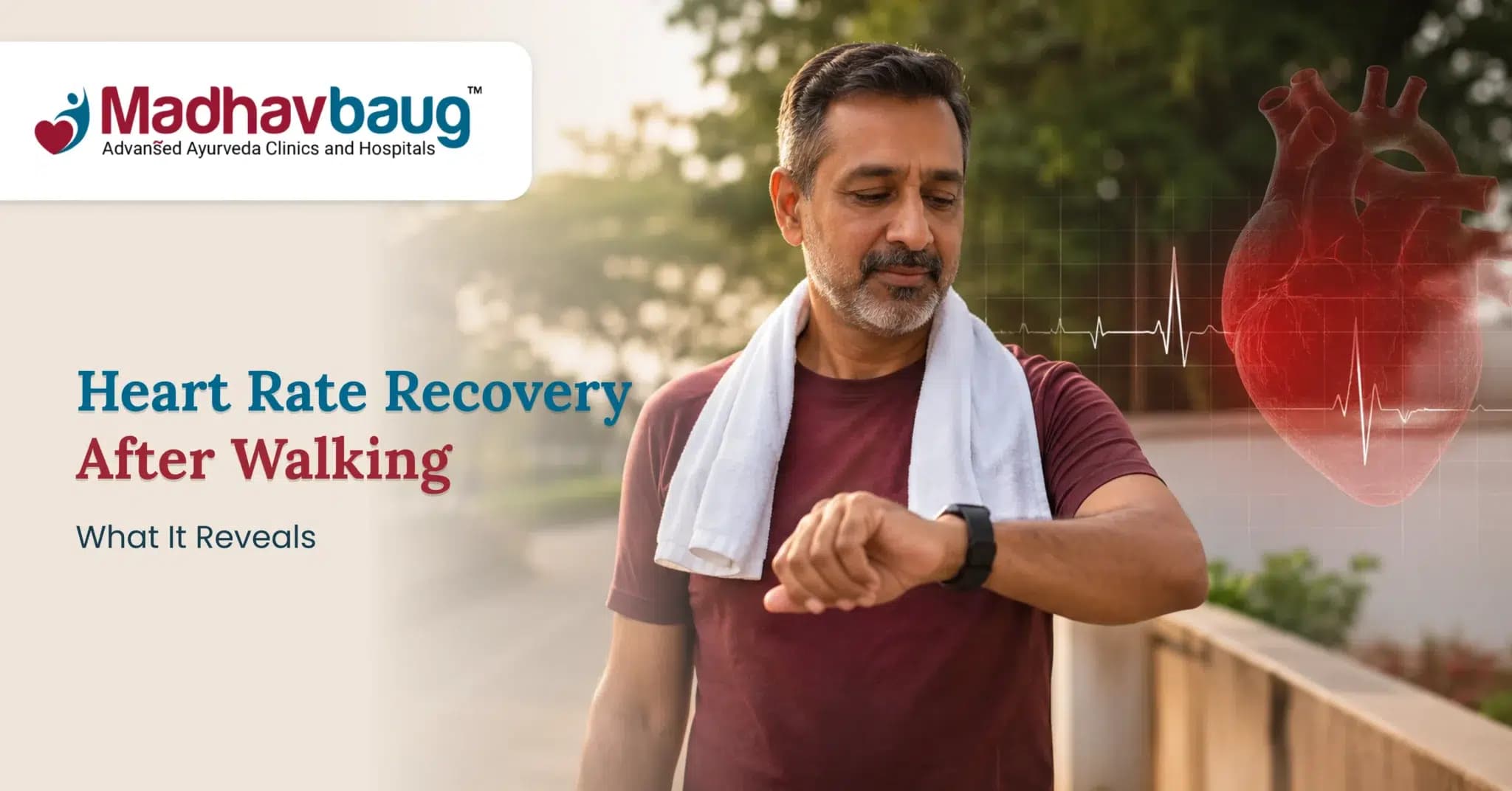

Your heart works hard when you walk, and it calms down when you stop. Heart rate recovery is simply how fast this drop happens.
This guide explains what heart rate recovery means, how to measure it at home, what the numbers suggest, and when it is worth speaking to a doctor.
What is Heart Rate Recovery?
When you walk, your heart beats faster to keep up with the effort. The moment you stop, your heart rate begins to come down. Heart rate recovery measures how quickly that happens.
A heart that is fit and healthy tends to slow down faster after exercise. A heart that is under strain, or when the body is slow to bring it back down, recovery can take longer. This is why heart rate recovery is considered a useful window into heart health and is not just limited to fitness.
It is worth being clear that heart rate recovery is an indicator and is not a complete diagnosis. A slower recovery can have several reasons; some can be straightforward, and some need to be discussed with a doctor. The goal of tracking it is to notice patterns over time and not jump to a conclusion from a single reading.
How to Measure Heart Rate Recovery
You do not need any special equipment. A smartwatch, a pulse oximeter, or even placing two fingers on your wrist will do the job.
Here is how to do it:
- Go for a brisk walk for at least 10 minutes
- At the end of the walk, note your heart rate immediately, either from your device or by counting your pulse for 15 seconds and multiplying by four.
- Sit down and rest quietly for one minute
- Note your heart rate again and record the difference
This drop is what doctors refer to when they talk about the normal heart rate after exercise recovery. Research has linked slower recovery to a higher risk of heart disease over time (Qiu et al., 2017), which is why tracking this number regularly can give you a useful picture of how well your heart is coping after exercise.
For a general idea, if your heart rate drops by less than 12 beats per minute, you should consider speaking to a doctor. That being said, it is important to understand that various factors can affect this number. So, it is ideal not to draw any conclusions from the reading on your own.
Factors That Affect Heart Rate Recovery
Several factors can influence this number, and knowing them helps make better sense of what your reading actually means.
Fitness level
It is the most direct factor. People who exercise regularly tend to recover faster because their cardiovascular system handles physical demand more efficiently.
Age
Age plays a role, too. Recovery tends to slow gradually with age, even in otherwise healthy individuals, which is one reason why cut-off values cannot be applied the same way across all age groups.
Existing heart conditions
Heart disease, high blood pressure, or heart failure can all slow down recovery, since these conditions affect how the heart and nervous system respond to physical activity.
Medications
Various medicines like beta blockers, commonly prescribed for blood pressure and heart conditions, can slow the heart rate and affect the recovery. This is why readings should always be discussed with a doctor who knows your full medication history.
Stress and sleep
This can also have a measurable impact. Chronic stress and poor sleep affect the autonomic nervous system, which governs how quickly the heart slows down after activity.
How to Walk Safely for an Accurate Reading
Since several factors can affect your result, getting a reliable reading starts with how you do the walk itself, particularly for anyone who has not been active recently or is managing an existing heart condition
- Walk on a flat surface at a pace where you are putting in effort but can still speak in short sentences.
- Avoid testing immediately after a meal, in extreme heat(temperature), or when unwell.
- If you feel chest pain, dizziness, or unusual breathlessness at any point, stop immediately and speak to a doctor.
People managing heart disease or any active cardiac condition should check with their doctor before attempting this, since what counts as a safe level of effort varies from person to person. Understanding heart disease prevention and the right activity levels for your condition is always the better starting point.
Tracking Trends Over Time
One reading means very little on its own. Walking for heart health works best when you track the pattern over several weeks, since that is where meaningful changes start to show.
Keep a simple log of the date, how long you walked, your heart rate immediately after stopping, and your heart rate one minute later. Over four to six weeks, you will start to see whether your normal heart rate after exercise is improving, staying stable, or declining, and that trend is far more useful than any single number.
A consistently worsening recovery, or one that drops suddenly, should be discussed with a doctor.
For a more detailed assessment of how your heart is responding over time, Madhavbaug’s PowerMAP tracks these markers under medical supervision.
When to Watch for Abnormal Symptoms?
Tracking heart rate recovery at home is useful, but there are certain signs during or after a walk that should never be ignored. These need prompt medical attention.
Stop walking and seek medical help if you experience:
- Chest pain, tightness, or pressure during or after a walk
- Unusual breathlessness that does not settle within a few minutes of rest
- Dizziness, lightheadedness, or feeling faint
- Heart palpitations or an irregular heartbeat that you can feel
- Extreme fatigue that feels like too much for the effort put in
A heart rate that takes unusually long to come down, combined with any of the above, is a stronger signal that your heart needs to be checked. On its own, a slow recovery reading is not an emergency, but alongside symptoms, it should not be ignored.
If you are managing heart disease or a related cardiac condition, it is worth discussing your target heart rate range and recovery expectations with your doctor before starting any regular walking programme.
Clinical Testing: What a Doctor Does Differently
A home heart rate recovery test gives you a useful starting point, but a clinical setting allows doctors to assess the heart under controlled, progressive effort with far more precision.
The most common clinical tool is the treadmill stress test, also called a TMT or exercise stress test. During this test, you walk on a treadmill at increasing speeds and inclines while your heart is monitored through an ECG in real time.
This allows the doctor to see not just how your heart rate recovers, but:
- How your heart responds to physical demand at every stage of effort
- Any changes in heart rhythm or electrical activity under stress
- Whether the blood supply to the heart muscle is reducing during exertion
- How quickly and completely the heart returns to its resting state after the test
At Madhavbaug, the treadmill stress test is part of the baseline cardiac assessment done before any treatment begins. The Duke Treadmill Score, which combines exercise duration, ECG changes, and chest pain data, is used to assess cardiac risk and is repeated at every clinical milestone to track how the heart is responding to treatment over time.
For anyone whose home heart rate recovery readings are consistently slow or who has risk factors for heart disease, a clinical stress test is the natural next step, and your nearest Madhavbaug clinic can help you get an accurate diagnosis.
How Madhavbaug Approaches Heart Health?
At Madhavbaug, every patient starts with a thorough assessment, and if the assessment identifies an underlying cardiac condition, the SHS (Sampoorna Hriday Shuddhikaran) programme is prescribed, a non-surgical, non-invasive cardiac care plan combining:
- Panchakarma therapies to improve circulation, reduce cardiac workload, and support the heart muscle
- Pranayama and supervised physiotherapy to strengthen the heart and regulate blood pressure
- A personalised cardiac diet to reduce blood vessel inflammation and support long-term recovery
- Ayurvedic herbal medicines prescribed alongside existing medications under strict medical supervision
- Daily progress tracking through the mibPULSE App
Madhavbaug’s published research has shown a 26.80% reduction in fat deposits in blood vessels at 90 days (Kaware and Khan, 2023), a finding that reflects real improvement in how the heart handles physical effort, indexed in Madhavbaug’s research and clinical trials library.
For anyone whose heart rate recovery is a concern, or who is managing an existing cardiac condition, the Ayurvedic Treatment for Heart Blockage programme offers a structured path forward under full medical supervision.
Final Thoughts
Heart rate recovery is one of those numbers most people never think to track, yet it can reveal more about cardiac health than the walk itself. A simple measurement, taken consistently over time, can identify changes worth paying attention to long before any symptom appears.
If your recovery feels slower than it should, or if a recent check-up has raised any concerns, getting a proper assessment is always the right next step.
Book a consultation with Madhavbaug to understand what your heart is telling you.
Frequently Asked Questions (FAQs)
- What is a good heart rate recovery by age?Recovery tends to slow with age, so there is no single number that works for everyone. A drop of 12 or more beats in the first minute is a commonly used reference point, but older adults may see a smaller drop and still be in a healthy range. The trend over time matters more than any one reading.
- How to lower your heart rate quickly after a walk?Slow down gradually rather than stopping abruptly, then sit down and breathe slowly. Taking deep breaths helps the body shift back to rest. Staying hydrated before and during the walk also helps the heart rate settle faster.
- What is a good two-minute heart rate recovery?By two minutes after stopping, most people with reasonable cardiovascular fitness will have seen their heart rate drop by 20 to 22 beats or more. A drop of fewer than 12 beats by the end of the first minute, or fewer than 22 beats by the end of the second, is generally considered worth discussing with a doctor, though individual factors always apply.
- Can walking improve heart rate recovery?Yes. Regular walking for heart health is one of the most effective ways to improve heart health over time, and a faster heart rate recovery is one of the clearest signs that fitness is improving.
- When should I see a doctor about my heart rate recovery?If your heart rate takes much longer than expected to come down, or if you experience any chest discomfort, dizziness, palpitations, or unusual breathlessness during or after a walk, speak to a doctor rather than continuing to monitor at home.
References
- Qiu S, Cai X, Sun Z, Li L, Zuegel M, Steinacker JM, Schumann U. Heart rate recovery and risk of cardiovascular events and all-cause mortality: a meta-analysis of prospective cohort studies. J Am Heart Assoc. 2017;6(5):e005505. https://pubmed.ncbi.nlm.nih.gov/28487388/
- Kaware R, Khan S. Role of Ayurveda-based diet and Panchakarma therapy on quantitative change in coronary atherosclerosis in known CAD assessed by quantitative CT coronary angiography. Asian J Cardiol Res. 2023;6(1):125-131. https://journalajcr.com/index.php/AJCR/article/view/148



 Locate a Centre
