
Abstract
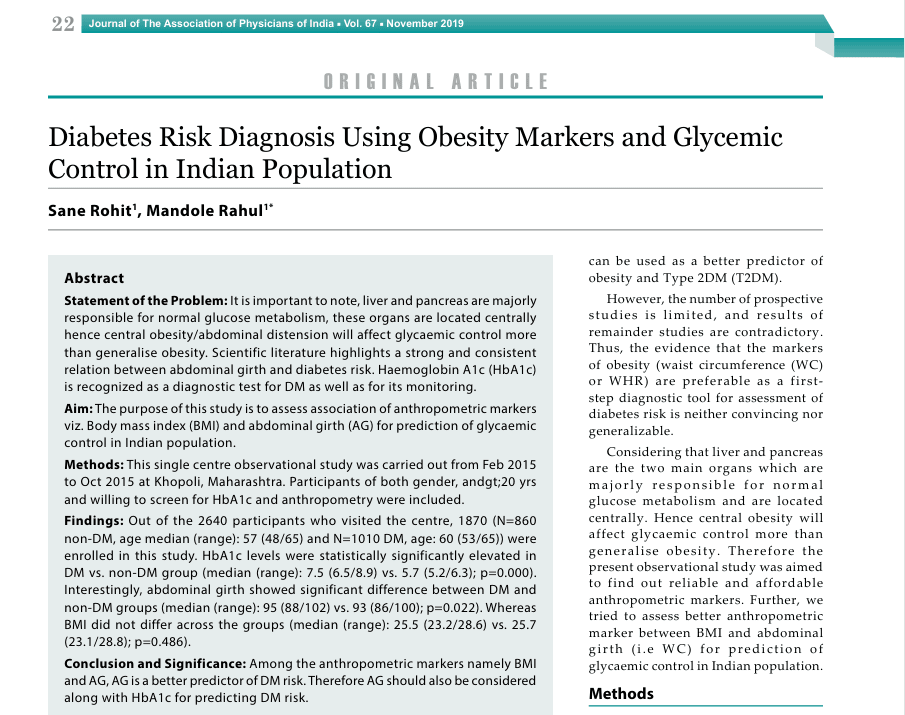
Statement of the Problem: It is important to note, liver and pancreas are majorly
responsible for normal glucose metabolism, these organs are located centrally
hence central obesity/abdominal distension will affect glycaemic control more
than generalise obesity. Scientific literature highlights a strong and consistent
relation between abdominal girth and diabetes risk. Haemoglobin A1c (HbA1c)
is recognized as a diagnostic test for DM as well as for its monitoring.
Aim: The purpose of this study is to assess association of anthropometric markers
viz. Body mass index (BMI) and abdominal girth (AG) for prediction of glycaemic
control in Indian population.
Methods: This single centre observational study was carried out from Feb 2015
to Oct 2015 at Khopoli, Maharashtra. Participants of both gender, andgt;20 yrs
and willing to screen for HbA1c and anthropometry were included.
Findings: Out of the 2640 participants who visited the centre, 1870 (N=860
non-DM, age median (range): 57 (48/65) and N=1010 DM, age: 60 (53/65)) were
enrolled in this study. HbA1c levels were statistically significantly elevated in
DM vs. non-DM group (median (range): 7.5 (6.5/8.9) vs. 5.7 (5.2/6.3); p=0.000).
Interestingly, abdominal girth showed significant difference between DM and
non-DM groups (median (range): 95 (88/102) vs. 93 (86/100); p=0.022). Whereas
BMI did not differ across the groups (median (range): 25.5 (23.2/28.6) vs. 25.7
(23.1/28.8); p=0.486).
Conclusion and Significance: Among the anthropometric markers namely BMI
and AG, AG is a better predictor of DM risk. Therefore AG should also be considered
along with HbA1c for predicting DM risk.

 Locate a Centre
