


Key Takeaways
|
If you are wondering whether Ayurveda with prescription medicines can be combined safely, the answer depends on your medicines, health condition and medical supervision. Some say it needs careful observation since herbal formulations may interact with prescription drugs, and some say stop allopathic medications altogether after starting with ayurvedic medications.
This Madhavbaug guide walks through why combining care is important, what real interaction risks look like, why disclosing every medicine you take matters, how monitoring works when you use both systems together, and who actually gets to decide if a prescription dose should change.
Why Combine Ayurveda With Prescription Medicines?
Combining Ayurveda with prescription medicines means using Ayurvedic treatment to correct the imbalance causing the disease, while your prescribed medicine continues managing it in the meantime. It’s an addition to your care, not a replacement for it, at least not on day one.
Conditions like type 2 diabetes, hypertension, obesity and heart disease are lifelong once diagnosed, and prescription medicines are genuinely effective at controlling blood sugar, blood pressure and cholesterol. What they don’t always do is reverse the root cause and the metabolic pattern that caused the condition.
This is where a structured Ayurvedic approach, working through diet, Panchakarma-based therapies, and lifestyle correction, aims to support the body’s metabolism, which in turn helps to reduce the dosage of the prescription medicine.
“Patients often come to us wanting to stop their medicines on day one. That’s not how this works, and it’s not safe. We start by adding Ayurvedic care to what they’re already taking, and any reduction in dosage only happens later, gradually, and only when the numbers actually support it.”
— Dr. Bipin Gond, Zonal Medical Head, Madhavbaug
What Are the Real Risks of Combining Ayurveda and Prescription Medicines?
Herb-drug interactions happen because active compounds in herbs can affect how a prescription drug is absorbed, broken down, or cleared from the body. Some interactions make a drug work too strongly, others make it work less well, and both of these matter for a condition like diabetes or heart disease.
This doesn’t mean Ayurveda is inherently unsafe. It means Ayurvedic treatment for someone already on prescription medicine needs to be planned by someone who understands both systems.
Evidence based ayurvedic research reviewing herb-drug interaction mechanisms has documented cases such as certain blood-thinning herbs increasing bleeding risk in patients on anticoagulants and liquorice-containing preparations raising blood pressure or interacting with corticosteroids (Izzo and Ernst, 2001). This does not mean Ayurveda is unsafe. It’s the reason a doctor needs to know your complete medicine list before recommending anything.
| Category | What Can Happen | Why It Matters for You |
| Diabetes medicines | Certain herbs can increase blood sugar-lowering effects. | Risk of hypoglycaemia if not monitored and dosed appropriately |
| Blood pressure medicines | Some herbal compounds can raise or lower blood pressure further | Risk of readings going outside a safe range |
| Blood thinners | Some herbs affect clotting or interact with anticoagulant drugs. | Increased bleeding risk if combined without medical guidance |
| Heart medicines | Certain herb-drug combinations can affect heart rhythm or fluid balance. | Requires careful monitoring, especially in existing heart disease |
The honest takeaway here is not to “Avoid Ayurveda”.
It means “Do Not Self-Combine”.
Our doctors at Madhavbaug, who are qualified Ayurvedic physicians, properly analyse your full prescription list and are trained to avoid these harmful combinations.

Why Medicine Disclosure Matters More Than Patients Realise
Full medicine disclosure means telling your Ayurvedic doctor every prescription drug and supplement you currently take, including dosages, since this is the only way they can check the chances of an herb-drug interaction risk before recommending any treatment. Hiding any medicine may affect your doctor’s decision and lead to risk in the future.
This matters more than most patients assume.
Following are some of the details worth sharing at your first Ayurvedic consultation:
- Every prescription medicine you take, including dosage and how long you’ve been on it
- Any medicines you’ve recently stopped or changed, and why
- Over-the-counter medicines you use regularly, including painkillers or antacids
- Supplements, multivitamins, or other herbal products you’ve already started on your own
- Any known drug allergies or past adverse reactions
If you’re currently on medicines for diabetes, hypertension, or heart disease and considering Ayurveda, sharing your complete medicine list at your first consultation is what allows your treatment to be planned safely.
How Monitoring Works When You Combine Both Systems
Monitoring Ayurveda and prescription medicines together means regularly rechecking the same readings that a prescribing doctor may check, so any change in your condition is caught early. This is what makes combined care safe.
Ayurvedic research actually anticipated this need for structured safety tracking long before the term “pharmacovigilance” existed, describing categories for unsuitable drug use, incompatible combinations, and dosing errors in detail (Ajanal et al., 2013).
Formal Ayurvedic pharmacovigilance systems in India now build on that same foundation with modern reporting standards (Thatte and Bhalerao, 2008).
At Madhavbaug, this scheduled monitoring is preferred to keep track of your condition.
| Condition | What Gets Monitored | How Often |
| Diabetes | Blood sugar, HbA1c | At baseline, then at scheduled follow-ups |
| Hypertension | Blood pressure, sometimes over 24 hours | At baseline, then regularly through treatment |
| Heart Disease | ECG, relevant cardiac markers, symptoms | At baseline, then as clinically appropriate |
| All conditions | Weight, waist circumference, general response to treatment | At every follow-up visit |
When Does a Prescription Dose Changes?
The prescribing dose changes based on the monitored results over time. This is only done by a certified doctor and never by a patient based on a general assumption that Ayurveda is “working”. This is the single most important safety rule.
Here’s what that decision pathway actually looks like in practice:
| Continue all prescribed medicines exactly as directed. ↓ Disclose the full medicine history to your Ayurvedic doctor. ↓ Ayurvedic treatment is added alongside existing medicines. ↓ Scheduled monitoring tracks your readings over weeks and months. ↓ If results genuinely improve and sustain, your doctor checks in for a follow-up. ↓ Only the doctor decides whether, and how, to adjust dosage. |
Skipping any step in that sequence, especially stopping medicine early because symptoms feel better, is where most preventable harm actually happens with any combined treatment approach, not just Ayurveda. Feeling better is not the same as being clinically stable, and only monitored data can tell the difference.
| Clinical Insight “I’ve seen patients reduce their own blood pressure medicine because their readings looked good for a week. That’s exactly the kind of decision that should go through your doctor. A stable trend over months looks very different from one good week.” Dr. Pravin Jayram Ghadigaonkar, BAMS, MD, PhD (Scholar) – Preventive Cardiology 20+ Years of Clinical Experience, Head Medical Operations & Patient Improvement, Madhavbaug |
What This Looks Like at Madhavbaug
At Madhavbaug, patients already taking prescription medicines for diabetes, obesity, hypertension, or heart disease begin Ayurvedic care alongside their existing treatment. Before recommending any Ayurvedic formulation or therapy, the doctor reviews your current medicines, doses, medical history and test results to understand what is appropriate for you.
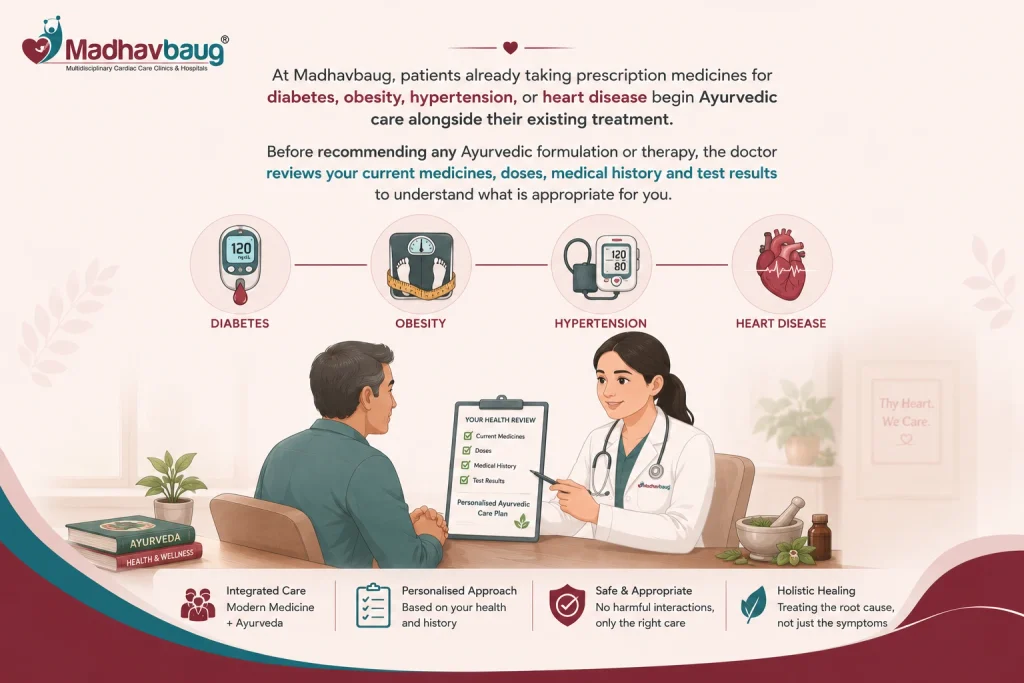
During the consultation, it is useful to ask questions such as:
- Can this Ayurvedic treatment be taken safely with my current medicines?
- Will I need to continue my existing prescription medicines?
- Which tests or health measurements will be monitored during treatment?
- How will we know whether the treatment is working?
- If my blood sugar, BP or other readings improve, who will decide whether my medicine needs to be changed?
- How often will I need follow-up consultations?
From there, your care is monitored through scheduled follow-ups, tracked test results and continuous monitoring systems. The aim is to understand how your health responds and make decisions based on your progress.
If you are wondering whether Ayurveda can be safely combined with your current medicines, this is where a personalised consultation becomes important. Your treatment should be based on your actual health condition and medication list, not only on the basis of a general recommendation.
Book a Consultation
The only reliable way to know whether Ayurveda can be safely combined with your specific medicines is a proper consultation where your complete medical history, prescription medicines, doses and current health reports are reviewed by a doctor.
At Madhavbaug, this assessment can help you understand which Ayurvedic treatment may be appropriate, what needs to be monitored, and how your existing treatment can be managed safely alongside it. Book a consultation at your nearest Madhavbaug clinic to discuss your treatment options with a doctor.
If you’re taking prescription medicines and considering Ayurveda alongside them, a proper consultation is the safest way to find out what can, and can’t, be combined for your specific condition.
Frequently Asked Questions
Can Ayurveda be taken with prescription medicines?
Yes, in many cases, but only when a doctor who knows your complete medicine list is coordinating the treatment. Some herb-drug combinations carry genuine interaction risks, so Ayurvedic treatment should be planned around your specific prescriptions, not added casually alongside them.
Can Ayurveda and allopathy be used together safely?
They can be, and are, used together for many chronic conditions, provided both are disclosed to and supervised by a doctor. The risk isn’t in combining the two systems, it’s in combining them without full disclosure or monitoring.
Should I stop taking my prescribed medicine once I start Ayurvedic treatment?
No. You should continue your prescribed medicines exactly as directed unless your prescribing doctor specifically advises a change based on monitored results. Stopping medication on your own, even if you feel better, is one of the most common and preventable safety mistakes patients make.
What should I tell my Ayurvedic doctor before starting treatment?
Share every prescription medicine, over-the-counter drug, and supplement you currently take, including dosages, along with any recent changes to your medicines and known allergies. This is what allows your doctor to screen for interaction risks before recommending anything.
How does Madhavbaug monitor safety when combining both treatments?
Madhavbaug tracks the same clinical markers your prescribing doctor already monitors, such as blood sugar, blood pressure, or cardiac markers, at scheduled follow-ups. Any prescription dose adjustment is only made in coordination with your treating physician, based on that monitored data over time.
Related reading
- Evidence-Based Ayurveda: Metabolic Health Metrics
- Ayurvedic Medicine for Diabetes
- Monsoon Sleep and Metabolic Health
- Humidity, Breathlessness and Heart Disease
References
Ajanal, M., Nayak, S., Prasad, B.S. and Kadam, A. (2013) ‘Adverse drug reaction and concepts of drug safety in Ayurveda: an overview‘, Journal of Young Pharmacists, 5(4), pp. 116–120.
Izzo, A.A. and Ernst, E. (2001) ‘Herb-drug interactions: focus on risk and clinical significance‘, Drugs, 61(15), pp. 2163–2175.
Thatte, U. and Bhalerao, S. (2008) ‘Pharmacovigilance of ayurvedic medicines in India‘, Indian Journal of Pharmacology, 40(Suppl 1), pp. S10–S12.





 Locate a Centre
