

Key Takeaways
|
There are very few fruits to avoid in diabetes. Whole fruits can usually be eaten, but fruit juice, sweetened smoothies, fruits in sugar syrup and fruit desserts with added sugar are best avoided or kept for rare occasions. Fresh fruits such as mango, banana and grapes can usually be eaten on a diabetic diet. However, each fruit will need to be eaten in moderation.
Worst Fruits for Diabetes and Which to Limit
It is common to see mango juice and fresh mango listed as fruits to avoid in diabetes. However, the American Diabetes Association recommends whole fruits as part of a healthy dietary pattern and to limit fruit juice and sugary drinks, according to its 2026 Standards of Care. Therefore, avoiding and limiting are not the same.
A better way of looking at this is below.
| Level of caution | Examples | What this means |
| Low | Guava, Apple, Orange, Pear, Papaya | These can be eaten in most meal plans. However, they do contain carbohydrates. |
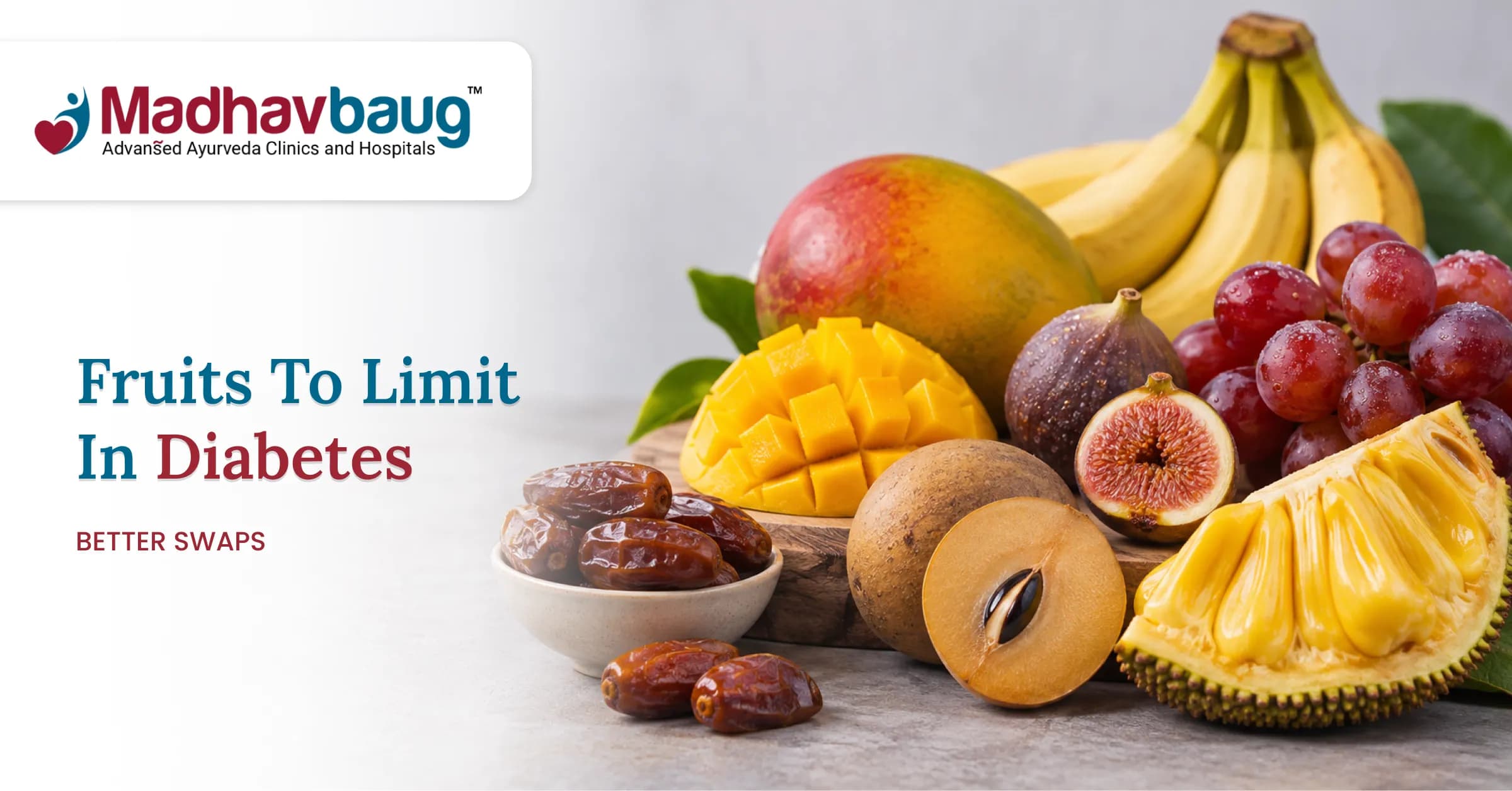
| Medium | Mango, Banana, Grapes, Chikoo, Custard apple, Jackfruit, Lychee and dried fruits | These can contain a higher amount of carbohydrates in a usual portion. Weigh or measure. |
| High | Fruit juice, Sweetened smoothies, Fruits in sugar syrup and Fruity desserts with added sugar | These are concentrated or have added sugar and will not be as filling. |
This is not a medical risk category, just a helpful way to group them. Even fruits in the first category can add a high amount of carbohydrates if eaten in larger portions. The term ‘worst fruits for diabetes’ can be misleading as it is generally the way the fruit is prepared or added sugar that is an issue. For fruits that fit more easily into a diabetic diet, see our guide to the best fruits for diabetes.
If you are following a structured diet, such as a low calorie programme, your care team may ask you to limit your fruit intake more strictly for a certain period of time. Follow their guidance.
Why do some fruits need to be eaten in moderation?
Although the sugar in fruits is natural, it is still a carbohydrate. Fruits with higher fibre and water content (Guava and Orange) will be more filling. Softer fruits will be easier to eat in larger quantities (Chikoo and Ripe Banana).
The effect on your glucose will depend on more than just the name of the fruit. The glycaemic index of a food tells us how it will generally affect our blood sugar. This is based on eating a standard portion. It does not tell us how it will affect us if we eat double the amount or with a high carbohydrate meal. The ripeness and type of fruit can also affect this. A very ripe banana may not act the same way as a firmer banana.
How much mango, banana, grapes and chikoo can I eat?
Dietitians often use an exchange system to help decide how much of a food to eat. One fruit exchange is approximately 15g of carbohydrates. Below is a list of how much fruit you would need to eat to get approximately 15g of carbohydrates. This information was taken from an Indian fruit exchange list produced by Novo Nordisk India.
| Fruit | Approximate amount of fruit for 15g of carbohydrates |
| Mango | Half a small mango |
| Banana | Half a large banana |
| Grapes | Approximately 15 grapes |
| Chikoo | 1 small chikoo |
| Guava | 1 medium guava |
| Orange | 1 orange |
This is an approximate amount. The actual amount of carbohydrates will depend on the type, ripeness, size and how much of the fruit can be eaten. You may be able to eat more or less than one exchange depending on your medication, activity and glucose levels.
Using an exchange list will help you decide how much of your favourite fruit you can eat. Seasonal fruits such as watermelon can be easy to overeat.
| 3F Fruit Check A simple way to decide what fruit to eat if you have diabetes is to use the 3F Fruit Check. Form Is it a whole fruit, dried fruit, juice or sweetened? Try to go for whole fresh fruits. Fruit Portion How much are you going to eat? Measure your portion using the exchange table above. Full Plate What other carbohydrates are you having? Fruit will add to the amount of carbohydrates you are having from rice, roti, poha, bread or sweets. |
Example – Banana and breakfast poha Let’s say your usual breakfast is a plate of poha with a large banana.
- Form – Whole banana is a good option.
- Fruit Portion – Large banana is almost 2 exchanges from the table above. This is a larger portion than you think.
- Full Plate – Poha is also mostly carbohydrates. This means you are having 2 sources of carbohydrates.
There is no one correct answer. Some people may find eating half a banana better. Others may prefer to eat it on its own as a mid morning snack. You could also eat the banana and have a smaller plate of poha. This will depend on your overall meal plan and how your glucose is affected. A healthcare professional can help you work this out.
In Indian meals, fruit is often eaten with or immediately after high carbohydrate foods. Therefore, if you are getting a higher reading than expected, it may not just be the fruit. Having a look at the whole meal along with an Indian diabetic diet chart will usually give you a clearer picture.
When fruit is eaten alongside rice, roti or another carbohydrate-rich food, a higher glucose reading may reflect the whole meal rather than the fruit alone. Looking at the full meal can help identify whether the portion or combination needs adjusting.
– Dr. Bipin Gond, Zonal Medical Head, Madhavbaug
Fruit Swaps for Diabetes
| Instead of | Try | Why? |
| Large glass of mango shake | Half a small fresh mango | No added sugar and no extra carbohydrates from the milk. You can see how much you are eating. |
| Packaged fruit juice | Water and 1 whole fruit | You will get the fibre and not be consuming multiple fruits worth of carbohydrates. |
| Large bowl of grapes | Approximately 15 grapes in a small katori | This will help you stick to a set amount. |
| Pineapple chunks in sugar syrup | Fresh pineapple | This removes the added sugar. |
| Sweetened fruit yoghurt | Plain unsweetened dahi with a little chopped fresh fruit | You can control how much fruit you add and there is no added sugar. |
| Banana shake with several dates | 1 small banana or another whole fruit | Banana, dates and milk create a high carbohydrate load in one glass. |
Although you are eating less, you are still getting carbohydrates. However, it is easier to plan. Adding nuts or protein can make a more filling snack. However, it will not remove the carbohydrates.
Want help planning fruit portions around your diabetes meals?
Fruit Juice for Diabetes
Fruit juice is not as good as whole fruits. Here is a breakdown of the most common options.
- Whole fruit – Fibre is retained and will take longer to eat.
- Freshly squeezed – No added sugar but most fibre is lost. Often more than one fruit will be used to make one glass.
- 100% Packaged – Similar to fresh. No added sugar does not mean no sugar.
- Sweetened fruit drinks – Added sugar. Best to avoid.
- Smoothies – More of the fruit is retained compared to strained juices. However, you can still be having several servings in one glass.
Even 100% juice will contain carbohydrates and will not be as filling as eating the fruit itself, according to the ADA. The ICMR-NIN Dietary Guidelines for Indians recommend whole fruits over fruit juices. This is a general guideline for everyone. It does not give specific amounts of fruits or juices to eat for diabetics. This is where individual advice comes in.
However, regular fruit juice can be a useful quick acting carbohydrate to treat a hypo (low blood sugar), according to the CDC. If your doctor has advised you to keep fruit juice, then continue to do so.
| Will eating less fruit improve my blood sugar? Study Highlight In a trial published in Nutrition Journal in 2013, 63 adults with newly diagnosed type 2 diabetes received nutritional advice for 12 weeks. One group were advised to eat 2 or more pieces of fruit per day. The other were advised to eat 2 or less. Both groups saw a reduction in their HbA1c. There was no statistically significant difference between the groups (Christensen et al., 2013). |
This was a small trial over a short period of time. It only included people with newly diagnosed type 2 diabetes. No individual fruits were tested. This does not show that eating unlimited fruits is safe.
When should you take individual advice?
General advice will suit many people. However, you may need individual advice if you
- Often have high or low glucose readings.
- Are taking insulin or sulfonylurea (a type of diabetic tablet that can cause hypos).
- Are pregnant or have gestational diabetes.
- Have kidney disease. Some people with reduced kidney function are advised to limit their intake of potassium rich fruits. This will depend on their blood tests and stage of disease. Others will not need to. Speak to your doctor.
- Have other special dietary requirements or are following a structured diet.
Your doctor or dietitian may look at your food diary and glucose readings to see how you are affected by certain meals. Do not change your medication based on what you are eating without medical advice.
| Clinical Insight “People taking insulin or a sulfonylurea may develop low blood glucose if they substantially reduce their carbohydrate intake without a treatment review. Kidney disease can also affect potassium advice. Fruit portions should be planned around glucose readings, kidney function and current medicines.” Dr Gurudatta Amin, BAMS, MD, PGDEMS 19+ Years of Clinical Experience, CMO, Madhavbaug |
Managing Diabetes with Individual Care at Madhavbaug
There is no one rule for fruit. At Madhavbaug we start by looking at your medical history and current reports. We may then offer you individual advice on your diet, lifestyle changes, regular follow ups and Ayurvedic treatments as part of your supervised care.
| Madhavbaug Research Highlight A study was carried out in 2026 looking at 316 patients with type 2 diabetes who had been treated at Madhavbaug clinics. Their average HbA1c reduced from 8.95% to 7.36% (Sane, Ghadigaonkar and Kulthe, 2026). This was not a controlled study. It looked at a combination of treatments and not individual fruits. It cannot show what effect individual parts had. It cannot prove that this was due to the programme. This does not mean that diabetes has been cured or reversed. Do not stop taking any prescribed medication. |
Some patients follow our Prameha Diet Kit. This may mean they are advised to limit their fruit intake more strictly for a certain period of time. These rules are different to the general advice and should only be followed under supervision.
Want fruit advice that fits your diabetes management plan?
FAQs
Which fruits should diabetics avoid?
The main ones to avoid are fruit juice, sweetened smoothies and shakes, fruits in sugar syrup and fruit desserts with added sugar. Higher carbohydrate fruits such as mango, banana, grapes, chikoo and dried fruits do not usually need to be avoided, but they should be eaten in measured portions.
Can diabetics eat banana?
Many people with diabetes can. Half a large banana gives roughly 15g of carbohydrates, which is one fruit exchange. A firmer banana eaten as a snack, or with a smaller portion of poha or roti, is easier to plan for than a very ripe banana or a banana shake.
Can diabetics eat mango?
Many people with diabetes can eat fresh mango in season. Half a small mango is about one fruit exchange. Mango shake, mango juice and aamras with added sugar are easier to overdo and are best avoided.
Can I eat fruit every day?
Many people can. Whole fruits can be part of a healthy dietary pattern. How many portions you can eat will depend on your medication, activity and glucose readings. It is a good idea to agree a portion with your doctor or dietitian.
Is it better to eat fruit in the morning or evening?
There is no one answer. If you are monitoring your glucose at home you could try eating fruit at different times of day and see how it affects you. Share these with your doctor or dietitian.
What are high sugar fruits?
Dried fruits such as dates, raisins and figs will be the highest as the water has been removed. Ripe mango, chikoo, custard apple, banana and grapes are fairly high sugar fruits among fresh fruits. However, the amount of sugar per 100g will not determine if it is suitable for you.
Is no added sugar fruit safe for diabetics?
Not automatically. No added sugar just means no sugar was added. The fruit will still contain natural sugars and will be a source of carbohydrates. This will apply to unsweetened juices, purées and dried fruits.
Are canned fruits safe?
Fruits canned in water or their own juice will be a better option. Drain the liquid and count the fruit as part of your portion. Be careful when reading the label as ‘light syrup’ still contains added sugar.
References
American Diabetes Association (n.d.) Fruit. Available at: https://diabetes.org/food-nutrition/reading-food-labels/fruit (Accessed: 4 November 2026).
American Diabetes Association Professional Practice Committee (2026) ‘5. Facilitating positive health behaviors and well-being to improve health outcomes: Standards of Care in Diabetes—2026’, Diabetes Care, 49(Supplement 1). Available at: https://diabetesjournals.org/care/article/49/Supplement_1/S89/163932 (Accessed: 4 November 2026).
Centers for Disease Control and Prevention (2024) Treatment of low blood sugar (hypoglycemia). Available at: https://www.cdc.gov/diabetes/treatment/treatment-low-blood-sugar-hypoglycemia.html (Accessed: 4 November 2026).
Christensen, A.S., Viggers, L., Hasselström, K. and Gregersen, S. (2013) ‘Effect of fruit restriction on glycemic control in patients with type 2 diabetes: a randomized trial’, Nutrition Journal, 12, article 29. doi: 10.1186/1475-2891-12-29.
ICMR-National Institute of Nutrition (2024) Dietary Guidelines for Indians. Hyderabad: ICMR-NIN. Available at: https://nin.res.in/dietaryguidelines/pdfjs/locale/DGI_2024.pdf (Accessed: 4 November 2026).
Novo Nordisk India (n.d.) Fruit exchange list. Available at: https://www.novonordisk.co.in/content/dam/nncorp/in/en_in/patient-education/documents/diet-in-diabetes-management/Website%20-%20FRUIT%20-%20List.pdf (Accessed: 4 November 2026).





 Locate a Centre

