

If you think of a diabetes diet chart, you may be confused about what to eat and what not to eat and, more importantly, when to eat.
A diabetes-friendly Indian diet chart includes Indian meals that have fibre, lean proteins, healthy fats and complex carbohydrates in ideal amounts, which help manage sugar levels.
This guide walks you through a practical, Madhavbaug doctor-reviewed food chart for diabetic patients built specifically around Indian meals so that you may balance your meal for a healthier tomorrow.
Why India Needs Its Own Diabetes Diet Chart
Most diabetes diet charts may include Western-plate-like grilled chicken, salad, and a side of quinoa. That’s not how most Indian households eat, and frankly, it’s not how most of us want to eat either.
This gap is bigger than it may seem to be. A large-scale survey of Indian diets by the ICMR–INDIAB programme showed that Indian diets are characterised by high consumption of low-quality carbohydrates, which include polished rice, refined wheat and added sugar, along with relatively low protein intake, which may be associated with a 14–30% increased cardiometabolic risk (Anjana et al., 2025).
In simple terms, the solution may not be cutting out rice and roti entirely but rebalancing the plate, and thus this article is to help you provide a generic food chart for diabetic patients.
The Indian Plate Method
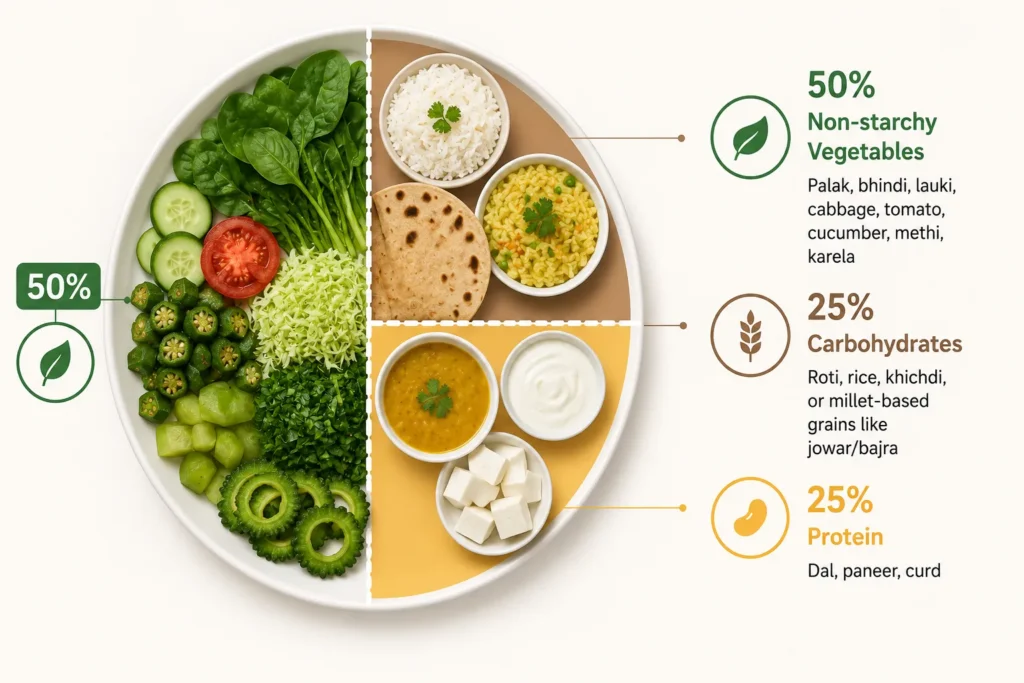
The plate method is the easiest way to build a diabetes meal plan in India-style, without counting every gram.
You may take your regular dinner plate and divide it as follows:
- ½ plate of non-starchy vegetables: palak, bhindi, lauki, cabbage, tomato, cucumber, methi, karela
- ¼ plate of carbohydrates: roti, rice, khichdi, or millet-based grains like jowar/bajra
- ¼ plate of protein: dal, paneer, curd
This structure has been specifically recommended for inclusion in Indian diabetes management guidelines precisely because it’s simple, adaptable to any regional cuisine, and doesn’t require a food scale to follow at every meal (Sembiah and Burman, 2024).
Carbohydrate, Protein and Fibre Portions
Here’s where a diabetes diet chart actually becomes useful when given along with approximate portion sizes in order to help control diabetes.
| Food Group | Typical Portion | Approx. Carb/Protein | Notes |
| Roti (whole wheat/multigrain) | 1 medium (small katori atta) | ~15g carbs | Prefer multigrain or millet-mixed atta. |
| Cooked rice | ½ cup (small fist) | ~15g carbs | Choose brown or parboiled rice where possible |
| Dal (cooked) | 1 katori | ~7g protein, ~15g carbs | A daily staple, not optional |
| Paneer/tofu | 50–75g (palm-sized) | ~10–12g protein | Good for vegetarian protein variety |
| Curd/yoghurt (plain) | 1 small katori | ~5g protein | Better than sweetened-flavoured versions |
| Non-starchy vegetables | 1–1.5 cups cooked | Minimal carbs, high fibre | Fill half the plate here |
| Fruit (whole, not juice) | 1 small-medium serving | ~15g carbs | Guava, apple, papaya, berries, spaced from meals |
| Nuts/seeds | Small handful (~8-10 pieces) | Healthy fat + fibre | Watch portion, calorie-dense |
A meaningful share of daily fibre should come from whole pulses, vegetables and minimally processed grains rather than refined flour. This is one of the most consistent, evidence-backed levers for improving post-meal glucose response in Indian diets (Anjana et al., 2025).
Note: This article is meant to give you a practical starting framework, not a rigid prescription. Everyone’s calorie needs, medication, activity level and health conditions are different. What works well for a 45-year-old office worker on metformin may not suit a 65-year-old on insulin with kidney concerns. Please treat this Indian diabetic diet plan as a template.
For a detailed, personalised diabetes diet chart, you may need proper medical-supervised guidance. Madhavbaug focuses on holistic care, including medicines and exercise as well as diet. To get your personalised Indian diabetic diet plan, consult at the nearest Madhavbaug centre today.
Sample Day 1
| Meal | What to Eat |
| Early morning | 1 glass of warm water; soaked methi seeds or fenugreek water (optional) |
| Breakfast | 2 vegetable-stuffed multigrain parathas (light oil) + 1 small katori curd |
| Mid-morning | 1 small guava or apple |
| Lunch | 2 rotis, 1 katori dal, 1 katori mixed-vegetable sabzi, and salad (cucumber, tomato, onion) |
| Evening snack | Roasted chana or a small handful of nuts + green tea |
| Dinner | 1 katori vegetable khichdi (moong dal) or 2 rotis + paneer bhurji + sautéed greens |
| Bedtime (if advised) | 1 small glass of milk (unsweetened) |
Smart Snack Swaps
Cravings don’t disappear with a diagnosis, but the options you reach for can change. Following are some smart snack swaps:
- Namkeen/fried snacks → roasted chana, makhana, or roasted peanuts
- Biscuits with tea → a small bowl of sprouts or a boiled egg
- Sugary fruit juice → whole fruit, or fruit with skin that is edible
- White bread sandwich → multigrain or besan chilla with vegetables
- Sweetened lassi → plain buttermilk (chaas) with roasted cumin
Regional Meal Examples
A good Indian diabetic diet plan should include regional cuisine as well. Some recommendations are as follows:
- North Indian
Multigrain roti, rajma or chana (moderate portion, high fibre), bhindi or lauki sabzi, cucumber-onion salad
- South Indian
Small idli/dosa (2 pieces) with sambar and coconut chutney (limited), or ragi/millet dosa for a better glycaemic response
- West Indian (Gujarati/Maharashtrian)
Bajra, jowar bhakri, dal, kadhi (light), stir-fried vegetables, but make sure to go easy on the jaggery/sugar traditionally added to Gujarati dals
- East Indian (Bengali)
Brown rice in a controlled portion and shukto (mixed vegetable) for fibre
What the Madhavbaug Shows
Diet is not just an add-on in diabetes care; it is often the difference-maker.
A retrospective observational study at Madhavbaug clinics demonstrated a consistent downward trend in HbA1c over 90 days across groups in patients on a structured Ayurvedic Panchakarma programme with dietary correction (Kshirsagar, Lakariya and Khan, 2024).
A related Madhavbaug study on detoxification and dietary modification found that the majority of participants completing a structured diabetes care programme achieved negative or improved glucose tolerance testing at 90 days (Imran et al., 2024).
These findings help us understand that with treatment, diet is also important, and Madhavbaug also aims to give comprehensive care by giving weightage to medicines, panchakarma, and diet, as well as exercise and much more. To know more about the detailed treatment approach, read here.
Ready for a Personalised Plan?
A generic diabetes diet chart is a great starting point, but your body and your daily routine deserve a plan built specifically for you. If you’d like to go beyond this food chart for diabetic patients and get a truly personalised diet plan reviewed alongside your current treatment, our Ayurvedic diet and lifestyle guide for diabetes and Ayurvedic food habits for diabetes patients are good next reads.
For a structured, doctor-supervised approach to improving your numbers over time, explore our Ayurvedic Diabetes Reversal Treatment Program, and when you’re ready, book a consultation at a Madhavbaug clinic near you for a diet plan built around your own reports and lifestyle.
Frequently Asked Questions
- Can a diabetic eat rice and roti at all?
Yes. The goal isn’t elimination, but it’s portion control and pairing. A small portion of rice or roti (about a quarter of your plate) combined with plenty of vegetables and adequate protein has a much gentler effect on blood sugar than a carb-heavy plate eaten alone.
- How many meals should a diabetic eat in a day?
Most Indian diabetes diet charts work well with 3 main meals and 1–2 small snacks, spaced fairly evenly, especially if you’re on medicines timed around meals. Your doctor may adjust this based on your specific treatment plan.
- Are millets better than rice or wheat for diabetes?
Millets like jowar, bajra and ragi generally have a lower glycaemic impact and higher fibre than polished rice or refined wheat, making them a useful substitution, though portion size still matters even with millets.
- Is fruit allowed on a diabetes diet chart?
Yes, whole fruit in moderate portions (not fruit juice) is encouraged as part of a balanced Indian diabetic diet plan. Spacing fruit away from your main carb-heavy meal can help smooth out the overall glucose response.
- Should I follow this chart without consulting a doctor?
This chart is a general educational framework. If you’re on diabetes medication, have kidney disease, are pregnant, or have any other complicating condition, please get this personalised with a doctor or dietitian before following it strictly.
References
- Anjana, R.M., Sudha, V., Abirami, K. et al. (2025) ‘Dietary profiles and associated metabolic risk factors in India from the ICMR–INDIAB survey-21’, Nature Medicine, 31, pp.3813–3824.
- Anjana, R.M. et al. (2022) ‘Macronutrient recommendations for remission and prevention of diabetes in Asian Indians based on a data-driven optimization model: the ICMR–INDIAB national study’, Diabetes Care, 45(12), pp.2883–2891.
- Imran, S., Sabir, I., Mandole, R. and Khan, S. (2024) ‘Role of ayurveda detoxification and dietary modification on restoration of euglycemia in T2DM patients’, International Journal of Research in Medical Sciences, 12(1), pp.188–193.
- Kshirsagar, J., Lakariya, A. and Khan, S. (2024) ‘Impact of ayurvedic panchakarma along with lifestyle modification in restoring glucose tolerance in type 2 diabetics’, International Journal of Basic & Clinical Pharmacology, 13(5), pp.669–672.
- Sembiah, S. and Burman, J. (2024) ‘Inclusion of diabetes plate method in Indian diabetes management guidelines—a public health imperative’, International Journal of Diabetes in Developing Countries, 44, pp.150–151.




 Locate a Centre
