

Key Takeaways
|
Your fasting sugar is 108. Your HbA1c is borderline. The doctor says, “Let us do a glucose tolerance test.” Or maybe you have had diabetes for years and the doctor now asks for something called a C-peptide test and of course you are not sure why.
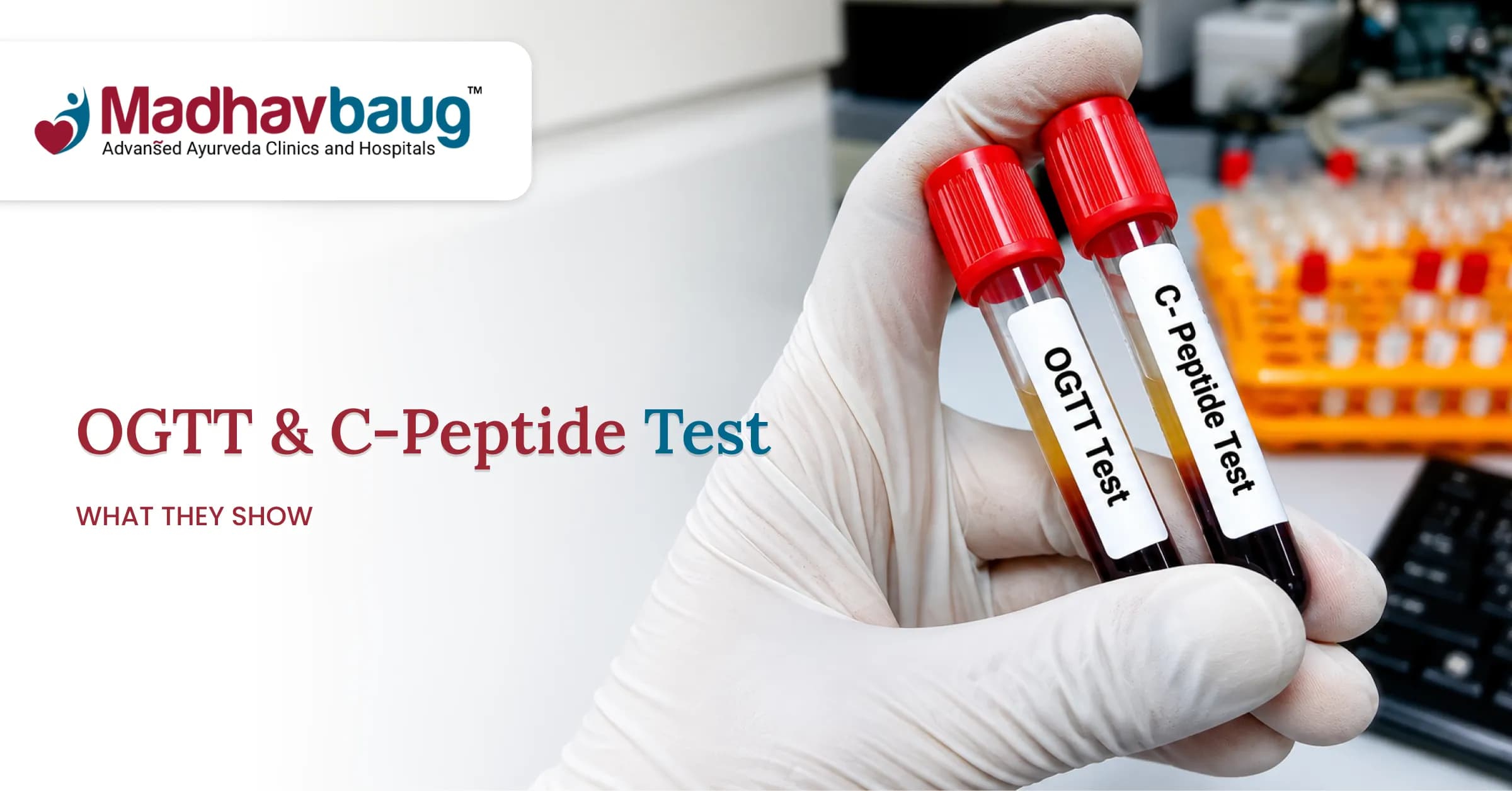
These two tests look at different things. In this blog, we explain the glucose tolerance test (OGTT), the GTT test normal range, how to prepare and what the C-peptide test tells you about your diabetes.
Confused about your sugar reports?
What Is a Glucose Tolerance Test (OGTT)?
An oral glucose tolerance test (OGTT) is a blood test that checks how well your body handles sugar. Oral means you take the glucose by mouth in the form of a sweet drink.
Here is the idea. When you swallow a fixed amount of glucose, your sugar rises. In a healthy body, insulin brings it back down within a couple of hours. If insulin is low or does not work well, of course the sugar stays high for longer. The glucose tolerance test measures how fast your body clears the sugar.
Doctors often suggest this test when your fasting sugar or HbA1c falls in the borderline range, a fasting sugar is normal but diabetes is still suspected, you are pregnant and need a screening for gestational diabetes or you have a family history of diabetes, PCOS or other risk factors.
After understanding what is oral glucose test, it is important to understand how this test is done and what its process.
How the GTT Test Is Done
The test is done at a laboratory and takes 2 to 3 hours. Below-mentioned is a step-by-step process for what happens during the OGTT test.
| Step | What happens |
| 1. Fasting sample | After an overnight fast of 8 to 12 hours, a blood sample is taken. This is your fasting sugar. |
| 2. Glucose drink | You drink 75 g of glucose mixed in about 250 to 300 mL of water, usually within 5 minutes. |
| 3. Waiting | You sit quietly for 2 hours. No eating, smoking or walking about. Water is usually allowed in small sips. |
| 4. Second sample | Blood is drawn exactly 2 hours after you start the drink. Some labs also take samples at 30, 60 or 90 minutes. |
Reading these steps you may feel that the process is long and may take a lot of preparation for the test. Following are some tips on how to prepare for the OGTT Test.
How to Prepare for the OGTT Test
- Eat your normal diet, including your usual rice, roti and other carbohydrates, for 3 days before the test. Do not go on a strict diet.
- Fast for 8 to 12 hours. Water is fine.
- Do not take heavy exercise the day before.
- Tell the lab about all your medicines, as some, such as steroids, can change the result.
- Postpone the test if you have a fever or infection. Illness raises sugar and can mislead the result.
While the process is going on some people feel nauseous, sweaty or dizzy after the glucose drink. If you are going through this process and you feel any of these symptoms while the process is going on, always inform the doctor.
GTT Test Normal Range
The normal range of the GTT test depends on how many hours have passed. For adults who are not pregnant, doctors mainly use the fasting reading and the 2-hour reading (ADA, 2025a; WHO, 2006).
| Reading | Normal | Prediabetes | Diabetes |
| Fasting sugar (mg/dL) | Below 100 | 100 to 125 | 126 or more |
| 2-hour sugar after glucose drink (mg/dL) | Below 140 | 140 to 199 | 200 or more |
| 2-hour sugar (mmol/L) | Below 7.8 | 7.8 to 11.0 | 11.1 or more |
A 2-hour value between 140 and 199 mg/dL is called impaired glucose tolerance. It means your body is not clearing sugar as efficiently as it should even though you may not yet have diabetes.
As mentioned above the normal range of the GTT test may differ during pregnancy for which it is important to understand the normal GTT range in pregnancy.
GTT Test Normal Range in Pregnancy
Pregnancy has its own normal GTT range because the aim is to protect both mother and baby. When a 75 g OGTT is done for gestational diabetes (ADA, 2025b) and if any one of the values reaches or crosses the number, gestational diabetes is diagnosed.
| Time | Gestational diabetes if sugar is (mg/dL) |
| Fasting | 92 or more |
| 1 hour | 180 or more |
| 2 hours | 153 or more |
Many centres in India also use a single-step test with 75 g of glucose even without fasting. In this method, a 2-hour value of 140 mg/dL or more is taken as gestational diabetes. The test is usually done at the first antenatal visit and repeated between 24 and 28 weeks of pregnancy. Your gynaecologist or doctor will tell you which method applies to you.
“GTT results help us understand how well your body processes glucose over a period of time. During pregnancy, even a small rise in blood sugar can matter, which is why doctors use different cut-off values. If your report shows a reading above the normal range, do not interpret it on your own. Your doctor will consider the test method, pregnancy stage and other health factors before recommending the next steps.”
– Dr. Bipin Gond, Zonal Medical Head, Madhavbaug
After understanding the GTT test in detail the next step is to know about the c-peptide test and its procedure.
What Is a C-Peptide Test?
When your pancreas produces insulin, it first makes a bigger molecule called proinsulin. This is split in two parts, insulin and C-peptide in equal amounts. So measuring C-peptide shows how much insulin your own pancreas is making (Jones and Hattersley, 2013).
Why not simply measure insulin?
Insulin disappears from the blood within minutes and it is also affected if you inject insulin. C-peptide stays in the blood longer and is not present in injected insulin. This makes it a steadier marker. Now it is important to understand how the c-peptide test is carried out.
How the C-Peptide Test Is Done
- It is a simple blood test often taken after an overnight fast.
- Sometimes it is taken 2 hours after a meal or after a stimulation to see how well the pancreas responds.
- Doctors usually check a blood sugar sample at the same time because C-peptide makes sense only when read together with the sugar level.
C-Peptide Test Normal Range
Normal values differ from lab to lab. Many laboratories quote a fasting range of about 0.8 to 3.1 ng/mL (roughly 0.26 to 1.03 nmol/L). Please check the range printed on your own report.
Once you have your C-peptide value, the next step is to understand what it indicates.
What Does the C-Peptide Result Mean?
| C-peptide result | What it may suggest |
| Low | The pancreas is making little insulin. This may be seen in type 1 diabetes, in LADA (a slow-onset form of type 1), and in type 2 diabetes of long duration when insulin-making cells have weakened. |
| Normal or high with high sugar | The body is making insulin but not responding to it properly. This is called insulin resistance and is common in type 2 diabetes, obesity and PCOS. |
| Very high with low sugar | Rarely, a tumour of the insulin-making cells. Doctors investigate this further. |
Two points to remember. Kidney disease can raise C-peptide because the kidneys clear it from the body and certain diabetes medicines can also change the value.
Some clinical guidelines treat a stimulated C-peptide below roughly 0.2 nmol/L (about 0.6 ng/mL) as a sign of severe insulin deficiency (Jones and Hattersley, 2013).
Difference Between OGTT vs C-Peptide Test
| Feature | Glucose tolerance test (OGTT) | C-peptide test |
| What it shows | How well your body clears sugar | How much insulin your pancreas makes |
| Main use | Diagnosing prediabetes, diabetes and gestational diabetes | Understanding the type of diabetes and insulin reserve |
| What you take | A 75 g glucose drink | Nothing, or a meal in some cases |
| Time needed | About 2 to 3 hours | A few minutes for the sample |
| Can it diagnose diabetes alone? | Yes, with repeat confirmation | No, it supports the diagnosis |
| Clinical Insight “Patients often ask which test is better. Neither is better. The glucose tolerance test tells us how the body handles sugar, and the C-peptide test tells us how much insulin the body is making. We use one to find out if there is a problem and the other to understand what is behind it. The numbers always need to be read along with the person’s symptoms and history.” Dr. Gurudatta Amin, BAMS, MD, PGDEMS, 19+ Years of Clinical Experience, CMO, Madhavbaug |
How Madhavbaug Can Help You Manage Blood Sugar
At Madhavbaug, our doctors understand your complete history including your prakriti and then prescribe the treatment. The diabetes treatment includes panchakarma, ayurvedic medicines, diet and lifestyle guidance. If you want to take a step towards holistic care for managing your blood sugar, visit your nearest Madhavbaug clinic and discuss your reports with the medical team.
Looking for guidance on your sugar reports?
Frequently Asked Questions
What is a glucose tolerance test?
It is a blood test that checks how well your body handles sugar. You give a fasting sample, drink a measured glucose solution and give another sample 2 hours later.
What is the GTT test normal range?
For adults who are not pregnant, a fasting sugar below 100 mg/dL and a 2-hour sugar below 140 mg/dL are normal.
What is the normal GTT range in pregnancy?
With the 75 g test, gestational diabetes is diagnosed if the fasting sugar is 92 mg/dL or more, the 1-hour sugar is 180 mg/dL or more or the 2-hour sugar is 153 mg/dL or more. In the single-step non-fasting method used in many centres in India, a 2-hour value of 140 mg/dL or more is taken as gestational diabetes.
What does a 2-hour OGTT value of 200 mean?
A 2-hour value of 200 mg/dL or more falls in the diabetes range. Your doctor will usually confirm it with another test.
How long does the OGTT test take?
Around 2 to 3 hours at the laboratory, including the fasting sample and the 2-hour wait.
Do I need to fast for the glucose tolerance test?
Yes, in most cases for 8 to 12 hours. Water is allowed. Some pregnancy screening methods in India do not need fasting, so follow your doctor’s advice.
Can I take my medicines before the OGTT test?
Do not skip or change any medicine on your own. Tell your doctor or the lab what you take, and follow their instructions for the test day.
What is a C-peptide test used for?
It shows how much insulin your pancreas is making. Doctors use it to understand the type of diabetes and how much insulin reserve you have.
What is the normal range of the C-peptide test?
Many labs use about 0.8 to 3.1 ng/mL for a fasting sample, but ranges vary, so check your report.
Does a low C-peptide mean type 1 diabetes?
A low value suggests the pancreas is making little insulin. It can be seen in type 1, LADA and long-standing type 2 diabetes, so your doctor will look at your full picture.
Can a C-peptide test replace the glucose tolerance test?
No. They answer different questions. OGTT helps diagnose diabetes, while C-peptide helps understand it.
References
American Diabetes Association Professional Practice Committee (ADA, 2025a). Diagnosis and classification of diabetes: Standards of Care in Diabetes. Diabetes Care. 2025;48(Suppl 1).
American Diabetes Association Professional Practice Committee (ADA, 2025b). Management of diabetes in pregnancy: Standards of Care in Diabetes. Diabetes Care. 2025;48(Suppl 1).
World Health Organization (WHO, 2006). Definition and diagnosis of diabetes mellitus and intermediate hyperglycaemia: report of a WHO/IDF consultation. Geneva: WHO; 2006.
Indian Council of Medical Research (ICMR, 2018). ICMR Guidelines for Management of Type 2 Diabetes. New Delhi: ICMR; 2018.
Jones AG and Hattersley AT (2013). The clinical utility of C-peptide measurement in the care of patients with diabetes. Diabetic Medicine, 30(7), pp. 803–817.





 Locate a Centre

