
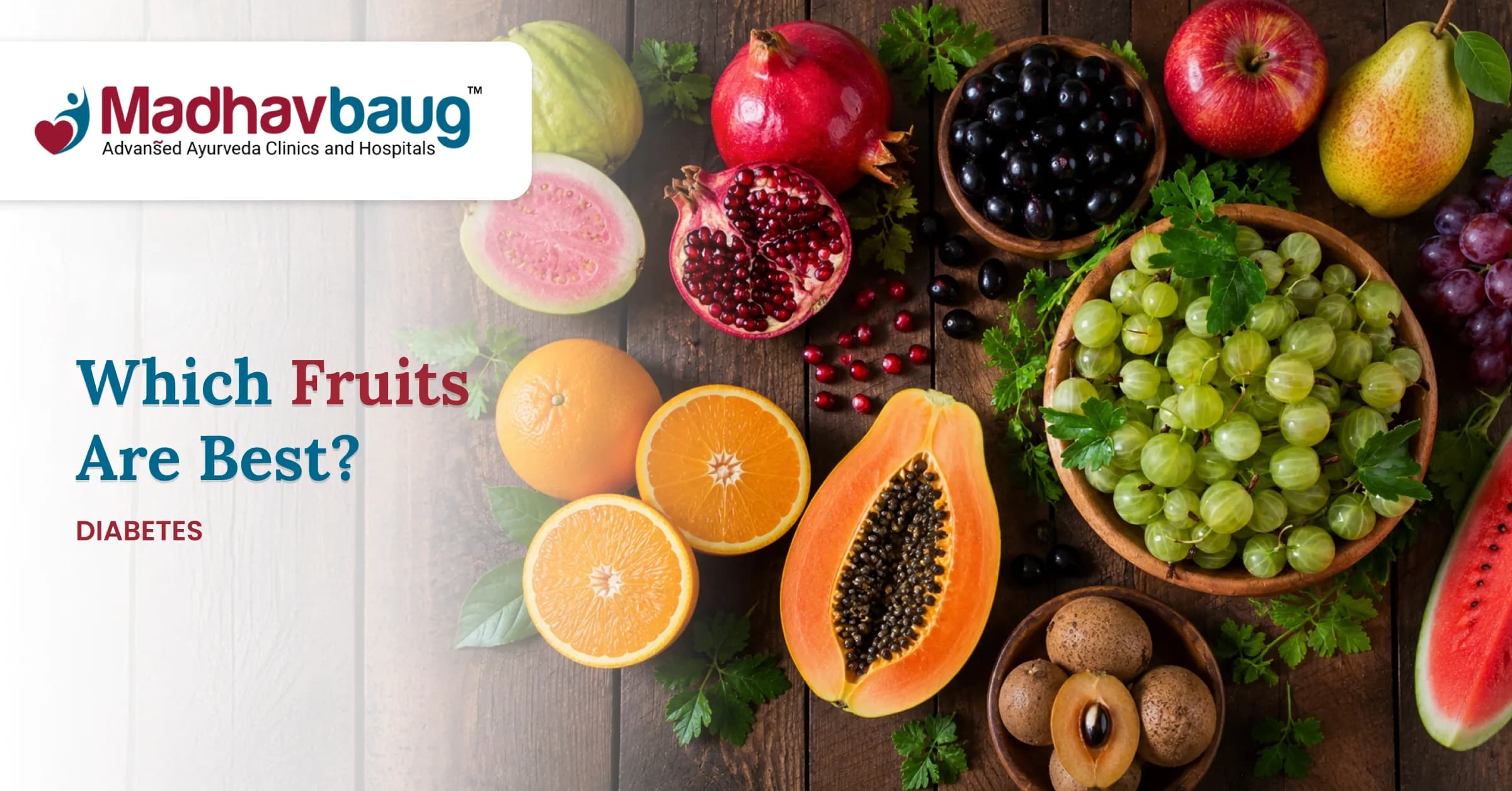

If you’ve been told you have type 2 diabetes or prediabetes, there are high chances that you may have thought of the best fruits for diabetes. It is a common myth that diabetic patients should not eat fruits, and you may also have experienced such situations where a relative sees you reach for a banana or a bowl of grapes and says, “Are you sure you should be eating that?” And so you stop, or you eat it anyway and quietly worry about what your next reading will look like.
Here’s the problem with advice like “avoid fruit”, which may not be that accurate, and it isn’t necessary. Some fruits may raise blood sugar quickly, some barely move it at all, and portion and timing change the picture even more than the fruit itself. Cutting out fruit entirely often means losing fibre, potassium, and antioxidants your body actually needs, while the fruits that were genuinely a problem may never have been addressed properly in the first place.
This guide by Madhavbaug breaks down the best fruits for diabetes using glycaemic index (GI), portion size and timing, so you can make an informed choice rather than an anxious guess. And because no two bodies respond to food identically, we’ll also show you how to check your own response, ayurvedic guide and lifestyle for diabetes and when it’s time to move from guesswork to a proper diabetes assessment.
The Immediate Answer and the Portion Principle
“It is rarely the fruit itself that spikes blood sugar, it is the portion and the pairing.”
Fruits for diabetic patients are often scaled using the glycaemic index. Fruits like guava, amla, pomegranate, and berries tend to sit on the lower end of the glycaemic scale, while fully ripe mango, sapota (chikoo), and large servings of grapes sit higher. (Singh, M.K., 2025)
But even a “high GI” fruit eaten in a small portion, alongside protein or fibre, and at the right time of day, behaves very differently from the same fruit eaten on an empty stomach in a large serving.
So the real question for most people isn’t
“Which fruits should I avoid?” but “How much and when.”
GI vs Glycaemic Load
To know about the low GI fruits for diabetes, it is important to understand what GI is. The Glycaemic Index (GI) measures how quickly a food raises blood glucose compared to pure glucose, on a scale of 0 to 100. It’s a useful starting point, but it can also be misleading if used alone, because GI doesn’t account for portion size (Atkinson, Foster-Powell and Brand-Miller, 2008).
This is where Glycaemic Load (GL) comes in. GL factors in both the GI of a food and the actual amount of carbohydrate in a typical serving. Watermelon may be a good example. Even though its GI is high (around 72–80), which makes it sound alarming, but since watermelon is mostly water, a standard serving contains relatively few carbohydrates, so its glycaemic load is actually low.
This is precisely why the question “Is watermelon diabetes-friendly?” may not be answered as “yes” or “no”. It simply depends on how much you eat.
Basically, the GI may tell you how fast, and the GL may tell you how much, and so along with low GI fruits for diabetes, knowing the GL is equally essential.
Comparison Table: Common Indian Fruits, GI, GL and Timing
Here’s how some of the most common fruits for diabetic patients in Indian households may compare. These are approximate values, as GI can vary slightly depending on ripeness and variety, but they may be a good recommendation scale for everyday decisions.
| Fruit | Approx. GI | Approx. Glycaemic Load (per serving) | Recommended Portion | Best Time to Eat |
| Amla (Indian gooseberry) | Very Low (~15–20) (Akhtar et al., 2011) | Low | 1–2 whole, or 20–30ml juice | Morning, empty stomach or with breakfast |
| Guava | Low (~12–24) (Atkinson, Foster-Powell and Brand-Miller, 2008) | Low | 1 medium guava | Mid-morning or as a snack |
| Pomegranate | Low (~35) (Banihani, Swedan and Alguraan, 2013) | Low–Medium | 1/2 cup arils | Mid-morning snack |
| Jamun (Java plum) | Very Low (Atkinson, Foster-Powell and Brand-Miller, 2008) | Low | 1 small bowl | Mid-morning, in season |
| Apple (with skin) | Low–Medium (~36–40) (Atkinson, Foster-Powell and Brand-Miller, 2008) | Low | 1 small–medium apple | Between meals |
| Pear | Low–Medium (~38) (Atkinson, Foster-Powell and Brand-Miller, 2008) | Low | 1 medium pear | Between meals |
| Orange | Medium (~40–43) (Atkinson, Foster-Powell and Brand-Miller, 2008) | Low–Medium | 1 medium orange | Mid-morning |
| Papaya | Medium (~56–60) (Atkinson, Foster-Powell and Brand-Miller, 2008) | Medium | 1 small bowl (100g) | Morning, not on an empty stomach if sensitive |
| Grapes | Medium–High (~53–59) (Atkinson, Foster-Powell and Brand-Miller, 2008) | Medium | 8–10 grapes | Paired with a protein snack |
| Banana (ripe) | Medium (~51) (Atkinson, Foster-Powell and Brand-Miller, 2008) | Medium | 1/2 to 1 small banana | Post-workout or with breakfast |
| Mango (ripe) | Medium–High (~51–60) (Atkinson, Foster-Powell and Brand-Miller, 2008) | Medium–High | 4–5 thin slices | Small portion, earlier in the day |
| Watermelon | High (~72–80) (Naz et al., 2013; Atkinson, Foster-Powell and Brand-Miller, 2008) | Low (due to water content) | 1 cup cubed | Small portion, not on an empty stomach |
| Sapota (Chikoo) | High (~55–65) (Atkinson, Foster-Powell and Brand-Miller, 2008) | Medium–High | 1/2 fruit, occasionally | Occasional, smaller portion |
The best fruits for diabetes may especially include pomegranate and amla.
Pomegranate’s antioxidant compounds have been studied specifically in the context of type 2 diabetes, with some research suggesting benefits for markers like fasting blood glucose and oxidative stress (Banihani, Swedan and Alguraan, 2013).
Amla, meanwhile, is also an important fruit according to Ayurveda as a supportive fruit for blood sugar management, and some clinical research has found it may help improve fasting glucose and lipid profiles in people with type 2 diabetes (Akhtar et al., 2011).
Portions and Timing
Until now, you may have certain questions, like the best time to eat fruits for diabetes. This actually means you are going in the right direction because you can’t change a fruit’s natural sugar content, but you can absolutely control how much you eat and when.
A few practical principles:
- Keeping portions moderate and consistent is important. A “serving” of fruit is usually about the size of your fist and not a full bowl. Two small servings spread across the day are gentler on blood sugar than one large serving at once.
- One may avoid eating high-GI fruit on a completely empty stomach. Pairing fruit with a small amount of protein or healthy fat, a few almonds, a spoon of curd, or peanut butter slows down how quickly the sugar hits your bloodstream.
- Eating fruits for diabetic patients at mid-morning and early afternoon may tend to work better than late at night. Insulin sensitivity is generally higher earlier in the day for most people, and eating fruit close to bedtime gives your body less time to manage the resulting glucose before sleep.
- It is essential to watch your post-meal window. A fruit eaten immediately after a full meal adds to that meal’s overall glycaemic load. If you’ve just eaten rice or roti, it may be worth waiting an hour or two before having fruit, rather than stacking it right on top.
This ties directly into a pattern many patients notice but don’t always connect to fruit timing, for which our article explains what’s actually happening in that window and why timing changes the outcome.
How to Check Your Own Response: Glucometer and CGM
Everything above may give you a solid starting point, but the best time to eat fruits for diabetes and the ideal portion may be known by understanding how your body responds to a specific fruit and by testing it yourself.
If you use a glucometer, check your blood sugar right before eating the fruit and again about 1–2 hours afterward. A rise of more than 30–40 mg/dL from your baseline is generally worth noting and discussing with your doctor, especially if it happens consistently with the same fruit.
If you use a Continuous Glucose Monitor (CGM), you’ll get an even clearer picture, watching not just the peak but also how quickly your glucose rises and how long it takes to return to baseline. For this, Madhavbaug has the MIB Pulse app to continuously monitor the glucose levels, and if there is any fluctuation, the doctor shall directly inform you and even mention the possible measures to be taken. For more information about this, consult your nearest Madhavbaug centre today.
When to Consult a Clinician
Reach out to a doctor or diabetes specialist if:
- Your blood sugar readings are consistently high despite portion control and timing adjustments
- You’re experiencing frequent symptoms of hypoglycaemia
- You’re unsure how a new medication interacts with your existing diet
- You want a fruit and meal plan built specifically around your readings, rather than general guidelines
Note: General advice, including everything in this article, is a starting point. It cannot replace a plan built around your actual blood sugar patterns, medication, and health history. For a more personalised approach, book an appointment at your nearest Madhavbaug centre.
Get a Plan Built Around Your Body, Not a Generic List
Knowing the low GI fruits for diabetes and the best time to eat fruits for diabetes puts you in a much better position than guessing. But lists and tables can only take you so far, the real difference comes from understanding how your specific body responds and building a sustainable plan around that.
At Madhavbaug, our approach to diabetes goes beyond a diet sheet. Through a personalised assessment that looks at your blood sugar patterns, lifestyle, and overall health, our team helps you build a realistic plan, including fruit, that supports long-term blood sugar management rather than short-term restriction. Our Ayurvedic Diabetes Reversal Treatment Programme combines traditional Panchakarma-based care with modern diagnostics to address the root pattern behind fluctuating blood sugar, not just the symptoms.
If you’ve been managing diabetes on guesswork and generic fruit lists, it may be time for something more personal. Find your nearest Madhavbaug clinic and book a diabetes assessment to take a better step towards diabetic health.
Frequently Asked Questions
- What fruit can a diabetic eat at night?
Some foods that are good options to eat before bedtime are berries. A superstar diabetes food, berries are a great way to get vital vitamins and minerals without overdoing it on sugar. Like beans, they are also a great source of fibre.
- What should a diabetic not eat at night?
Snacking after your evening meal, especially on foods with carbohydrates, may lead to a high blood sugar level the next morning. If you’re hungry after dinner, drink a glass of water first. Sometimes thirst feels like hunger. If you’re still hungry, eat a low-carbohydrate, low-calorie snack
- What fruit is highest in sugar?
Dried fruits like dates, raisins, and figs are highest in sugar, while fresh tropical options like mangoes and grapes lead among fresh varieties.
- What food can diabetics eat freely?
No food can be eaten in truly unlimited or infinite quantities without some impact on blood sugar or health, but non-starchy vegetables, water, and unsweetened tea or coffee can be consumed very freely
- How many hours can a diabetic eat?
Some research shows that fasting for 16 hours of the day and eating within an 8-hour window may help lower blood glucose levels and lose weight in the short term. Furthermore, there is evidence that type 2 diabetes remission is possible by following an intermittent fasting diet.
References
- Singh, M.K., Han, S., Ju, S., Ranbhise, J.S., Akter, S., Kim, S.S. and Kang, I., 2025. Fruit Carbohydrates and Their Impact on the Glycemic Index: A Study of Key Determinants. Foods, 14(4), p.646.
- Atkinson, F.S., Foster-Powell, K. and Brand-Miller, J.C., 2008. International tables of glycemic index and glycemic load values: 2008. Diabetes care, 31(12), p.2281.
- Akhtar, M.S., Ramzan, A., Ali, A. and Ahmad, M., 2011. Effect of Amla fruit (Emblica officinalis Gaertn.) on blood glucose and lipid profile of normal subjects and type 2 diabetic patients. International journal of food sciences and nutrition, 62(6), pp.609-616.
- Banihani, S., Swedan, S. and Alguraan, Z., 2013. Pomegranate and type 2 diabetes. Nutrition research, 33(5), pp.341-348.





 Locate a Centre
