

| Key Takeaways An Ayurvedic consultation for lifestyle diseases combines a detailed health history, relevant diagnostic tests, and an assessment of your Prakriti (body constitution) to build a plan specific to you, not a generic protocol. It’s designed to work alongside your existing diagnosis for diabetes, hypertension, heart disease, or obesity, not replace emergency or ongoing medical care. Growing clinical evidence supports structured Ayurvedic interventions for blood sugar, blood pressure, and weight-related metabolic markers, particularly when combined with modern diagnostics and monitoring. Expect a first visit of roughly 45–60 minutes, followed by a structured plan and scheduled follow-ups to track your progress over time. |
If you’re considering an Ayurvedic consultation for a lifestyle disease like diabetes, high blood pressure, obesity, or heart disease, it is important to understand what the first consultation should be like before you go in. This guide walks through why the consultation is structured the way it is, what your doctor will ask, the tests you can expect, how your Prakriti is assessed, how your treatment plan comes together, and what ongoing monitoring and follow-up at Madhavbaug looks like.
What is Ayurvedic Consultation for Lifestyle Disorders
An Ayurvedic consultation for a lifestyle disease aims to build a treatment plan around your specific body, history, and current health status, rather than applying the same protocol to everyone with the same diagnosis. This is the entire point of the first consultation, and that’s why it tends to take longer and go deeper than a typical quick check-up.
Lifestyle diseases like type 2 diabetes, hypertension, obesity, and heart disease usually develop over years, shaped by diet, daily routine, stress, poor sleep, and genetics, all of which differ meaningfully from person to person. A proper consultation is what allows an Ayurvedic doctor to understand the specific pattern which has led to your condition, based on which your treatment plan is made.
“At Madhavbaug, we don’t start with a standard protocol. We start by understanding the root cause behind each patient’s condition. Two people with the same diagnosis can have very different underlying imbalances, and the consultation is where we identify that difference before we decide on treatment.”
— Dr. Cinni Vijay Pandey, Regional Medical Head, Madhavbaug
Why Does Consultation Start With Your Health History?
The consultation typically opens with a detailed conversation about your health history, since this is what helps your doctor connect your current symptoms to their underlying cause. This part of the visit takes longer than a typical clinical history-taking since your complete lifestyle and daily habits need to be understood.
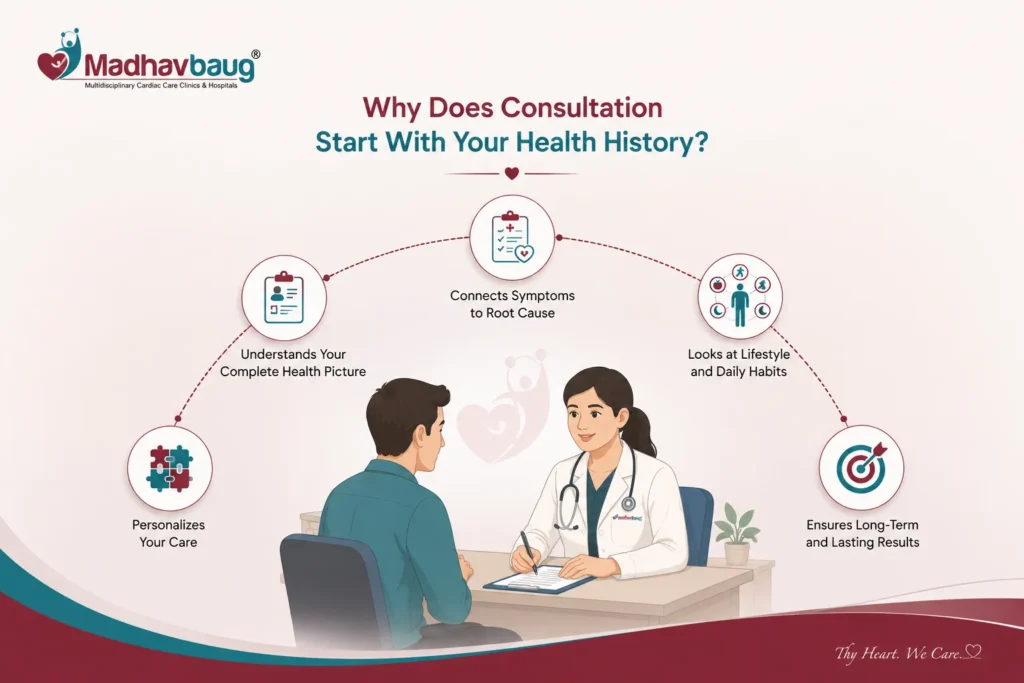
During this lifestyle disease-related Ayurvedic consultation, you’ll usually be asked questions like:
- “How long have you had this diagnosis, and how has it changed over time?”
- “What medicines are you currently taking, and at what dosage?”
- “Have you had any hospitalisations, procedures, or major health events?”
- “Does diabetes, hypertension, or heart disease run in your family?”
- “What does a typical day look like for you, including your diet, sleep, stress, and activity?”
It’s worth being honest with all of it, including any medicines you may have skipped or supplements you’ve started on your own, since that’s what helps your doctor build a plan that fits your actual life.
If you are managing lifestyle disorders, sharing your complete medical history, current medicines, lifestyle habits, and health concerns with a doctor , it can help create a personalised treatment plan.
Diagnostic Tests You Can Expect During an Ayurvedic Consultation
The doctor advises diagnostic tests relevant to your specific condition, since a treatment plan needs current, objective data to be built on, not just how you’re feeling. Which tests apply depends entirely on your diagnosis.
Following are some diagnostic tests advised for lifestyle disorders in an ayurvedic consultation:
| Lifestyle Disorder | Diagnostic Tests |
| Diabetes | Blood sugar and HbA1c levels |
| Hypertension | Blood pressure monitoring, sometimes over 24 hours |
| Heart Disease | Tests such as an ECG or relevant cardiac markers |
| Obesity | Body composition and metabolic measurements |
Basic health risk parameters, such as weight, waist circumference, and pulse, are checked at almost every consultation regardless of the primary condition, since they reflect overall metabolic health. These results, combined with your history, give your doctor the complete detail of your health before any treatment decisions are made.
How Does a Doctor in Ayurvedic Consultation Understands Your Prakriti?
Prakriti is your individual body constitution in Ayurveda, which is based on the relative balance of three doshas, Vata, Pitta, and Kapha. Understanding this natural relative balance and assessing it allows your ayurvedic doctor to personalise the treatment according to your lifestyle. This is what highlights an Ayurvedic doctor consultation over a conventional one.
Your doctor typically assesses Prakriti through a structured set of questions and observations covering your build, digestion, sleep pattern, temper, and how your body has historically responded to stress, food, and weather.
Evidence-based Ayurveda research states that since Prakriti assessment has traditionally relied on clinical experience, more objective, standardised tools have been found. (Venkatesh et al., 2025).
This means your Prakriti assessment adds real, personalised context to your consultation when combined with your detailed history and diagnostic tests.
| Clinical Insight “Patients coming in for hypertension have usually already cut back on salt, but very few have addressed their sleep quality, which is often the bigger driver of their blood pressure not settling.” Dr. Gurudatta Amin, BAMS, MD, PGDEMS 19+ Years of Clinical Experience, CMO, Madhavbaug |
Building Your Personalised Treatment Plan
Your treatment plan is built by combining your health history, diagnostic results, and Prakriti assessment into a holistic lifestyle recommendation which includes Panchakarma, diet, herbal formulations and therapies.
How Is a Personalised Treatment Plan Created?
A personalised treatment plan is not simply a combination of therapies. It starts with understanding what is driving your condition, your current health status, and how your body responds to treatment. At Madhavbaug, the plan for diabetes, hypertension, heart disease, or obesity may bring together several approaches instead of relying on one medicine or one therapy alone.
For example, a diabetes management plan may combine Panchakarma therapies, a structured diet and prescribed herbal formulations, while an obesity plan may include Virechana (purgation), Panchakarma, personalised nutrition and herbal formulations.
For hypertension, the plan may combine Ayurvedic therapies with diet, lifestyle changes and regular BP monitoring. For heart disease, it may bring together Ayurvedic therapies, diet, exercise and ongoing cardiac monitoring based on the individual’s condition.
| Health Concern | What the Personalised Plan May Include |
| Diabetes | Panchakarma therapies, structured diet and prescribed herbal formulations |
| Hypertension | Ayurvedic therapies, diet and lifestyle changes, BP monitoring and prescribed medicines where appropriate |
| Heart Disease | Ayurvedic therapies, diet, exercise, cardiac monitoring and medicines where required |
| Obesity | Panchakarma, personalised diet and herbal formulations |
This is why a plan designed for one person should not automatically be followed by someone else with the same diagnosis. Your Prakriti assessment, clinical evaluation and test results help the doctor determine which approaches may be appropriate for you and how your progress should be monitored.
If you are looking for such an approach which is personalised to your health, the next step is a proper assessment. Contact Madhavbaug today to discuss your condition with a doctor, understand which treatments may be suitable for you, and create a plan based on your individual needs.
Monitoring Your Progress After an Ayurvedic Consultation
An Ayurvedic consultation for a lifestyle disease isn’t a one-time visit. It’s the start of a monitored process which increases motivation, with follow-up appointments built in to track how your body is actually responding to the plan. This ongoing check-in is what allows the plan to be adjusted.
Follow-ups typically involve rechecking the same measurements from your first visit, such as blood sugar, blood pressure, or weight, alongside a conversation about how you’re managing the diet and lifestyle recommendations day to day.
Madhavbaug even includes continuous monitoring systems which help doctors track your daily day-to-day progress and how well you are adhering to your recommended lifestyle plan.
Our doctors use this to fine-tune the plan over time, since what works well in month one sometimes needs adjusting by month three as your body responds and your routine settles into the new pattern.
What Happens Next
After your consultation, you’ll generally leave with a written plan covering diet, any prescribed formulations, recommended therapies, and a follow-up schedule, so you know exactly what to do before your next visit. Bringing a family member to your first visit is recommended.
Here’s what the full patient journey looks like end to end, following Madhavbaug’s pathway:
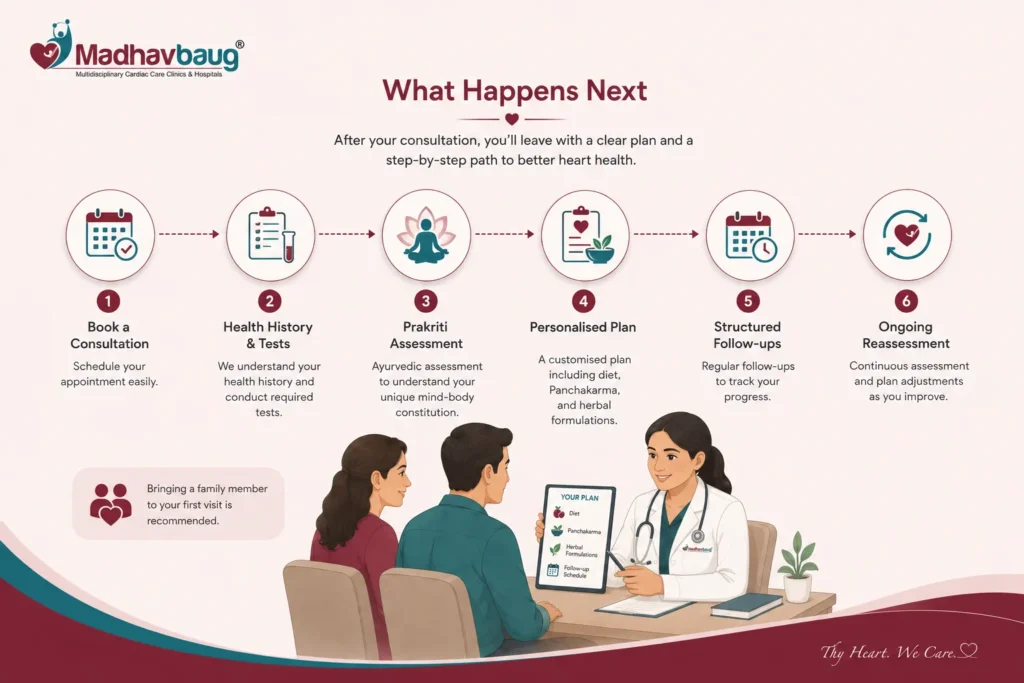
Your existing physician stays part of this journey throughout. You can see what this pathway has looked like for other patients in our success stories. Every step on that path starts with booking the first consultation.
Book a Consultation
The only way to know exactly what your own Ayurvedic consultation will involve is to book one, since the specific tests, history questions, and plan depend entirely on your condition and current health status.
Madhavbaug’s network of over 350 clinics and hospitals across India brings together Ayurvedic physicians and modern diagnostics under one roof for the medically supervised treatment of diabetes, hypertension, heart disease, and obesity. Take your first step towards a holistic journey and book your Ayurvedic consultation today.
If you are considering an Ayurvedic approach for lifestyle disorders, a personalised consultation can help you understand the treatment options for your condition and current health status.
Frequently Asked Questions
Q.1 What happens during an Ayurvedic consultation for lifestyle diseases?
A typical consultation includes a detailed health history, relevant diagnostic tests based on your condition, an assessment of your Prakriti (body constitution), and a personalised treatment plan covering diet, herbal formulations, therapies, and lifestyle changes. Follow-up visits are then scheduled to monitor your progress and adjust the plan over time.
Q.2 What does an Ayurvedic doctor consultation for diabetes involve?
For diabetes, the consultation typically includes a review of your blood sugar and HbA1c levels, your current medicines, family history, and daily diet and activity patterns, alongside a Prakriti assessment. The resulting plan usually combines dietary changes, Ayurvedic formulations, and lifestyle adjustments aimed at improving blood sugar control over time.
Q.3 How does an Ayurvedic consultation for hypertension work?
A hypertension consultation usually involves blood pressure monitoring, sometimes over a 24-hour period, a review of your medicines and family history, and a discussion of stress, sleep, and diet patterns. Clinical evidence suggests structured Ayurvedic interventions can meaningfully reduce blood pressure, particularly when combined with regular monitoring and lifestyle changes.
Q.4 Do I need to stop my current medicines before an Ayurvedic consultation?
No. You should continue your current medicines as prescribed and bring full details of them to your consultation. Any changes to dosage should only be made in coordination with your treating doctor, not on your own.
Q.5 How long does an Ayurvedic consultation for lifestyle diseases take?
A first consultation typically takes around 45 to 60 minutes, covering your health history, relevant tests, and Prakriti assessment. Follow-up visits are usually shorter, focused on checking your progress and fine-tuning your treatment plan.
Related reading
- Warning Signs Your Body Gives Before Lifestyle Diseases
- Early Detection and Prevention for Diabetes, BP and Heart Disease
- Is Your Lifestyle Making You Sick?
- Obesity Treatment in Ayurveda
- Managing Hypertension Naturally With Ayurevda
References
Venkatesh, A., Johansson, L., Sivanandan, P.V., Gopakumar, S.P., Sankaranarayanan, K., Kessler, C.S., Ravani, S. and Puthiyedath, R. (2025) ‘Prakriti (constitutional typology) in Ayurveda: a critical review of Prakriti assessment tools and their scientific validity‘, Frontiers in Medicine, 12, article 1656249.
Kumari, S., Patil, R. and Tubaki, B.R. (2025) ‘Efficacy of integrated Ayurveda treatment protocol in uncontrolled type 2 diabetes mellitus: a randomized controlled study‘, European Journal of Integrative Medicine, 73, article 102424.
Deshmukh, S., Choudhary, K., Ahmad, A., Reddy, G., Rao, B.C.S., Srikanth, N. and Acharya, R. (2025) ‘Effectiveness and safety of Ayurvedic intervention in essential hypertension: a systematic review with meta-analysis‘, Frontiers in Pharmacology.
Chandake, S., Tubaki, B.R. and Gonugade, V. (2024) ‘Efficacy of tryushnadya churna in metabolic syndrome with obesity – a randomized double blind controlled clinical trial‘, Journal of Ayurveda and Integrative Medicine, 15(4), article 100973.



 Locate a Centre
