

Key Takeaways
|
Ejection fraction is a term that most heart patients hear for the first time when they look at their echocardiogram report and India being home to an estimated 1.3 to 4.6 million people living with heart failure (Huffman and Prabhakaran, 2010) there are many families who carry this number in their file without really knowing what it means.
Your ejection fraction tells how well your heart is pumping blood to the rest of the body and even a small fall in this number should not be ignored when you feel completely fine. Usually people start worrying only when breathlessness or swelling begins but by that time the heart may have been weak for quite some time.
In this blog we explain what ejection fraction means, what is a normal ejection fraction, what a low ejection fraction does to the body, how to increase ejection fraction with the right treatment and how Madhavbaug’s comprehensive heart care can support you along with your cardiologist.
Worried about your echo report?
What Is Ejection Fraction?
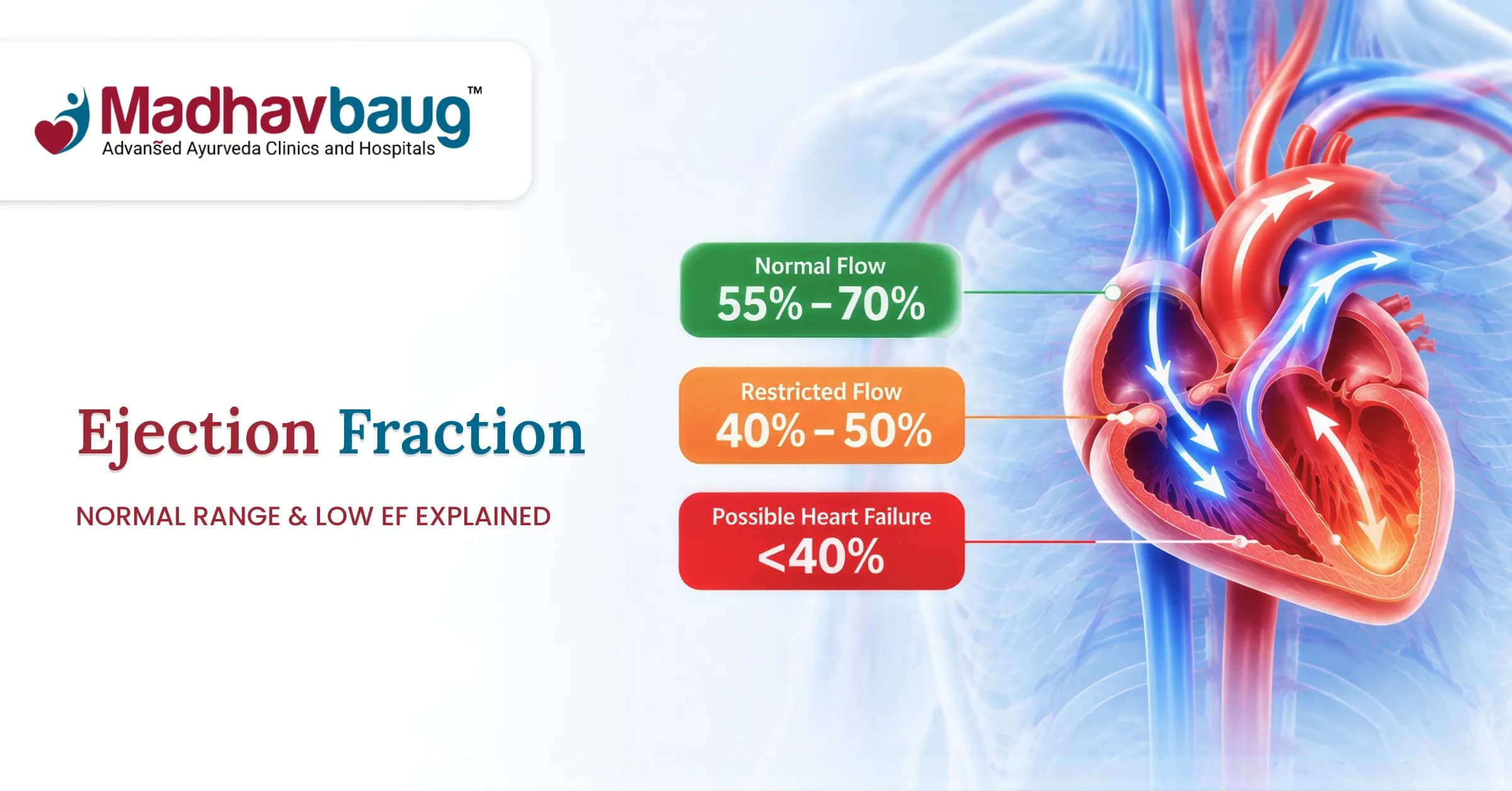
Ejection fraction or EF, written as LVEF (left ventricular ejection fraction) on most echo reports, is the percentage of blood that the left ventricle pumps out in one heartbeat compared to the total blood the left ventricle holds just before that beat.
To understand it in easy terms, you should firstly know that your heart has four chambers and the lower left chamber called the left ventricle is the main pumping chamber which sends blood rich in oxygen to your brain, kidneys, muscles and every other organ. The share of blood that this left ventricle pumps out in one heartbeat is called the Ejection fraction.
For example if your left ventricle fills with 100 ml of blood and pumps out 60 ml with one beat then your ejection fraction is 60%. The heart is never completely empty so even a perfectly healthy heart will not show an ejection fraction of 100% and this is something that many people get confused about.
Normal Ejection Fraction Range
A normal ejection fraction is generally accepted to be between 50% and 70% although the exact range may differ slightly between men and women and between labs (Lang et al., 2015). Following is the table that explains what each range of the ejection fraction usually means for you.
| Ejection fraction | What it usually means for you |
| 50% to 70% | If your EF is in this range it means the ejection fraction is normal and the heart is pumping well |
| 41% to 49% | This range means your heart may have a mildly reduced EF and the heart muscle may be weak |
| 40% or below | If your EF is in this category it means it’s low ejection fraction and when it comes with symptoms, it is called heart failure with reduced ejection fraction |
| Above 75% | If your EF is above the normal range then it may point to a thickened heart muscle which needs medical attention |
A normal ejection fraction does not always mean that the heart is completely healthy. Studies show that many people have heart failure with a normal or preserved ejection fraction where the heart muscle has become stiff and does not relax well even though the pumping percentage looks fine on the report.(Bozkurt et al., 2021)
After understanding what the normal ejection fraction range is, you should know how the ejection fraction is measured.
How Is EF Measured in an Echo Test?
Echocardiogram or ECHO is the medium that is used to measure your ejection fraction which is a noninvasive ultrasound of the heart that takes approximately 20 – 30 minutes to measure EF and it also causes no pain or radiation. On your echo report, this value is usually written as EF or LVEF.
Nevertheless, if these echo pictures are not clear, the doctor or cardiologist may also suggest a cardiac MRI, a nuclear scan or a CT scan.
Low Ejection Fraction Symptoms and What It Does to Your Body
When you have a low ejection fraction the heart is not able to pump out enough blood with each beat and this when the body tries to maintain a balance by retaining salt and water as well as speeding up the heartbeat. However, in the beginning this works but with time it adds more load on the weak heart and the symptoms start showing. Following are the symptoms that you may notice if you have a low ejection fraction.
| Symptom | What you may notice |
| Breathlessness | You may feel short of breath while walking, climbing stairs or even lying down. |
| Tiredness | You may feel extremely weak and drained even after doing some work. |
| Swelling | You may observe puffy feet or your ankles or legs shall swell by evening. |
| Sudden weight gain | You may be surprised to see yourself gain 1 to 2 kg over a few days because of the fluid buildup |
| Palpitations | You may feel very fast heartbeat |
| Night cough | You may cough at night constantly or need extra pillows so that you can breathe comfortably |
Causes of Low Ejection Fraction
The chances of you having a low ejection fraction are higher if you have any of the following things.
- A previous heart attack or blocked heart arteries
- High blood pressure that has been uncontrolled for many years
- Cardiomyopathy which is a disease of the heart muscle itself
- A narrowed or leaking heart valve
- A fast or irregular heartbeat such as atrial fibrillation for a long time
- Uncontrolled diabetes, thyroid problems or heavy alcohol use
- A viral infection or inflammation of the heart muscle
When the ejection fraction stays at or below 35% even after at least three months of proper medicines the risk of a dangerous heart rhythm goes up and your cardiologist may discuss a device such as an ICD or CRT to protect your heart (Heidenreich et al., 2022).
How to Increase Ejection Fraction
The honest answer to how the ejection fraction can be increased depends on why the EF is low. Once the doctor knows why your EF is low, it is easy to say if your EF can be increased or maintained or what are the treatment measures you may need.
“Many patients and families keep asking me how to increase the EF number but I would like them to look at the whole picture. A patient who takes the medicines on time, keeps the salt low and walks every day can feel far better even when the EF number moves only a little, and what I always tell them is to never skip the follow up visits and the echo that the doctor has asked for.”
– Dr. Priyadarshini Bhalekar, Zonal Medical Head, Madhavbaug
In many patients especially when the cause is found early and treated well the ejection fraction improves and this is now recognised as heart failure with improved ejection fraction (Wilcox et al., 2020) but in some patients it stays the same and the aim then is to stop it from falling further and to keep you feeling better. Following are some ways that can help your heart and these are general points so for your specific case your doctor may give proper consultation and prescribe.
- Firstly, treating the cause behind the weak heart such as opening blocked arteries, repairing a valve, controlling blood pressure or correcting an irregular heartbeat.
- Take your heart failure medicines regularly because doctors commonly use ACE inhibitors, ARBs or ARNI, beta blockers, aldosterone blockers and SGLT2 inhibitors which together can improve the pumping of the heart and reduce hospital visits (Heidenreich et al., 2022).
- Make sure you eat less salt and follow the fluid limit given by the doctor and weigh yourself every morning so that sudden weight gain can be detected.
- Do walk or exercise but only at the speed and the activity limit that the doctor has approved and ask about a supervised cardiac rehabilitation programme if you are weak or have just come out of the hospital.
- Stop smoking and tobacco in any form and refrain from alcohol completely because your heart muscle is weak.
- Keep your sugar, cholesterol and weight maintained and regularly track them and also if you snore with pauses while breathing at night then it is important to evaluate it because sleep apnoea strains the heart.
How Madhavbaug Can Help You Manage Low Ejection Fraction
Heart failure is a lifestyle-linked condition which cannot be managed only by looking at one echo number. Ejection fraction is only one part of heart care which also includes the right medicines, diet, activity, sleep and building healthy habits that you can keep up for years.
| Clinical Insight “In my experience, patients often come to us only after the symptoms have become difficult, while the low ejection fraction was already written in an old report. At Madhavbaug, we look at the patient’s symptoms, echo reports, blood pressure, food habits and overall health before planning the care. Along with regular monitoring, our Ayurvedic therapies and diet guidance are meant to work together with the cardiologist’s treatment and not to replace it. If you have been told that your ejection fraction is low, do not wait for the next symptom and speak to your doctor so that your treatment can be reviewed.” Dr. Pravin Jayram Ghadigaonkar, BAMS, MD, PhD (Scholar) – Preventive Cardiology 20+ Years of Clinical Experience, Head Medical Operations & Patient Improvement, Madhavbaug |
Madhavbaug offers holistic and comprehensive heart disease treatment which works alongside the treatment from your cardiologist and looks at the factors that may have weakened your heart. This approach includes understanding your prakriti and then planning Ayurvedic therapies including panchakarma along with herbs, a heart friendly diet, a safe exercise plan and regular follow ups so that your progress can be tracked at every visit.
If you have a low ejection fraction on your report or you are already on heart failure medicines and still feel tired and breathless you can visit your nearest Madhavbaug clinic today and get your heart care planned in a proper and organised way.
Looking for guidance on your heart care?
Frequently Asked Questions
What is ejection fraction?
Ejection fraction is the percentage of blood that the left ventricle pumps out of the heart with each beat and it shows how well your heart is pumping.
What is a normal ejection fraction?
A normal ejection fraction is usually between 50% and 70%. A reading slightly outside this range does not always mean disease so your doctor will read it along with your symptoms and other tests.
What is a low ejection fraction?
A low ejection fraction is generally a value of 40% or below and it means that the heart is pumping less blood than the body needs. It is commonly seen in heart failure and needs proper treatment and follow up.
What are the symptoms of low ejection fraction?
Breathlessness, tiredness, swelling of the feet, quick weight gain, palpitations and a cough at night are the common ones. Some people have no symptoms in the beginning which is why a regular echo is important when you have heart disease.
How to increase ejection fraction?
The treatment depends on the cause and may include regular heart failure medicines, opening blocked arteries or repairing a valve, a low salt diet, safe exercise and quitting smoking and alcohol.
Can a low ejection fraction be reversed?
In some patients the ejection fraction can increase but only when the cause is treated early and the medicines are taken regularly but in others it may not go back to normal.
Is a 30% ejection fraction serious?
Yes it is a significantly low ejection fraction and needs close follow up with a cardiologist who may advise medicines in proper doses and in some cases a device to protect against dangerous heart rhythms.
What are the ejection fraction tests?
An echocardiogram is the most common and simple test. A cardiac MRI, nuclear scan or CT scan may be used when more detail is needed.
What does EF mean in an echo report?
EF in an echo report stands for ejection fraction and it is often written as LVEF. It shows what percentage of blood the left ventricle pumps out with each beat and a value between 50% and 70% is usually considered normal.
Does the normal ejection fraction range change with age?
The normal range of about 50% to 70% applies to adults of all ages. Ejection fraction does not drop much with healthy ageing so a low reading in an older person should still be checked by a doctor and not be taken as normal for age.
References
Bozkurt B, et al. (2021). Universal definition and classification of heart failure. Journal of Cardiac Failure, 27(4).
Heidenreich PA, et al. (2022). 2022 AHA/ACC/HFSA Guideline for the Management of Heart Failure. Circulation, 145(18).
Huffman MD and Prabhakaran D. (2010). Heart failure, epidemiology and prevention in India. National Medical Journal of India, 23(5).
Lang RM, et al. (2015). Recommendations for cardiac chamber quantification by echocardiography in adults. Journal of the American Society of Echocardiography, 28(1).
Wilcox JE, et al. (2020). Heart failure with recovered left ventricular ejection fraction. Journal of the American College of Cardiology, 76(6).




 Locate a Centre

