

Reducing HbA1c levels may not be done through medicines alone. It shall need a consistent healthy lifestyle including eating low-glycemic whole foods, engaging in physical activity on a regular basis, preventing stress, taking proper sleep, and much more.
For you to understand this better, imagine you going to the lab for a routine blood check and finding a very surprising fact. Your HbA1c level is more than 7, and you are in a panic, and only one question repeatedly runs in your head: “How to reduce HbA1c?”
You may think of following a strict diet, going to the gym every day, and so on. However, that’s not the actual case with how HbA1c works, and directly doing such things without proper guidance leads to frustration and, sometimes, to skipped medicines that do more harm than good.
Here’s a complete guide including what HbA1c actually measures, why it takes its time to move, and what a realistic 12-week plan looks like, along with Madhavbaug’s Comprehensive Diabetes Care (CDC) approach.
What HbA1c Actually Measures and How to Read Your Number
HbA1c, or glycated haemoglobin, tells you how much glucose has been attached to the haemoglobin in your red blood cells.
Red blood cells are usually active for 120 days, and so HbA1c is not just today’s reading but an average of your blood sugar over the last 8 to 12 weeks. (Vives, C.J., 2021)
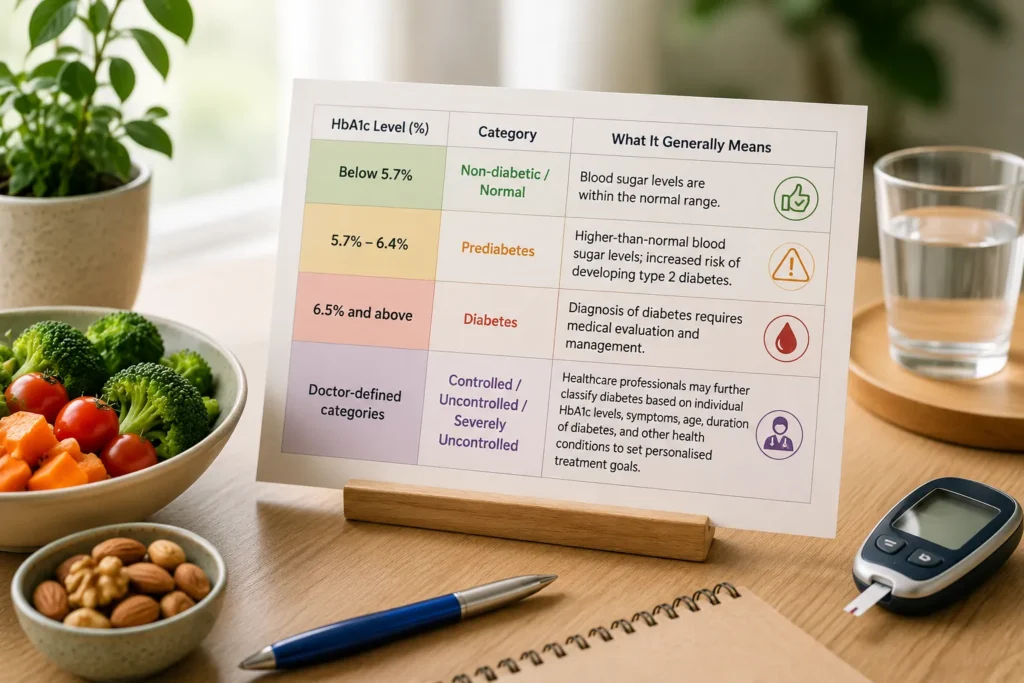
Following are the guidelines for the HbA1c levels and their categories:
| HbA1c Level (%) | Category | What It Generally Means |
| Below 5.7% | Non-diabetic / Normal | Blood sugar levels are within the normal range. |
| 5.7% – 6.4% | Prediabetes | Higher-than-normal blood sugar levels; increased risk of developing type 2 diabetes. |
| 6.5% and above | Diabetes | Diagnosis of diabetes requires medical evaluation and management. |
| Doctor-defined categories | Controlled / Uncontrolled / Severely Uncontrolled | Healthcare professionals may further classify diabetes based on individual HbA1c levels, symptoms, age, duration of diabetes, and other health conditions to set personalised treatment goals. |
Source: American Diabetes Association Professional Practice Committee, 2024.
Why HbA1c Moves Slowly and How Long Does It Take to Lower HbA1c
Since HbA1c is a three-month average, you need approximately 12 weeks, which is one complete cycle of the red blood cell. For lowering HbA1c naturally, not only medicines but also a lifestyle is recommended.
Madhavbaug follows a Comprehensive Diabetes Care (CDC) approach which includes Panchakarma, personalised diet, exercise and continuous monitoring systems like the MIB Pulse app. This CDC therapy is well researched and has successfully lowered HbA1c naturally for many people and improved their quality of life.
Following are some of the Madhavbaug research articles showing why 12 weeks is the right window:
- In one Madhavbaug analysis of type 2 diabetes patients on CDC therapy, the share of patients with “controlled” HbA1c went from zero at baseline to nearly half the group by week 12, with a statistically significant drop in the mean HbA1c figure (Sane et al., 2020).
- A separate cohort from the Vidarbha region told much the same story: average HbA1c fell from 8.45% at baseline to 6.89% after 12 weeks of CDC therapy (Sane et al., 2020).
This shows that twelve weeks is not less but a realistic unit of change here in order to lower HbA1c naturally.
How To Reduce HbA1c Through Comprehensive Diabetes Care (CDC) Approach
Madhavbaug’s own retrospective data on Panchakarma plus lifestyle modification shows a gradual decrease in HbA1c across three follow-up points at days 30, 60 and 90.
Your Tentative 12-Week Journey, Phase by Phase
Weeks 1–4: Stabilise and Assess.
This is the baseline period wherein your HbA1c, fasting and post-meal glucose, weight, BMI, and abdominal girth are recorded and your personalised plan starts. Your Panchakarma-based detox, Prameha Diet Care, which includes an HbA1c reduction diet plan.
If you are on any ongoing allopathic medications, you may be advised to continue them at this stage without changing anything at this stage.
Weeks 5–8: Build the Habit.
This is when your lifestyle changes. The CDC programme not only focuses on lowering HbA1c naturally but also on making your life better by introducing you to an active, healthy lifestyle.
Diet, herbal medications, a personalised exercise plan, and a sleep routine all together. This is usually when your day-to-day post-meal readings start looking better, well before the three-month HbA1c average has caught up.
Weeks 9–12: Consolidate and Re-test.
The goal here is simply staying consistent. HbA1c gets repeated at the 12-week mark alongside weight, BMI and girth so your Madhavbaug doctor may decide whether any medicine adjustment is needed or not, which you cannot do yourself.
Medical Adherence: The One Thing You Shouldn’t Improvise
However well your diet and Panchakarma sessions are going, that’s never a reason to stop or cut down prescribed medicines on your own. For lowering HbA1c naturally, adhering to what the doctor suggests is extremely important.
One recent hospital-based study found an average HbA1c of 7.0% among high-adherence patients versus 8.6% among low-adherence patients on similar regimens (Shaikh et al., 2025).
Madhavbaug does track your everyday routine through continuous monitoring systems like the MIB Pulse app. This does help the doctor keep a real-time track of what exactly you are doing and your daily activities and even daily readings. The doctor might call you in case there is any change in the trend of patterns. However, with this you also have to adhere to the doctor’s advice and strictly follow it. To start your comprehensive plan today, book a consultation at your nearest Madhavbaug centre.
Want to understand how your current diabetes profile may affect your scope for improvement? Check your Diabetes Reversal Score based on your health information.
A Simple Weekly Tracking Template For Lowering HbA1c Naturally
| Week | Fasting Blood Sugar (mg/dL) | 2-Hour Post-Meal Blood Sugar (mg/dL) | Weight (kg) / BMI | Average Sleep (Hours/Day) | Diet Followed? (✓/✗) | Medicines Taken as Prescribed? (✓/✗) |
| 1 | . | . | . | . | . | . |
| 2 | . | . | . | . | . | . |
| 3 | . | . | . | . | . | . |
| 4 | . | . | . | . | . | . |
| 5 | . | . | . | . | . | . |
| 6 | . | . | . | . | . | . |
| 7 | . | . | . | . | . | . |
| 8 | . | . | . | . | . | . |
| 9 | . | . | . | . | . | . |
| 10 | . | . | . | . | . | . |
| 11 | . | . | . | . | . | . |
| 12 | . | . | . | . | . | . |
Red Flags That Need Immediate Attention
You consulted a Madhavbaug doctor and started your CDC programme, but you need to be aware of these red flags. In case you are suffering from any of these, report immediately to the doctor:
- Blood sugar readings consistently above 300 mg/dL
- Symptoms of very low blood sugar (shakiness, cold sweats, confusion, fainting)
- Sudden unexplained weight loss
- Wounds or foot ulcers that won’t heal
- Blurred vision
- Persistent vomiting
- Abdominal pain
Ready to Start Your Supervised 12-Week Plan to Lower HbA1c Naturally?
If your HbA1c has come back high and you’d like a structured, doctor-supervised plan built around Ayurvedic Panchakarma, a personalised diet, and careful coordination with your existing medicines, Madhavbaug’s Ayurvedic Diabetes Type-2 Reversal Treatment Programme is built exactly for this.
Book a consultation with a Madhavbaug Ayurvedic doctor to get the basic assessment and a plan built around your current HbA1c report and daily routine.
Frequently Asked Questions
- How long does it take to lower HbA1c?
Since HbA1c is an average of your blood glucose over roughly the last three months, most credible plans check results at 12 weeks, not after a few days. You might see improvement earlier on daily glucometer readings, but the HbA1c figure itself needs the full three-month cycle to catch up (American Diabetes Association Professional Practice Committee, 2024; Sane et al., 2020).
- Can I lower HbA1c naturally, without medicines?
Diet, activity, sleep and Ayurvedic therapies like Panchakarma can genuinely support better glycaemic control, and research has recorded significant HbA1c drops with structured Ayurvedic and lifestyle protocols (Chattopadhyay et al., 2022; Cradock et al., 2017).
- What should a good HbA1c reduction diet plan include?
Generally, portion-controlled, low-glycaemic-load meals built around whole grains, vegetables and enough protein, eaten at consistent times.
- Is it safe to stop my diabetes medicines once my HbA1c improves?
No. Any change to your prescribed medicine needs to be strictly done by your doctor.
- How is HbA1c different from a daily glucometer or CGM reading?
A glucometer or CGM reading tells you your blood sugar right now or over a short stretch of time. HbA1c tells you the three-month average.
References
- Vives, C.J., Berga, C.L. and Feliu, F.E., 2021. Concise review: how do red blood cells born, live, and die?. Annals of hematology, 100(10), pp.2425-2433.
- American Diabetes Association Professional Practice Committee (2024) ‘Standards of Care in Diabetes—2024’, Diabetes Care, 47(Supplement_1), pp. S1–S321.
- Chattopadhyay, K., Wang, H., Kaur, J., Nalbant, G., Almaqhawi, A., Kundakci, B., Panniyammakal, J., Heinrich, M., Lewis, S.A., Greenfield, S.M., Tandon, N., Biswas, T.K., Kinra, S. and Leonardi-Bee, J. (2022) ‘Effectiveness and safety of Ayurvedic medicines in type 2 diabetes mellitus management: A systematic review and meta-analysis’, Frontiers in Pharmacology, 13, 821810.
- Cradock, K.A., ÓLaighin, G., Finucane, F.M., Gainforth, H.L., Quinlan, L.R. and Ginis, K.A.M. (2017) ‘Behaviour change techniques targeting both diet and physical activity in type 2 diabetes: A systematic review and meta-analysis’, International Journal of Behavioral Nutrition and Physical Activity, 14, 18.
- Sane, R., Mandole, R., Amin, G.A., Ghadigaokar, P., Paranjape, S., Gond, B., Asnodkar, P., Badre, A., Shinde, S. and Ahmed, A. (2020) ‘Role of comprehensive diabetes care in known diabetes patients from western Mumbai region: an observational study’, International Journal of Research in Medical Sciences, 8(8), pp. 3013–3018.
- Sane, R., Mandole, R., Amin, G.A., Ghadigaokar, P., Paranjape, S., Vasnik, K., Sabir, S., Kaware, R. and Kukade, R. (2020) ‘Role of comprehensive diabetes care in known diabetes patients from Vidarbha region’, International Journal of Diabetes and Endocrinology, 5(3), pp. 41–46.
- Shaikh, N., Qureshi, N., Qureshi, M.J., Mian, Z.R., Saeed, H., Rana, M.A. and Ali, M. (2025) ‘Association of antidiabetic medication regimens and medication adherence with HbA1c reduction in type 2 diabetic patients: A retrospective study’, Cureus, 17(9).



 Locate a Centre
