

Key Takeaways
|
If you’ve come across Panchakarma for lifestyle disease, the natural next question is whether it’s actually right for you. This guide covers what Panchakarma is, the role it may play in conditions like diabetes, hypertension, heart disease, and obesity, who tends to be a good fit, the precautions worth knowing, what the process actually involves, and why medical supervision matters throughout.
What Is Panchakarma?
Panchakarma is a structured set of five Ayurvedic purification therapies, Vamana, Virechana, Basti, Nasya, and Raktamokshana, designed to clear accumulated toxins (ama) from the body and restore balance between the three doshas. In clinical use for lifestyle diseases, a doctor typically selects and adapts specific elements of Panchakarma, rather than applying all five procedures to every patient.
Each therapy works differently:
Virechana (therapeutic purgation) and Basti (medicated enemas) are commonly used in metabolic and cardiac conditions.
Vamana (therapeutic emesis) and Nasya (nasal administration) tend to be reserved for other indications.
The therapy and how intensively it’s advised depend entirely on your condition, your Prakriti (body constitution), and a doctor’s clinical judgement.
“Panchakarma isn’t a single treatment, it’s a toolkit. For a lifestyle disease. We rarely use all five therapies at once. We select the specific elements that are appropriate for that patient’s condition and increase intensity gradually under supervision.”
— Dr. Gurudatta Amin, CMO, Madhavbaug
If you’re exploring Panchakarma for a lifestyle disease, a consultation can help determine whether it’s suitable for your condition and how it fits alongside your current treatment.
What Role Can Panchakarma Play in Lifestyle Diseases?
Panchakarma may play a supportive role in managing diabetes, ischaemic heart disease, hypertension, and obesity when delivered as part of a structured, supervised programme alongside diet and monitoring. The evidence for this comes increasingly from real clinical outcome data.
Here’s what Madhavbaug’s own published clinical research has found in patients completing a 90-day, Panchakarma-based programme:
| Condition | What the Data Showed |
| Type 2 Diabetes | Patients with baseline HbA1c of 6.6–9.0% saw levels fall to an average of 6.12% by day 90 of a Panchakarma-based programme with lifestyle modification (Kshirsagar, Lakariya and Khan, 2024) |
| Ischaemic Heart Disease | VO2max improved from 16.34 to 28.11 mL/kg/min, and Duke Treadmill Score improved from –6.77 to 3.77 over a 90-day Panchakarma-based Ischaemia Reversal Programme (More-Mhaisane, Khan and Patil, 2025) |
| Weight & Cardiac Risk Markers | Average weight fell from 68.31 kg to 63.82 kg, and HDL cholesterol improved from 27.66 to 31.94 mmol/l over 90 days in cardiac patients on a Panchakarma-based programme (Muramkar, Kulthe and Ghadigaonkar, 2024) |
| Heart Disease With Hypertension | Blood pressure and exercise capacity both improved significantly after a minimum of 7 sessions of a Panchakarma-based programme in patients with a known history of hypertension (Sane et al., 2018) |
These are real outcomes from supervised, structured programmes and run over a defined period with regular monitoring, which is a very different picture from an occasional or self-directed detox session.
| Clinical Insight “The patients who see the best results are the ones who complete the full 90-day programme with regular check-ins, not the ones who do a single session and expect a quick fix. Panchakarma for a lifestyle disease is a structured process, not a one-time treatment.” Dr. Pravin Jayram Ghadigaonkar, BAMS, MD, PhD (Scholar) – Preventive Cardiology 20+ Years of Clinical Experience, Head Medical Operations & Patient Improvement, Madhavbaug |
Who Is a Good Candidate for Panchakarma?
A good candidate for Panchakarma in the context of a lifestyle disease is typically someone with a reasonably stable version of their condition, no acute complications, and the physical capacity to tolerate a structured, multi-week programme under supervision. This is assessed individually, not assumed from the diagnosis alone.
In practice, this often includes people managing diabetes, hypertension, stable ischaemic heart disease, or obesity who are looking for a structured, monitored addition to their existing treatment.
Age on its own doesn’t rule someone out, but it does change how the programme is paced. A doctor will typically confirm suitability using your current test results, a clinical exam, and your Prakriti assessment before recommending a specific Panchakarma-based programme.
What Precautions and Contraindications Should You Know About?
Panchakarma isn’t appropriate for everyone, and a responsible practitioner will assess the specific conditions and precautions before recommending it, since the procedures involved create real physiological changes that not everybody can safely handle. Being aware of these upfront helps you have a more informed ayurvedic consultation
Pregnancy
The main Panchakarma procedures are generally avoided during pregnancy.
Uncontrolled or unstable disease
Uncontrolled diabetes, unstable angina, a recent cardiac event, or severe uncontrolled hypertension typically require stabilisation first.
Severe frailty or very low body weight
The physical demands of Panchakarma may not be appropriate without significant modification.
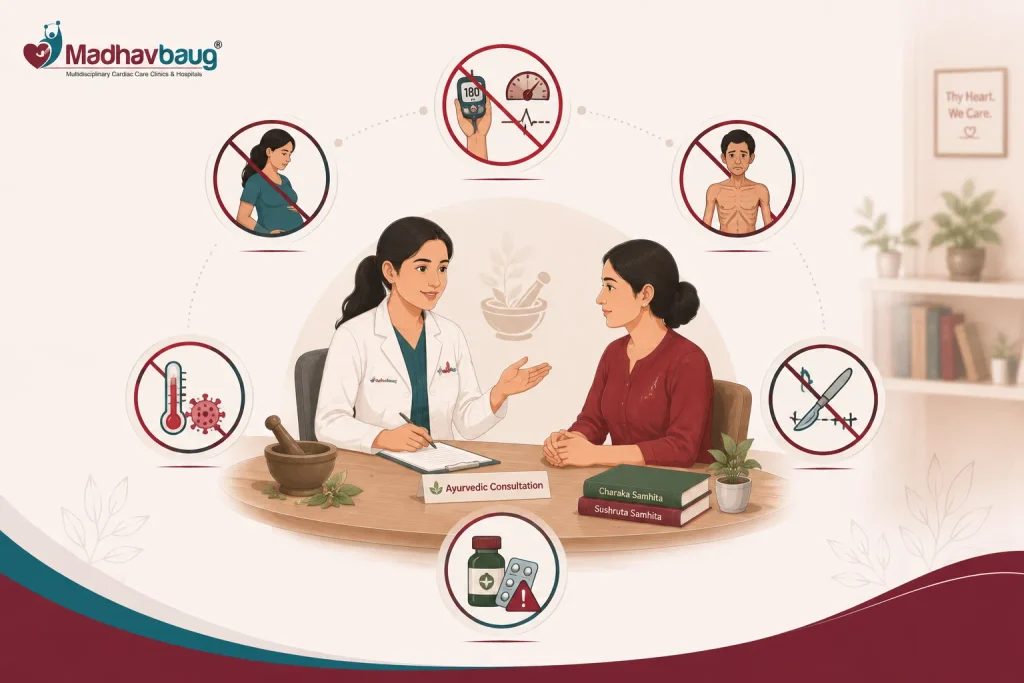
Active infection or fever
Panchakarma is generally deferred until an acute illness has resolved.
Recent major surgery
Most practitioners recommend waiting a defined recovery period before starting.
Certain medicine interactions
Some medicines, particularly blood thinners or complex multi-drug regimens, need careful coordination before purgation-based therapies are considered.
None of these are necessarily permanent exclusions. Some indicate a modified, gentler approach, or waiting until your condition is more stable, decided by your doctor.
What Does the Panchakarma Process Actually Involve?
A structured Panchakarma programme for a lifestyle and disease reversal generally follows a clear sequence that begins with an initial assessment and ends with a post-programme follow-up. Here’s what that sequence typically looks like:
| Medical assessment & test review ↓ Suitability & precaution screening ↓ Purvakarma (preparatory oil therapy & steam) ↓ Main Panchakarma procedure(s), selected for your condition ↓ Structured diet & recovery period ↓ Follow-up reassessment (e.g., day 30, 60, 90) |
The specific therapies used and how the programme is paced are decided based on your condition, your Prakriti, and how your body responds along the way, which is why two patients with the same diagnosis may follow a different version of this sequence.
Why Does Medical Supervision Matter?
Medical supervision matters throughout a Panchakarma programme because the therapies, like purgation, enemas, and related procedures, create genuine physiological effects that need to be monitored and adjusted by a qualified doctor. This is especially true when Panchakarma is a part of the management of a chronic disease.
A supervising doctor tracks your relevant readings, such as blood sugar, blood pressure, or cardiac function, throughout the programme and adjusts the dose or specific therapies used based on how you’re responding. This is also where your existing medicines are managed by your doctor. Any adjustment to the prescribed medicine dosage during a Panchakarma programme should always be made in coordination with your treating doctor.
How Madhavbaug Approaches Supervised Panchakarma
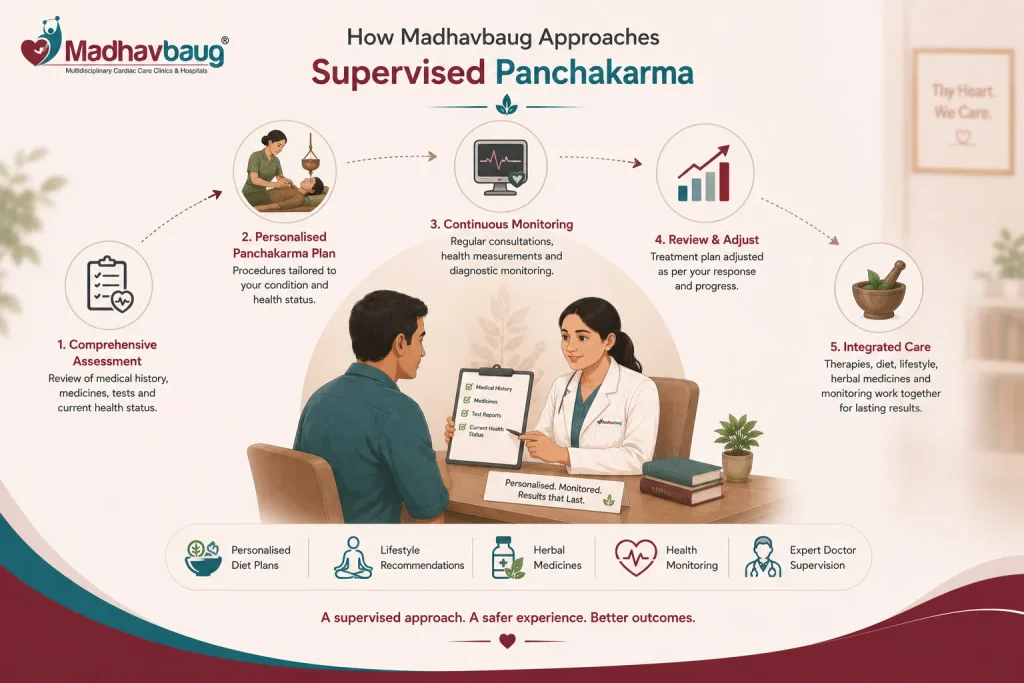
At Madhavbaug, Panchakarma is approached as part of a supervised treatment plan and not a standalone procedure. Before treatment begins, our doctors review your medical history, existing medicines, relevant test reports and current health status to determine whether Panchakarma is appropriate for you.
During the programme, your response is followed through regular consultations, relevant health measurements, diagnostic monitoring and continuous monitoring. For patients managing conditions such as diabetes, hypertension or heart disease, this allows the doctor to assess how treatment is progressing and make changes when needed instead of following the same approach throughout.
This also means that Panchakarma does not have to be treated separately from the rest of your healthcare. Your Ayurvedic therapies, diet plans, lifestyle recommendations, herbal medicines and health monitoring can be considered together as your treatment progresses.
If you are considering Panchakarma for a chronic condition, the next step is to understand whether it is appropriate for your health status and current treatment.
Book a Consultation
The only way to know whether Panchakarma is a suitable addition to your treatment plan is a proper clinical assessment, current stability, and test results.
Madhavbaug’s network of over 350 clinics and hospitals across India delivers Panchakarma-based programmes for diabetes, hypertension, and heart disease under the supervision of NCISM-registered Ayurvedic physicians, with modern diagnostics used to track your progress throughout. Visit your nearest clinic today to start your journey for Panchakarma for lifestyle diseases.
If you’re considering Panchakarma for a lifestyle disease, a consultation is the safest way to confirm whether you’re a suitable candidate and how the programme would be structured for your condition.
Frequently Asked Questions
Who should do Panchakarma?
Panchakarma is generally suitable for people with a reasonably stable version of a lifestyle disease, such as diabetes, hypertension, or stable ischaemic heart disease, who don’t have contraindications like pregnancy, acute illness, or severe frailty. Suitability is confirmed through a clinical assessment, not assumed from the diagnosis alone.
What are the benefits of Panchakarma for lifestyle disease?
Published outcome data from structured, supervised Panchakarma-based programmes has shown measurable improvements in markers like HbA1c in diabetes, exercise capacity and Duke Treadmill Score in ischaemic heart disease, and weight and HDL cholesterol in cardiac patients over a 90-day supervised course. These results reflect structured, monitored programmes.
Is Panchakarma safe for chronic disease patients?
It can be, when properly screened and supervised by a qualified doctor who coordinates with your existing treatment. It isn’t automatically safe for everyone with a chronic condition — uncontrolled disease, recent cardiac events, or certain medicine interactions may rule it out or require a modified approach.
Can Panchakarma replace my current medicines?
No. Panchakarma is generally used alongside your existing treatment, not as a replacement for it. Any change to prescribed medicine dosage should only ever be made in coordination with your treating physician, never independently during a Panchakarma programme.
How long does a Panchakarma programme for lifestyle disease usually take?
Programmes for lifestyle diseases are often structured around a 90-day timeline with regular reassessment points, such as day 30, 60, and 90, though the exact duration and session frequency depend on your specific condition and how you respond.
What conditions might rule someone out from Panchakarma?
Pregnancy, uncontrolled or unstable disease, active infection or fever, severe frailty, recent major surgery, and certain medicine interactions are among the factors that may rule out or require a modified approach to Panchakarma. A doctor screens for these before recommending any programme.
Does Panchakarma work for everyone with the same condition?
Not in the same way. Two people with the same diagnosis may follow different versions of a Panchakarma programme, since the specific therapies used and how the programme is paced depend on individual factors like Prakriti, current stability, and how the body responds along the way.
Related Reading
- Outcomes of an Ayurvedic Panchakamra Multimodel Protocol
- Panchakamra Session Intensity and Clinical Outcomes
- Impact of Panchakarma-Based Comprehensive Diabetes
- Ayurvedic Treatment for Weight Loss
- Best Diabetes Reversal Programme: What to Expect
- Obesity Treatment in Ayurveda
- Our Published Research
References
Kshirsagar, J., Lakariya, A. and Khan, S. (2024) ‘Impact of ayurvedic panchakarma along with lifestyle modification in restoring glucose tolerance in type 2 diabetics‘, International Journal of Basic & Clinical Pharmacology, 13(5), pp. 669–672.
More-Mhaisane, S., Khan, S. and Patil, S. (2025) ‘Efficacy of panchakarma based ischemia reversal therapy along with diet modification in management of ischemic heart disease‘, International Journal of Basic & Clinical Pharmacology, 14(1), pp. 69–74.
Muramkar, P.S., Kulthe, N. and Ghadigaonkar, P. (2024) ‘Effect of ayurveda-based panchakarma and lifestyle modification on global longitudinal strain in cardiac disorder patients‘, International Journal of Advances in Medicine, 11(6), pp. 566–570.
Sane, R., Gond, B., Raje, G., Walzade, K., Badre, A. and Mandole, R. (2018) ‘Ischemia Reversal Program (IRP) in patients suffering from ischemic heart disease (IHD) with known history of hypertension: a retrospective study‘, Journal of Ayurveda Medical Sciences, 3(2), pp. 377–383.



 Locate a Centre
