
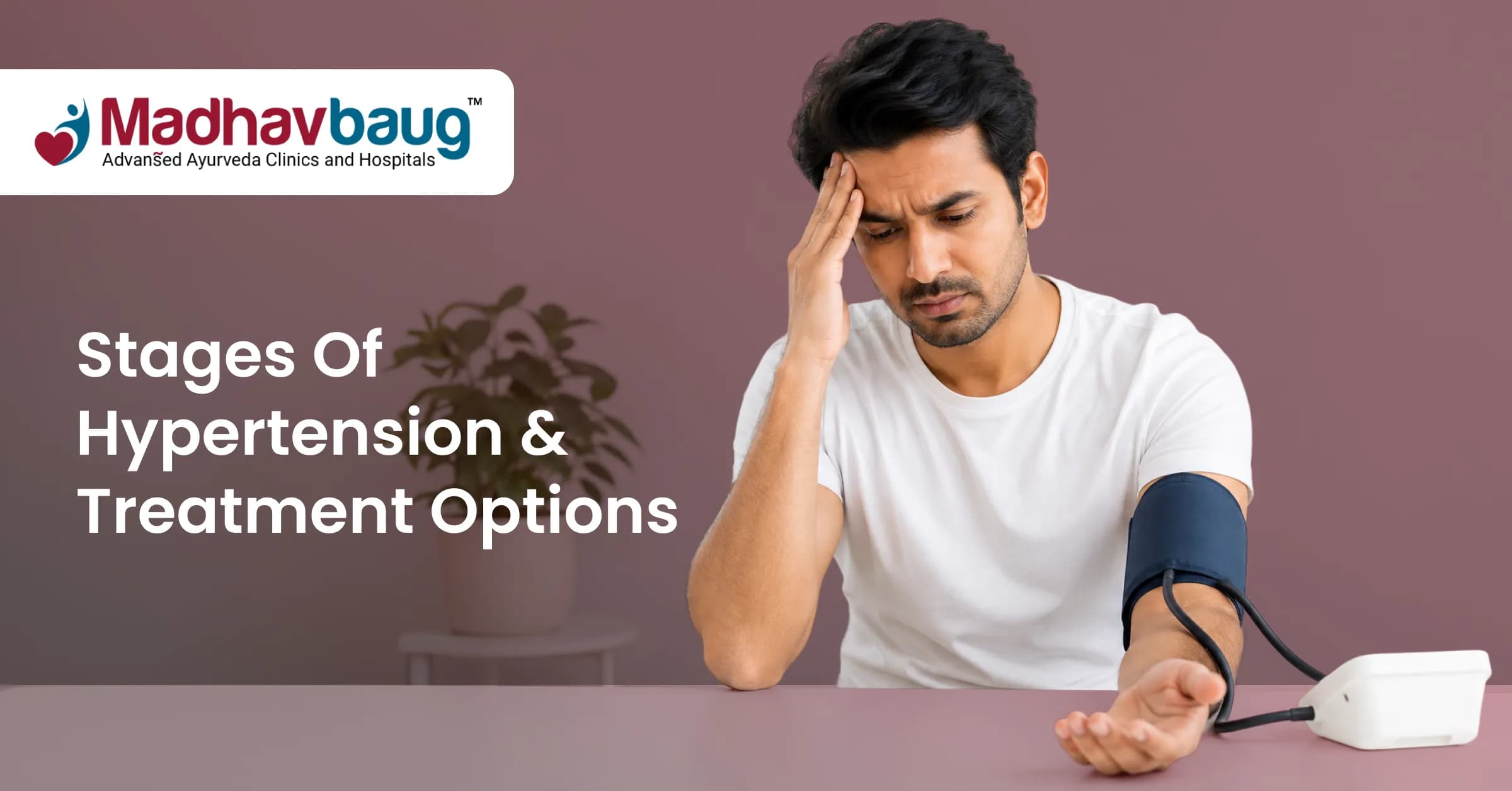
If your doctor has told you your blood pressure is high, the next question matters: how high, and what does that actually mean for your health?
Hypertension is not one fixed condition. It is a spectrum. Where you sit on that spectrum determines your risk level, what treatment makes sense, and how much room you have to act before serious damage occurs.
Here is everything you need to know, starting with the numbers.
Unsure which stage you are in? Book a consultation with Madhavbaug today for a complete evaluation and personalised treatment plan.
What Are the Stages of Hypertension?
Blood pressure is measured in two numbers. Systolic on top, the pressure when the heart beats. Diastolic below, the pressure when it rests. Both matter in hypertension classification.
Normal: below 120/80 Heart and blood vessels under healthy, sustainable pressure. Focus is maintaining it through lifestyle.
Elevated: systolic 120 to 129, diastolic below 80 Not yet hypertension but a clear warning. No medication needed yet, but lifestyle changes are essential now. Without action, this frequently becomes Stage 1.
Stage 1 Hypertension: 130 to 139 systolic or 80 to 89 diastolic First confirmed stage. Significantly increases risk of heart disease, stroke, and kidney damage over time. Lifestyle changes are the primary approach. Medication may be added depending on overall cardiovascular risk.
Stage 2 Hypertension: 140 or higher systolic or 90 or higher diastolic More serious. Typically requires both medication and structured lifestyle changes. Risk of organ damage, heart attack, and stroke is substantially elevated.
Stage 3 Hypertension: above 180/120 Medical emergency. May present with severe headache, chest pain, blurred vision, breathlessness, or confusion. Do not monitor and recheck at home. Go to hospital immediately.
What Are the Treatment Options for Hypertension?
Treatment depends on your stage, your overall health, and whether conditions like diabetes or heart disease are also present.
Lifestyle Changes
These are not optional extras. They are core medical interventions at every stage:
- Cut sodium, add potassium daily
- 30 to 45 minutes of exercise: walking, yoga
- Lose abdominal weight
- Pranayama and stress management daily
- 7 to 8 hours of consistent sleep
- Quit tobacco, limit alcohol significantly
Medications
At Stage 1 with high cardiovascular risk, and at Stage 2 and above, medication is typically required:
- ACE inhibitors or ARBs: relax blood vessels
- Beta blockers: slow heart rate, reduce pressure
- Calcium channel blockers: widen blood vessels
- Diuretics: reduce fluid and sodium load
Always prescribed and adjusted by a doctor based on individual response. Never stop or self-adjust.
Integrative and Ayurvedic Treatment
For patients looking beyond symptom management:
- Panchakarma: reduces vascular inflammation, restores arterial flexibility
- Ayurvedic herbs: Arjuna, Jatamansi, Ashwagandha with clinically studied cardioprotective properties
- Structured dietary protocols targeting metabolic drivers
- Supervised Pranayama for nervous system regulation and cortisol reduction
How Madhavbaug Can Help
At Madhavbaug, the stage you are in is the starting point, not the ceiling.
The team works with you to:
- Identify your exact stage through full cardiac and metabolic diagnostics
- Build a personalised plan: diet, Ayurvedic therapies, physiotherapy, Pranayama
- Optimise existing medications to reduce long-term dependency
- Monitor progress continuously through the MIB Pulse App
- Work toward genuine reversal, not just number management
Know your stage. Take it seriously. Get the right support to address it at the root.
Book your consultation at madhavbaug.org today.
Frequently Asked Questions
- What are the treatment options for hypertension?
Treatment includes lifestyle changes such as diet, exercise, and stress management at all stages, medication at Stage 1 with high risk and Stage 2 onwards, and integrative Ayurvedic approaches that address root causes rather than just controlling numbers. - Can stage 3 hypertension be cured?
Stage 3 or hypertensive crisis, is a medical emergency requiring immediate hospital care. With prompt treatment and sustained lifestyle and medical management, blood pressure can be brought under control, but it requires ongoing monitoring and a structured long-term plan. - Which vitamin decreases blood pressure?
Potassium, magnesium, Vitamin D, and Vitamin C all support healthy blood pressure. Potassium has the strongest and most direct effect, found abundantly in banana, amla, coconut water, dal, and leafy greens. - What is intracranial hypertension?
Intracranial hypertension is increased pressure inside the skull that compresses the brain and optic nerves. It is a separate condition from arterial hypertension and presents with symptoms like persistent headaches, vision changes, and nausea. It requires specialist neurological evaluation and treatment.


 Locate a Centre
