
If you or your loved one is suffering from high blood pressure (hypertension) and someone has told you to try ayurvedic medicine for high BP, the following question may reflect:
Is ayurvedic medicine for hypertension reliable?
Yes, Ayurveda can be used alongside your BP treatment, but only under a qualified doctor’s supervision, and never by stopping your prescribed tablets on your own.
However, every year, doctors see patients who feel “fine” after a few weeks of ayurvedic medicine for high BP, stop their BP medicine suddenly, and land up in the emergency room with a dangerous spike in pressure.
High BP does not always show symptoms. Feeling okay is not the same as being safe. So it is important to understand that you should never stop or reduce your blood pressure medicine without talking to your doctor first. Any change in dose has to be planned, gradual and watched closely, whether that plan comes from your cardiologist or your Ayurvedic doctor.
Now, let’s get into the real question this article is here to answer:
What does the evidence actually say about ayurvedic treatment for high blood pressure?
Explore the blog further to find the answer to this question.

Why Is Ayurvedic Medicine for High BP Personalised?
No two people with hypertension are the same, even if their reading on the monitor looks identical. One person’s BP may be high because of family history and ageing arteries. Another’s high BP may be due to stress, poor sleep and a desk job. A third person may have high BP linked with diabetes or kidney issues. The medicine, the diet, the exercise plan and everything else changes based on what is actually driving the numbers up.
This is exactly why a generic herb or a bottle of “BP tablets” bought off the internet is risky. It treats the number, not the person.
A proper assessment that checks your weight, sugar levels, kidney function, salt intake, stress levels, and how your BP behaves at different times of day has to come before any treatment plan, Ayurvedic or otherwise.
This is why ayurvedic medicine for hypertension needs to be structured around the person and not around a fixed formula for everyone.
At Madhavbaug, this begins with a detailed diagnostic workup, followed by a doctor-supervised plan that runs alongside your existing prescription rather than replacing it on day one. To know more, visit our nearest Madhavbaug clinic.
Central Content: Your BP treatment should consider more than just the numbers on the monitor. A personalised assessment of your BP pattern, lifestyle, blood sugar, weight and overall health can help your doctor plan care suited to your needs.
What does the evidence actually say about Ayurveda for BP?
Let’s be honest about this instead of overselling it, because that is what builds real trust.
A large 2025 systematic review found certain individual herbs and formulations like Punarnava (Boerhavia diffusa), Guggulu (Balsamodendron mukul), and the formulation Karsha vati lead to statistically meaningful improvements in BP readings in the trials. (Deshmukh et al., 2025).
A separate systematic review focused specifically on Shirodhara (the continuous oil-pouring therapy on the forehead) found it had a measurable effect on systolic and diastolic BP when combined with Ayurvedic medicine, along with improvement in related symptoms like palpitations, disturbed sleep, giddiness, fatigue and headache (PMC, 2025).
What this tells us honestly is this, that Ayurveda medicines for hypertension are not a magic fix that will replace your tablets overnight, and no credible clinic should claim that. But specific therapies and herbs, used correctly and as part of a supervised, structured programme, do show a real, measurable effect on BP and on the symptoms that come with it. (Deshmukh et al., 2025).
How Madhavbaug Approaches High BP Treatment
At Madhavbaug, high BP is not treated as just a number to bring down. The approach looks at what is actually causing the arteries to stay under pressure. It may be fat deposits, reduced vascular elasticity, stress load, excess sodium and water retention, and poor metabolic health. Ayurvedic treatment for high blood pressure works on these root drivers alongside your existing medication.
Here is what a typical Madhavbaug hypertension programme actually includes:
| Treatment Component | What It Involves | Purpose |
| Diagnostic Assessment First | Detailed blood pressure evaluation, including Ambulatory Blood Pressure Monitoring (ABPM) when required | Understand the patient’s 24-hour BP pattern before starting treatment, as a single clinic reading may not reflect true blood pressure control. |
| Panchakarma-BasedTherapies | Structured Ayurvedic detoxification therapies, usually scheduled once a week (often on weekends) | Help reduce vascular inflammation, improve arterial flexibility, and support the body’s natural removal of excess fluid and sodium. |
| Dinacharya (Daily Routine) Correction | A personalised daily routine designed to support healthy body functions | Builds a strong foundation for long-term blood pressure management and enhances the benefits of other therapies |
| Personalised Ayurvedic Medicines | Individualised Ayurvedic formulations prescribed under medical supervision | Address each patient’s specific health condition rather than using a one-size-fits-all approach. |
| Diet Correction | Structured, easy-to-follow diet plan or diet kit | Support healthy weight, blood pressure control, and overall heart health through balanced nutrition. |
| Daily Exercise Routine | Approximately 25 minutes of guided exercise each day, often supported through a mobile app | Improve cardiovascular fitness, circulation, and overall metabolic health. |
| Regular Blood Pressure Monitoring | BP checks during clinic visits along with home blood pressure monitoring | Track treatment response using actual BP readings and make timely adjustments when needed. |
| Gradual Medicine Tapering (If Appropriate) | Conventional BP medicines may be reduced gradually only after sustained improvement and under close medical supervision. | Ensure blood pressure remains stable while reducing medication safely. Patients should never stop or change medicines on their own. |
To explore further about our treatment in detail, read here.
Blood Pressure | Panchakarma | Madhavbaug Health Guru
This is what separates a supervised programme from a random herbal remedy picked up on advice from a neighbour or a social media post.
The monitoring, the gradual pace, and the fact that your doctor is aware of what you are taking. To enrol for a personalised programme, visit your nearest Madhavbaug clinic.
Ayurvedic Herbs and Your Ongoing BP Medicines
Many high-BP-medicated herbs interact with prescription medicines. A lot of people wonder whether Ayurvedic herbs and their regular BP tablets can be taken together at all. Some assume the two should never mix. Others assume that because something is natural, it is automatically safe to add on their own. Both ideas are a bit off the mark.
At Madhavbaug, several herbs, including the ones used in our Muktika Vati formulation, are given to patients alongside their existing BP medicines, but always as part of a plan designed and watched over by our doctors. What actually makes this safe is not that the herb and the medicine do not affect each other. It is that our doctors know exactly how they interact, and they adjust the plan accordingly. Here is what ayurvedic herbs for hypertension looks like in simple terms.
- Herbs that help lower BP on their own.
Sarpagandha (Rauwolfia serpentina) is the plant that reserpine, a well-known BP-lowering compound, originally comes from. It is one of the ingredients in Muktika Vati, and it is given to patients who are already on their regular BP tablets.
Because Sarpagandha has its own effect on blood pressure, our doctors keep a close eye on the patient’s BP and adjust the dosage of both the herb and the tablets as needed. This is simply how the treatment is designed to work, and it is nothing patients need to worry about when it is being guided by a doctor. What actually carries risk is someone deciding to start a BP-lowering herb on their own, without anyone monitoring them. That is where real caution is needed, not in the combination itself.
- Herbs with sedative or calming effects.
Jatamansi, Brahmi and Ashwagandha, also part of the Muktika Vati formulation, have a gentle calming effect that helps with the stress that often adds to high BP. If a patient is also taking sleep medicine or anti-anxiety tablets, our doctors plan the timing and dosage of everything together so the person feels calmer without feeling overly drowsy.
- Herbs that affect potassium and fluid balance.
This point is not about our formulations, but it is worth knowing. Certain laxative herbs like aloe, liquorice, senna and cascara are not part of Madhavbaug’s heart care formulations, but they can affect potassium levels in the body. This matters for anyone already on BP or heart medicines, since those can also affect potassium. This is exactly the kind of thing a patient should never add on their own without telling their doctor first.
- Herbs affecting blood sugar, if you also have diabetes.
Gymnema is used at Madhavbaug for patients who are managing both high BP and diabetes together. It is given alongside their prescribed diabetes medicine, with regular monitoring to make sure blood sugar does not drop too low. Used this way, under supervision, it becomes a helpful part of the treatment rather than something to be cautious about.
High BP medicine interactions aren’t always unsafe. Ayurveda and regular allopathic treatment are not working against each other here. At Madhavbaug, they are used together on purpose. In patients who took Muktika Vati alongside their regular BP medicine under our doctors’ care, we saw real improvement, with average systolic BP coming down from around 169 to 134 and diastolic BP coming down from around 102 to 82. This kind of result happens because the plan is designed and monitored by a doctor, not because a patient decided to try something on their own.
So if there is one thing to remember from all of this, it is simple. Never add any new herb, even one a relative swears by or something you read about online, to your existing BP medicines without your doctor knowing the complete picture. That is the one habit that truly needs care.
To get such supervised and personalised ayurvedic medicine for hypertension, book a consultation at Madhavbaug and start your journey today.
Diet, Activity, Sleep and Weight
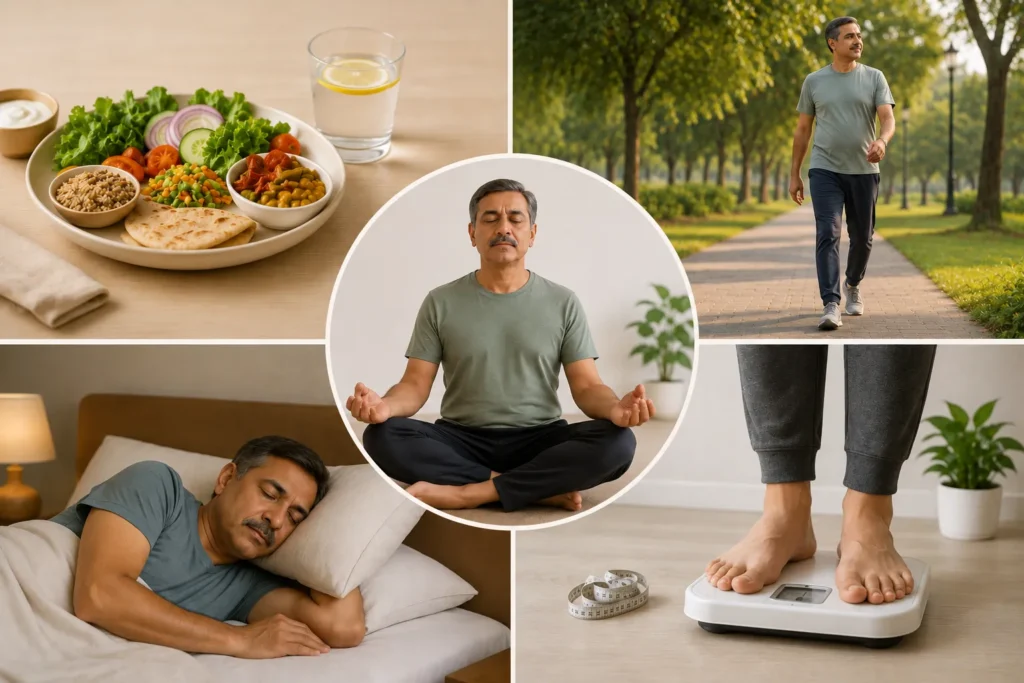
The ayurvedic approach to hypertension is not restricted to only herbal supplements. It includes diet, activity, sleep, weight and many other factors, making ayurveda a holistic approach addressing the root cause. Following are some tips which need to be considered:
Salt intake
Cutting down visible and hidden salt (pickles, papad, packaged snacks, restaurant food) is one of the most effective, low-cost changes you can make.
Even 25–30 minutes of daily walking or light activity has a measurable effect on BP over weeks, not just on the day you exercise.
Sleep quality
Poor or disturbed sleep keeps your stress hormones elevated, which keeps BP elevated. This is one reason calming therapies and a fixed daily routine (Dinacharya) are built into a structured programme rather than treated as optional.
Even a modest, sustained weight loss of 4–5 kg can meaningfully lower BP readings in people who are overweight, as seen consistently in clinical follow-ups. (Neter, J.E., et al 2003)
None of these levers work overnight, and none of them replace medicine on their own. But combined with supervised treatment, they are what create lasting change instead of a temporary dip in numbers, making the Madhavbaug’s ayurvedic treatment for hypertension transform health by creating a healthy lifestyle and not just treating the symptoms.
Who Needs Urgent Medical Care
Some situations are not “monitor it at home and see” situations.
Get to a hospital or call for emergency help immediately if you or someone with high BP has:
- A BP reading above 180/120 mmHg, especially with symptoms
- Severe headache with blurred vision or confusion
- Chest pain, breathlessness or a pounding heartbeat that feels different from usual
- Weakness or numbness on one side of the body, slurred speech, or sudden difficulty seeing. (These could be signs of a stroke.)
- Fainting or near-fainting episodes
This is an emergency, and it needs a hospital, not a home remedy. Visit your nearest Madhavbaug clinic immediately if you or your loved one are suffering from any of these symptoms.
The Bottom Line
Ayurveda has a real evidence base for supporting BP control. Many herbs and therapies show statistically significant results in trials. (Deshmukh et al., 2025).
However, if used carelessly, alongside your existing tablets without medical guidance, it carries real interaction risks, but if used correctly as part of a supervised, monitored, root-cause-focused programme that works with your doctor, it can be a meaningful part of managing your BP long-term.
If you’re currently on BP medicine and considering an Ayurvedic approach alongside it, the safest next step is a proper consultation, not a trial-and-error attempt at home.
Madhavbaug’s doctors will review your current medicines, your BP pattern, and your overall health before recommending anything, and any change to your existing prescription will always be planned gradually and safely.
Book a consultation with a Madhavbaug doctor near you.
Central Content: If you’re considering Ayurveda alongside your current BP medicines, don’t make changes on your own. A doctor-supervised assessment can help you understand how an Ayurvedic approach may fit safely into your existing care plan.
Frequently Asked Questions
1. Is Ayurvedic medicine for high BP safe to take with my prescription tablets?
It can be, but only under medical supervision. Some Ayurvedic herbs add to the effect of BP tablets and can drop your pressure too low if not dosed correctly. Never combine them on your own. Get your Ayurvedic doctor and your regular doctor to know your full medicine list.
2. Can I stop my BP medicine once I start Ayurvedic treatment?
No. Never stop or reduce your BP medicine on your own. If your BP improves consistently and your doctor confirms it with readings over time, medicine tapering can be considered, but only gradually, and only under supervision.
3. What is the best ayurvedic treatment for high blood pressure?
There isn’t one single “best” treatment. It depends on your individual case. Structured programmes combining Panchakarma therapy, personalised herbal formulations, diet correction and monitoring have shown better, more consistent results than any single herb taken alone.
4. Do Ayurvedic BP medicines have side effects?
Yes, they can, especially when taken without medical guidance or combined incorrectly with prescription drugs. Reported concerns include excess drops in BP, increased drowsiness with sedative medicines, and effects on potassium or blood sugar levels. This is why supervised, doctor-guided use matters.
5. Is it normal for BP to fluctuate during Ayurvedic treatment?
Some fluctuation is expected as your body responds to therapy and lifestyle changes. This is exactly why regular home monitoring and scheduled doctor reviews are built into a proper treatment programme so any unusual pattern is caught early.
References
- Deshmukh, S., Choudhary, K., Ahmad, A., Reddy, G., Rao, B.C.S., Srikanth, N. and Acharya, R. (2025) ‘Effectiveness and safety of Ayurvedic intervention in essential hypertension: a systematic review with meta-analysis’, Frontiers in Pharmacology.
- Hypertension Journal (2026) Guidelines on Home Blood Pressure Monitoring in India.
- Journal of Hypertension (2021) ‘Home blood pressure monitoring: methodology, clinical relevance and practical application’, Journal of Hypertension.
- PMC (2025) ‘The effect of Shirodhara on essential hypertension: systematic review and meta-analysis’, PubMed Central.
- Neter, J.E., Stam, B.E., Kok, F.J., Grobbee, D.E. and Geleijnse, J.M. (2003) ‘Influence of weight reduction on blood pressure: a meta-analysis of randomized controlled trials’, Hypertension, 42(5), pp. 878–884.


 Locate a Centre
