


Key Takeaways
|
The ayurvedic treatment timeline is the important factor to understand before starting any ayurvedic treatment for a chronic condition. This guide explains why timelines vary, what a typical 90-day programme looks like at days 30, 60, and 90, which markers doctors track along the way, and how your plan may be adjusted based on your results.
Why Do Ayurvedic Treatment Timelines Vary?
Ayurvedic treatment timelines vary because they depend on your specific condition, how long you’ve had it, your current test results, and how consistently you follow the plan. Two patients with the same diagnosis can be on genuinely different timelines.
Someone newly diagnosed with mild hypertension may see meaningful change faster than someone managing long-standing, poorly controlled diabetes. Your Prakriti (body constitution) and current Vikriti (state of imbalance) also factor in, since they shape how your body tends to respond to treatment.
This is exactly why a doctor won’t promise a fixed number of days upfront. They’ll set a monitoring schedule and adjust the timeline based on what your results show along the way.
“Patients often ask us for one number. ‘How many days until I’m better?’ We explain that we can tell them what we’ll be checking and when, but the actual pace depends on how their body responds. That’s why we work in checkpoints, not a single countdown.”
— Dr. Gurudatta Amin, CMO, Madhavbaugaug
If you want a realistic, personalised timeline for your own condition, a consultation is the clearest way to get one.
What Does a Typical 90-Day Ayurvedic Programme Look Like?
Many structured Ayurvedic programmes for chronic conditions like diabetes, hypertension, and heart disease are built around a 90-day cycle, with reassessment at roughly day 30, 60, and 90. This structure is what allows a doctor to track real change over time.
Here’s the general shape of that timeline:
| Day 1: Baseline assessment & tests ↓ Day 30: Early reassessment ↓ Day 60: Mid-programme reassessment ↓ Day 90: Full reassessment ↓ Ongoing monitoring based on your results |
The specific markers tracked at each stage depend on your condition, but the rhythm of checking in at these three points is common across most structured programmes.
Days 1–30 of Ayurvedic Treatment Duration
In the first 30 days, most patients notice early changes in routine, digestion, energy, and how symptoms feel day to day, though blood test results typically take longer to shift meaningfully. This early stage is more about settling into the plan than seeing large changes in test numbers.
This is also when your doctor confirms if your body is reacting well to the treatment and adjusts the plan if needed, before the more intensive stretch of the programme. If you’re on a Panchakarma-based programme, this period often includes preparatory therapies and initial dietary changes.
Days 30–60 of Ayurvedic Treatment
By day 60, many patients start to see measurable change in their tracked health markers. This is typically the first point where a doctor can meaningfully compare your numbers to your original baseline.
For hypertension and heart-related markers specifically, published research on a Panchakarma-based programme found meaningful improvement after a minimum of 7 sessions in patients with a history of hypertension. (Sane et al., 2018).
This is also a common point for a doctor to adjust the plan, intensify, ease off, or shift specific therapies, based on how your body has responded so far.
| Clinical Insight “Day 60 is often when patients start believing the numbers, not just how they feel. Seeing an actual HbA1c or blood pressure reading move is usually what shifts someone from cautiously optimistic to genuinely confident in the plan.” Dr. Pravin Jayram Ghadigaonkar, BAMS, MD, PhD (Scholar) – Preventive Cardiology 20+ Years of Clinical Experience, Head Medical Operations & Patient Improvement, Madhavbaug |
Day 90: What a Full Reassessment Looks Like
By day 90, most structured Ayurvedic treatment programmes reach a full reassessment, comparing your current test results against your day 1 baseline across every marker relevant to your condition. This is the point where the overall impact of the programme becomes clearest.
Madhavbaug’s own published research illustrates what this can look like in practice. In one study, patients with a baseline HbA1c of 6.6–9.0% saw levels fall to an average of 6.12% by day 90 (Kshirsagar, Lakariya and Khan, 2024).
In another, cardiac patients saw average weight fall from 68.31 kg to 63.82 kg, waist circumference from 93.56 cm to 88.22 cm, and HDL cholesterol improve from 27.66 to 31.94 mmol/l over the same 90-day window (Muramkar, Kulthe and Ghadigaonkar, 2024).
A separate study found VO2max improved from 16.34 to 28.11 mL/kg/min, and Duke Treadmill Score from –6.77 to 3.77, in ischemic heart disease patients over 90 days (More-Mhaisane, Khan and Patil, 2025).
These are real, tracked outcomes from a structured, supervised programme.
Which Health Markers Are Tracked Along the Way?
Different markers are tracked depending on your condition, but most fall into a few consistent categories: blood sugar and HbA1c for diabetes, blood pressure for hypertension, lipid profile and cardiac markers for heart disease, and weight or waist circumference across most metabolic conditions.
| Timeframe | What Is Typically Tracked |
| Day 1 – Baseline | Blood sugar & HbA1c, blood pressure, lipid profile, relevant cardiac markers, weight and waist circumference, depending on the condition. |
| Day 30 – Early Review | Symptoms, lifestyle and routine changes, treatment tolerance, weight and blood pressure trends. |
| Day 60 – Progress Check | Changes in key health markers such as blood sugar, blood pressure, weight or lipid levels, as relevant to the condition. |
| Day 90 – Reassessment | Repeat relevant tests and compare results with the baseline to assess overall progress and determine whether the care plan needs adjustment. |
How Might Your Plan Be Adjusted Along the Way?
Your treatment plan does not have to remain the same throughout the programme. At each follow-up, your doctor can review your symptoms, lifestyle changes, test results and response to treatment and decide whether any part of the plan needs to be modified.
If your blood sugar, blood pressure, weight or other relevant markers are moving in the desired direction, the existing approach may be continued. If progress is slower than expected, your doctor may reassess your diet, daily routine, Ayurvedic therapies or other components of the plan. The timing and extent of these changes depend on your individual health status.
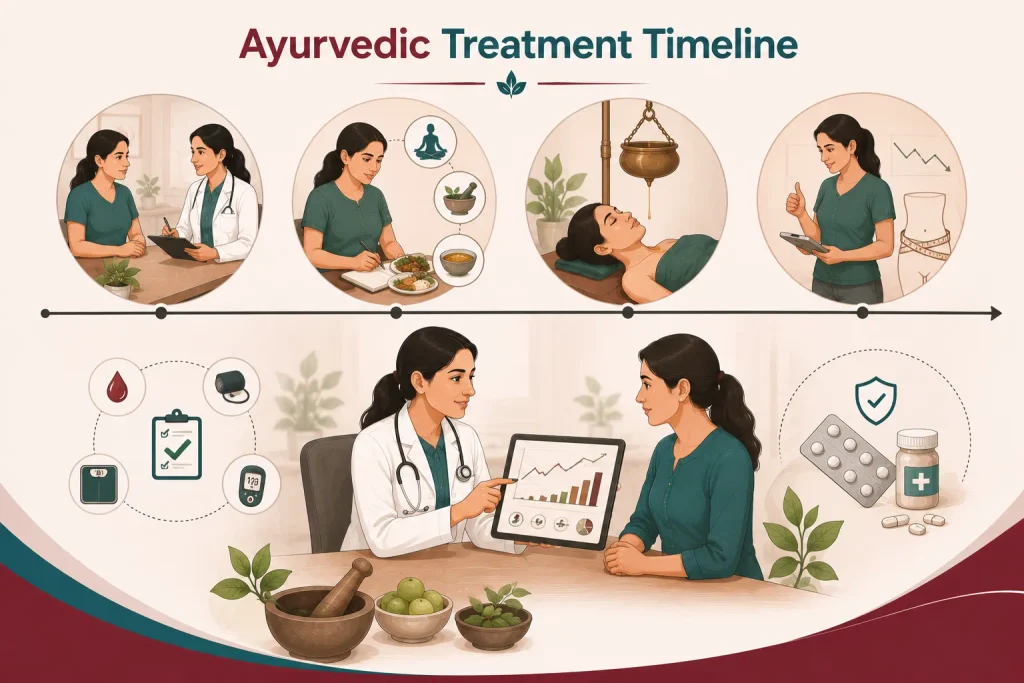
Your existing medicines are also an important part of this process. Do not stop, reduce or change the dose of any prescribed medicine on your own. If your health markers improve and a change in medication is being considered, it should be discussed with and supervised by the doctor managing your medication.
A 90-day programme should therefore not be viewed as a fixed treatment that is followed without review. It is better understood as a structured period of assessment, treatment and monitoring, where the plan can be reviewed according to how your health markers and symptoms change.
What Should You Do Before Your Consultation?
A little preparation can make your first consultation more useful. If you already have recent blood reports, HbA1c results, lipid profiles, blood pressure readings, ECG or other relevant medical reports, keep them available for the doctor to review. Also make a note of the medicines and supplements you currently take, including their doses if possible.
It can also help to keep track of your recent weight, waist circumference, blood sugar or blood pressure readings, particularly if these have been measured regularly at home.
Book a Consultation
There is no single timeline that applies to everyone with diabetes, hypertension, obesity, high cholesterol or other metabolic concerns. The pace of improvement depends on your current health status, baseline test results, existing medicines, lifestyle and response to treatment. A 30-, 60- or 90-day timeline can provide a framework for monitoring, but your actual progress needs to be assessed through appropriate clinical measurements.
Madhavbaug has 350+ clinics and hospitals across India, where Ayurvedic physicians can review your health history, existing reports and current treatment before developing a personalised care approach, especially for diabetes, hypertension, heart disease and obesity. Relevant health markers can then be monitored during follow-ups to understand how you are responding and whether the plan needs adjustment.
If you are managing a chronic metabolic condition and want to understand what your own treatment and monitoring timeline could look like, book a consultation at your nearest Madhavbaug clinic for an assessment based on your current health status.
If you want to know what a realistic 90-day timeline looks like for your own condition, a consultation is the place to start.
Frequently Asked Questions
How long does Ayurvedic treatment take to work?
This varies by condition and how consistently you follow the plan, but many structured programmes for chronic conditions are built around a 90-day cycle, with checkpoints at roughly day 30, 60, and 90. Early changes in routine and symptoms are often noticed sooner, while measurable test results typically take longer to shift.
What is a typical Ayurvedic treatment duration?
Many structured programmes for conditions like diabetes and hypertension run over 90 days, with reassessment at set points along the way. Some conditions may need a shorter or longer duration, depending on severity and how your body responds, so your doctor will confirm a timeline specific to you.
What results can I expect from Ayurvedic treatment over time?
Results depend on your condition and how closely you follow the plan, but published research on structured, 90-day programmes has shown measurable improvement in markers like HbA1c, blood pressure, weight, waist circumference, and cholesterol. Your doctor will track your specific markers against your own baseline.
What happens at each stage of a 90-day Ayurvedic programme?
Day 1 typically involves a full baseline assessment and tests. By day 30, most patients notice early changes in routine and symptoms. By day 60, measurable shifts in key test results often start to appear. Day 90 usually involves a full reassessment comparing your results against your original baseline.
Will my Ayurvedic treatment plan change over the 90 days?
It might. Your plan is typically reviewed at each checkpoint and may be adjusted, intensified, eased off, or changed, based on how your test results and symptoms are actually progressing, not followed unchanged regardless of outcome.
Do I need to stop my current medicines during a 90-day Ayurvedic programme?
No. You should continue your prescribed medicines and share full details of them with your Ayurvedic doctor. Any change to dosage should only be made in coordination with your treating physician, never independently.
Related Reading
- Ayurvedic Treatment for Weight Loss: Programme Guide
- Prediabetes and Ayurveda: A 90-Day Lifestyle Action Plan
- Ayurvedic Medicine for High BP: Safety and Evidence
- Weight Regain After Dieting: An Ayurvedic Habit Stratergy
References
Kshirsagar, J., Lakariya, A. and Khan, S. (2024) ‘Impact of ayurvedic panchakarma along with lifestyle modification in restoring glucose tolerance in type 2 diabetics‘, International Journal of Basic & Clinical Pharmacology, 13(5), pp. 669–672.
Sane, R., Gond, B., Raje, G., Walzade, K., Badre, A. and Mandole, R. (2018) ‘Ischemia Reversal Program (IRP) in patients suffering from ischemic heart disease (IHD) with known history of hypertension: a retrospective study‘, Journal of Ayurveda Medical Sciences, 3(2), pp. 377–383.
Muramkar, P.S., Kulthe, N. and Ghadigaonkar, P. (2024) ‘Effect of ayurveda-based panchakarma and lifestyle modification on global longitudinal strain in cardiac disorder patients‘, International Journal of Advances in Medicine, 11(6), pp. 566–570.




 Locate a Centre
