
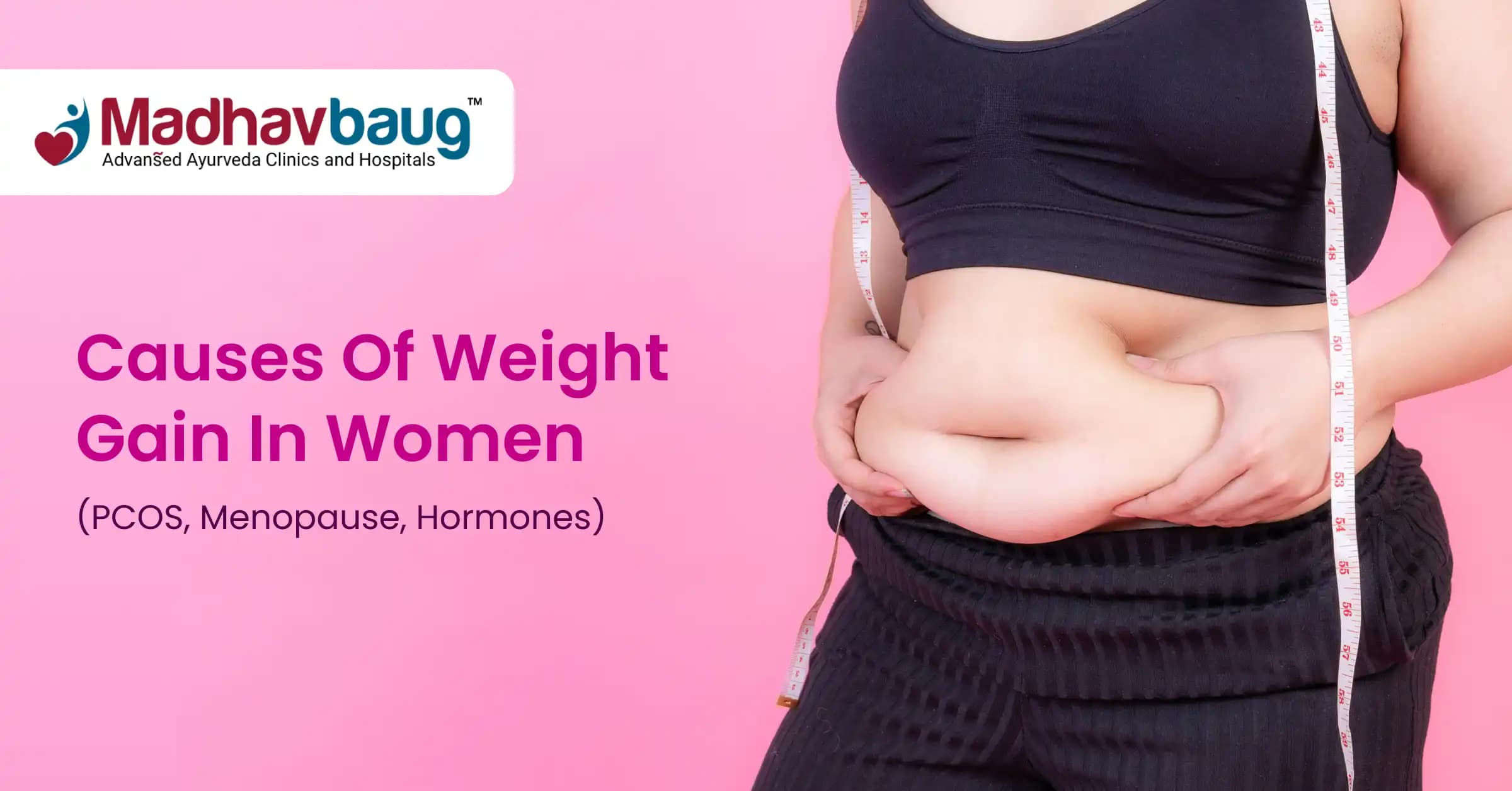
Your diet has not changed. Your routine has not changed. But your clothes feel tighter, the scale keeps going up, and nothing seems to work. For millions of women in India, this is not an imagination problem or a willpower problem. It is a hormone problem.
The causes of weight gain in women are rarely as simple as eating too much. More often, there is something happening internally, a shift in hormones that changes how the body stores fat, processes food, and burns energy. PCOS, menopause, insulin resistance, cortisol, thyroid function: these are the real drivers that most generic diet advice completely ignores.
This is what is actually going on inside your body, and what you can do about it.
Struggling with sudden weight gain and not sure why? Madhavbaug’s specialists take a root-cause approach to women’s metabolic health. Book your consultation today.
What Is PCOS and Why Does It Cause Weight Gain?
PCOS, or Polycystic Ovary Syndrome, is one of the most common hormonal conditions among Indian women of reproductive age. It affects the ovaries, disrupts the menstrual cycle, and throws multiple hormones out of balance at once.
What most women do not realise is that PCOS is also a metabolic condition, not just a reproductive one. At its core, PCOS is an insulin related problem. The body’s cells stop responding to insulin properly, so the pancreas produces more. Chronically high insulin does two things that make weight management genuinely difficult: it tells the body to store fat, and it blocks the body from burning the fat it already has. The fat that does accumulate tends to go straight to the abdomen, specifically around the organs, which is called visceral fat and is the more metabolically dangerous kind.
Elevated androgens are usually part of the picture too. These hormones compound the problem by further disrupting metabolism and adding to abdominal fat accumulation.
This is why PCOS-related weight gain feels so different from regular weight gain:
- The belly is disproportionately affected compared to the rest of the body
- Cutting calories produces little to no lasting result
- Cravings are blood sugar driven, not just habit
- Fatigue and bloating make consistent activity harder to maintain
- Weight comes back quickly after any loss
Warning signs that PCOS might be behind your weight gain:
- Stubborn belly fat that does not respond to diet
- Strong sugar and carb cravings
- Irregular periods that seem connected to weight shifts
- Difficulty losing weight even when eating very little
The other difficult part is that obesity makes PCOS worse, and PCOS makes obesity worse. It is a cycle that keeps feeding itself. Which is exactly why treating just the weight, without addressing the insulin resistance underneath it, tends to go nowhere.
What Is Menopause and How Does It Affect a Woman’s Weight?
Menopause is the stage in a woman’s life when her menstrual cycle ends, typically in the late forties or early fifties. But the hormonal changes leading up to it, a phase called perimenopause, can begin years earlier and bring significant physical changes with them.
The most relevant hormone here is oestrogen. As oestrogen levels decline, the body’s fat distribution changes. Fat that previously settled around the hips and thighs begins to migrate toward the abdomen. This is why many women notice a shift in body shape through their forties, even when their eating and exercise habits have not changed at all.
Other factors that compound weight gain during this phase:
- Slower metabolism with age
- Loss of muscle mass
- Poor sleep increases cortisol and appetite
- Mood changes triggering emotional eating
Sudden weight gain in women during the late forties is often written off as normal ageing. It is not something to just accept. It is a hormonal shift, and the right support can make a real difference.
How Do Hormones Cause Weight Gain With PCOS?
With PCOS, the primary hormonal driver of weight gain is insulin. As insulin resistance develops, the body compensates by flooding the bloodstream with more insulin. Chronically high insulin promotes fat storage, even visceral fat around the organs, and it blocks the body from using stored fat as fuel.
On top of this, PCOS is often accompanied by elevated androgens, which further disrupt metabolism and contribute to abdominal fat accumulation. Cortisol, the stress hormone, also tends to run higher in women with PCOS, adding another layer of hormonal weight gain around the belly.
Left unaddressed, this pattern carries real health consequences. The signs and symptoms of obesity that develop over time include:
- Persistent fatigue
- Breathlessness with light activity
- Joint pain in knees and lower back
- Waist above 80 cm (Indian threshold for women)
The effects of obesity extend beyond the waist, leading to serious health problems such as increased cardiac risk, worsening insulin resistance, disrupted ovulation, and a higher likelihood of type 2 diabetes.
This is why hormonal weight gain with PCOS feels different from regular weight gain:
- Belly is disproportionately affected
- Calorie restriction rarely produces lasting results
- Cravings driven by blood sugar instability
- Fatigue and bloating make staying active harder
Treating PCOS-related weight gain means addressing insulin resistance first, not just reducing food intake.
How Do Hormones Cause Weight Gain During Menopause?
With menopause, the dominant hormonal shift is the decline in oestrogen. But oestrogen does not just regulate reproduction. It also plays a significant role in how the body uses and stores energy.
When oestrogen declines, fat metabolism slows and fat storage, particularly around the abdomen, becomes more pronounced. This is a well-documented reason why abdominal weight gain becomes so common and so stubborn in women after forty.
At the same time:
- Progesterone falls, causing water retention and bloating
- Thyroid function may slow, reducing metabolism
- Poor sleep raises ghrelin, increasing appetite
- Lower oestrogen may affect mood and food choices day to day
The combined effect is that the body genuinely behaves differently. The symptoms of obesity that can emerge during this phase, including low energy, joint discomfort, and increasing abdominal girth, are often mistaken for general ageing rather than being recognised as a hormonal and metabolic shift that can be addressed.
The same diet and activity level that maintained weight in the thirties may no longer be enough in the late forties or fifties. This is not a failure of effort. It is physiology.
How Can Madhavbaug Help?
At Madhavbaug, weight gain in women is never dismissed as a lifestyle problem or a side effect of aging. It is treated as a metabolic and cardiac health concern that requires proper investigation and a personalised plan.
The Madhavbaug team works with you to:
- Find the root cause: PCOS, menopause, thyroid, insulin resistance, or a mix
- Run full hormonal, metabolic, and cardiac diagnostics
- Build a personalised plan: Ayurvedic therapies, dietary correction, physiotherapy
- Target visceral fat, not just overall body weight
- Rebalance hormones alongside managing weight
This is not a generic diet programme. It is a medically guided approach built around your specific hormonal profile, your age, your symptoms, and your health history.
Your weight gain has a reason. Madhavbaug can help you find it and address it properly. Visit madhavbaug.org to book your consultation today.
Frequently Asked Questions
- Why do women gain weight during menopause?Mainly because oestrogen levels drop, which slows metabolism and shifts fat storage toward the abdomen.
- Can PCOS cause weight gain even with a healthy diet?Yes. Insulin resistance and hormonal imbalances make it harder to manage weight even when eating well.
- How do hormonal imbalances affect weight in women?Imbalances in insulin, thyroid hormones, oestrogen, and cortisol disrupt metabolism, increase fat storage, and trigger cravings.
- Why is abdominal weight gain more common in women as they age?Reduced oestrogen shifts fat storage from the hips and thighs toward the abdominal area.
- What are the common causes of unexplained weight gain in women?PCOS, menopause, thyroid disorders, chronic stress, poor sleep, and certain medications are among the most common causes.
References
- International Institute for Population Sciences (IIPS) and ICF (2021) National Family Health Survey (NFHS-5), 2019-21: India Fact Sheet.
Available at: https://upnrhm.gov.in/NHM-Doc/NFHS/NFHS/NFHS-5%28FY%202019-21%29Report.pdf - Bray, G.A., Fruhbeck, G., Ryan, D.H. and Wilding, J.P.H. (2016) Management of obesity. The Lancet, 387(10031), pp. 1947-1956. Available at: https://www.sciencedirect.com/science/article/abs/pii/S1521693414002429
- Matsuzawa, Y., Shimomura, I., Nakamura, T., Keno, Y., Kotani, K. and Tokunaga, K. (1995). Pathophysiology and pathogenesis of visceral fat obesity. Obesity Research, 3(S2), pp.187S-194S. https://doi.org/10.1002/j.1550-8528.1995.tb00462.x

 Locate a Centre
