

 Add to Preferred Sources
Key Takeaways
|
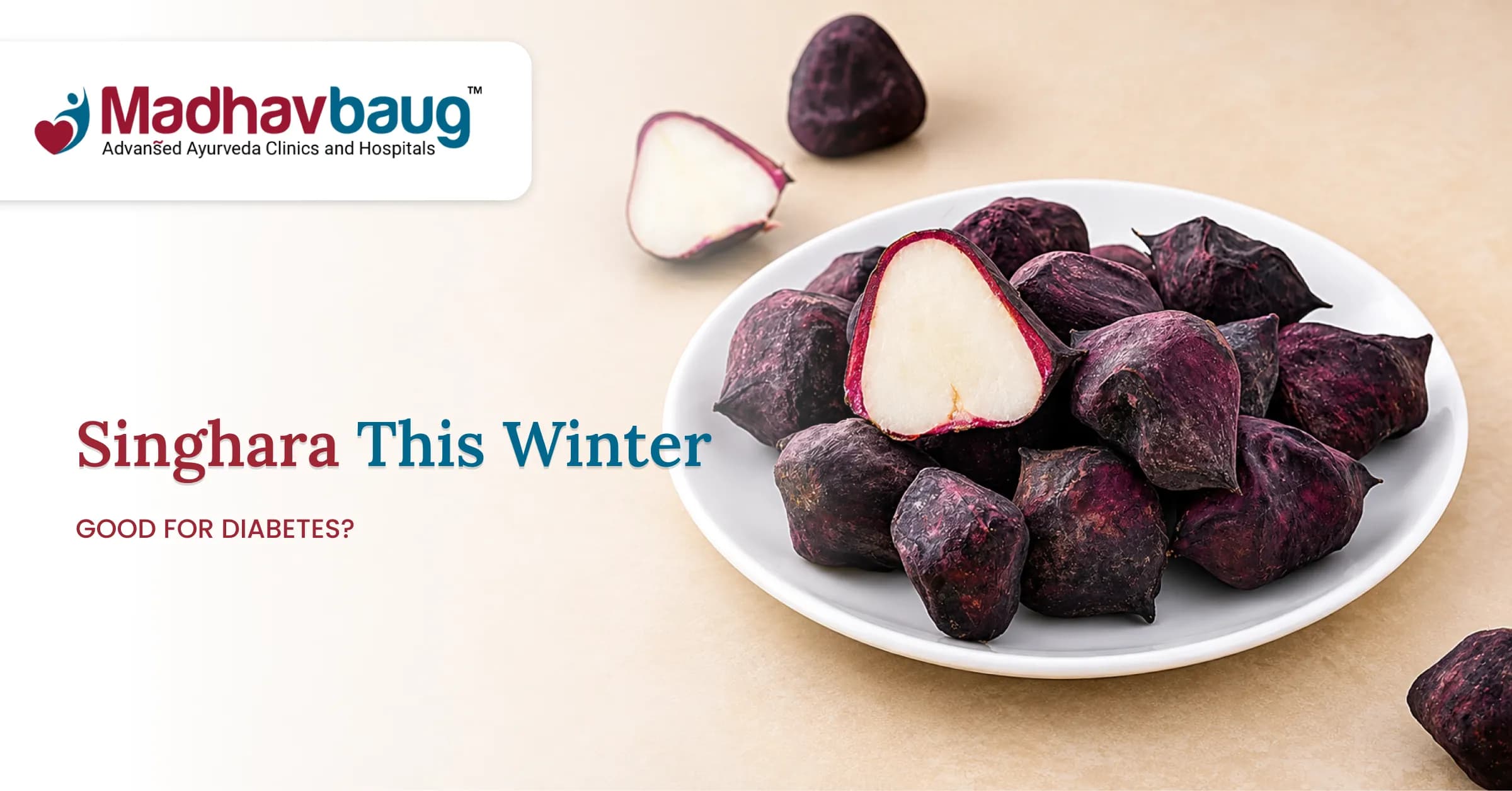
Singhara appears in the markets as the days turn cooler and many families boil it with a little salt or roast it on a winter evening. Singhara flour is also a regular part of vrat food. People with diabetes and high BP often ask whether this dark and spiky fruit is a good choice for them.
The answer needs some care. Singhara is a natural food with fibre and minerals yet it is also rich in starch. A review of the nutrition and pharmacology of Indian singhara notes that its fruit is a source of carbohydrate, protein and minerals such as potassium but that most of the health claims come from laboratory studies (Adkar et al., 2014). Knowing what it contains and how to eat it is therefore very important.
In this blog we explain what singhara is, its nutrition, the benefits of water chestnut, whether singhara is good for diabetes and blood pressure, how to eat it safely this winter and how Madhavbaug can support you.
Want to know which winter foods suit your sugar and BP?
What Is Singhara?
Singhara is the edible kernel of the fruit of Trapa bispinosa (Trapa natans) which is an aquatic plant that grows in ponds and lakes across India. It is also called paniphal and water chestnut. The kernel is eaten fresh after boiling or roasting and it is dried and ground into flour that is used in vrat dishes. It is used in Ayurveda as well (Adkar et al., 2014).
It should not be confused with the Chinese water chestnut which is a different plant. Many online charts quote nutrition values for the Chinese water chestnut so the numbers can differ from Indian singhara.
Singhara Nutrition
Analysis of fresh Indian singhara fruit has reported the following approximate values in 100 g (Adkar et al., 2014).
| Nutrient in 100 g of fresh singhara | Approximate value |
| Energy | About 115 kcal |
| Carbohydrate | About 22 g |
| Protein | About 4 g |
| Fibre | About 2 g |
| Fat | Less than 1 g |
| Water | About 70 g |
The fruit also contains minerals such as potassium and iron. The most important point for people with diabetes is the carbohydrate. A small bowl of about 100 g of boiled singhara carries roughly as much carbohydrate as one to one and a half chapatis.
Singhara Benefits (Water Chestnut Benefits)
Singhara can be a useful seasonal food when it is eaten in a sensible portion. The main water chestnut benefits come from its nutrition. Here are the singhara benefits that matter most.
- Low in fat. Fresh singhara has less than 1 g of fat in 100 g so it is a lighter choice than fried winter snacks.
- Gives energy. Its starch provides energy which is one reason it is a common vrat food.
- Water and some fibre. About 70 g of every 100 g is water and it also has some fibre.
- Potassium and iron. It provides minerals such as potassium and iron. Potassium with very little sodium suits a blood pressure friendly diet.
- Gluten-free flour. Singhara atta has no gluten so it helps people who cannot take wheat.
- Plant compounds. Laboratory studies have found antioxidant activity in singhara extracts but this has not been tested well in people (Adkar et al., 2014).
- Valued in Ayurveda. Singhara is traditionally valued as a cooling and nourishing food and it is used in several home remedies. These traditional uses have not been proven in good human studies.
| Clinical Insight “From over 20 years of clinical experience, I advise people with diabetes to pay attention to the portion of singhara they eat, especially during winter when it is readily available. Singhara is a nutritious seasonal food but it still contains carbohydrates that can raise blood glucose levels. If you enjoy boiled singhara, you can include a small bowl in your meal by reducing the quantity of roti or rice accordingly. I would also recommend checking your blood sugar after eating it to understand how your body responds. If you have diabetes along with high blood pressure or kidney problems, discuss the right portion with your doctor before making it a regular part of your diet.” Dr. Pravin Jayram Ghadigaonkar, BAMS, MD, PhD scholar – Preventive Cardiology 20+ Years of Clinical Experience, Head Medical Operations & Patient Improvement, Madhavbaug |
It is better to see singhara as a nourishing food in a balanced diet and not as a medicine because the research on water chestnut benefits and its health effects in people is still limited.
Is Singhara Good for Diabetes?
Some studies have looked at singhara for diabetes and sugar control. Compounds isolated from the husk (pericarp) of Trapa natans lowered blood sugar in laboratory and animal experiments (Huang et al., 2016). The husk is not the part that we eat and these experiments do not show that eating the kernel will lower the sugar in a person with diabetes.
Singhara is often described as having a low glycaemic index but we could not find good direct testing for Indian singhara. Its carbohydrate content is also not small. The way it is prepared matters a great deal. Following table explains how the common forms compare.
| Form of singhara | What to keep in mind |
| Boiled or roasted fresh singhara | The best form. Keep to a small bowl and count it as part of your carbohydrate for the meal |
| Singhara atta roti | A starch so keep it small and eat it with vegetables and dal |
| Singhara atta puri or pakora | Fried food that adds oil and calories so avoid or keep it very small |
| Singhara halwa or kheer | Added sugar and ghee so treat it as a sweet and keep the portion small |
If you have diabetes you can eat singhara in a small portion after checking with your doctor but it should replace a part of your usual roti or rice and not come on top of it (ICMR-NIN, 2024). Check your sugar two hours after the first few servings to see how your body reacts.
Singhara and Blood Pressure
Singhara contains potassium and very little sodium which suits a blood pressure friendly diet. It does not treat high blood pressure and it does not replace your medicines. Boil it with very little salt and skip the chaat masala and extra salt that are often added when it is sold roadside. If you have both diabetes and high blood pressure keep your salt low and review the portion with your doctor.
How to Eat Singhara Safely This Winter
- Wash the fruit well and boil it with the shell before peeling
- Eat it in a small bowl as part of a main meal and not as a stand alone snack on an empty stomach
- Choose boiled or roasted singhara over fried or sweet preparations
- Buy flour that is labelled pure water chestnut flour without added ingredients
- Eat it in place of a part of your roti or rice
- Do not eat raw singhara from ponds because it may carry germs or parasites
Who Should Be Careful With Singhara?
People with kidney disease who have been told to limit potassium and those who take medicines that raise potassium should ask their doctor before eating singhara regularly. People whose sugar is running high should keep to a very small portion or hold back until the readings settle. A few people have gas or acidity when they eat it in large amounts. People who are allergic to it should avoid it.
How Madhavbaug Can Help You
Seasonal food choices work best when they are planned around your own reports and habits. At Madhavbaug the doctor looks at your sugar and blood pressure readings along with your medicines, weight, prakriti and routine before giving diet and lifestyle guidance.
This picture helps the doctor plan diabetes care that fits your diet, activity, daily routine and ongoing medicines. If you want to learn more about diabetes care at Madhavbaug and how it shall be personalised around your health, visit the nearest Madhavbaug centre.
Need diet guidance that suits your sugar and BP?
Frequently Asked Questions
Is singhara good for diabetes?
A small portion of boiled or roasted singhara can fit into a diabetes diet for most people. It is a starchy food so it should replace a part of your usual carbohydrate and not be added on top.
Is singhara a low glycaemic index food?
It is often described that way but direct testing of Indian singhara is limited. A small portion of boiled or roasted singhara is the safer choice.
How much singhara can a diabetic eat?
About 100 g of boiled singhara which is a small bowl carries about as much carbohydrate as one to one and a half chapatis. Your doctor can fine tune the portion for you.
Is singhara atta good for diabetes?
Singhara flour is a starch so it can raise sugar. Use a small amount as roti and avoid frying it as puri or pakora.
Is singhara good for blood pressure?
It has potassium and very little sodium which suits a blood pressure friendly diet. It is not a treatment and people with kidney disease should ask their doctor first.
What are the benefits of singhara?
It gives energy along with some fibre and minerals and it is low in fat. The flour is gluten free. Research on its health effects in people is limited.
Can I eat raw singhara?
It is safer to wash it well and boil or roast it. Raw water plants can carry germs or parasites.
Does singhara cause gas or acidity?
In some people it does especially when eaten in large amounts. Start with a small portion and see how you feel.
Who should avoid singhara?
People with kidney disease on a potassium limit and those with an allergy should ask their doctor first. People with high sugar should keep the portion very small.
References
Adkar, P., Dongare, A., Ambavade, S. and Bhaskar, V.H. (2014) ‘Trapa bispinosa Roxb. A review on nutritional and pharmacological aspects’, Advances in Pharmacological Sciences, 2014, Article 959830.
Huang, H.C., Chao, C.L., Liaw, C.C. et al. (2016) ‘Hypoglycemic constituents isolated from Trapa natans L. pericarps’, Journal of Agricultural and Food Chemistry, 64(19), pp. 3794-3803.
Indian Council of Medical Research and National Institute of Nutrition (2024) Dietary guidelines for Indians. Hyderabad. ICMR-NIN.



 Locate a Centre

