
Key Takeaways
|
Heart blockage often builds up silently over many years and studies say that people in South Asia including India get their first heart attack around 5 to 6 years earlier on average than people in other countries (Joshi et al., 2007) and so knowing the right heart blockage test at the right time is very important.
Many patients get confused when the doctor writes ECG, TMT, echo or CT angiography on the prescription and nobody explains clearly what each one does and why so many tests are needed. Some people also feel that one test is enough and some fear that a test like CT angiography is risky or painful.
In this blog we explain the heart blockage test name for each test in easy terms, when you need an ECG, TMT or CT angiography, how to prepare for them, which heart blockage test is right for you and how Madhavbaug’s comprehensive heart care can support you.
Worried about chest pain or your heart report?
What Is Heart Blockage?
Heart blockage is a condition in which the arteries that supply blood to your heart muscle become narrow because a fatty material called plaque slowly builds up inside them. It is also called coronary artery disease.
When the artery is partly blocked you may feel chest pain or breathlessness while walking or climbing stairs and when the artery gets suddenly blocked completely it causes a heart attack. Many people have no symptoms at all in the early stage which is why the right test is so important.
When Do You Need a Heart Blockage Test?
You may need a test for heart blockage if you have chest pain, pressure or heaviness which comes on walking or climbing stairs and settles on rest. You should also get checked if you have breathlessness that has recently developed or increasing, pain that spreads to the arm, jaw or back, unusual sweating or tiredness on small work, dizziness or palpitations.
Nevertheless, even without any symptoms your doctor may suggest a heart blockage test if you have diabetes, high blood pressure, high cholesterol, a habit of smoking or tobacco, obesity or a family history of heart disease at a young age.
Do not wait for the next episode if the pain is not settling. Chest pain lasting more than a few minutes especially with sweating or breathlessness is an emergency and in such a situation an ECG is done within minutes at the hospital and treatment starts at once.
Heart Blockage Test and What Each Test Does
Heart blockage test is something that many patients search for but there is no single test and the doctor chooses one or more tests depending on your symptoms and risk. Following is the table that explains the common tests and what each one tells you.
| Test | What it tells you |
| ECG | It records the electrical activity of your heart in about 5 minutes and shows signs of a heart attack, poor blood supply or an irregular heartbeat |
| 2D echo | It shows how well your heart is pumping and whether any part of the heart muscle has become weak |
| TMT | It checks how your heart behaves when you walk on a treadmill and the load on the heart increases |
| CT angiography | It gives pictures of your heart arteries and shows whether they are narrowed or blocked |
| Coronary angiography | It is the most exact test in which dye is passed into the heart arteries through a thin tube and the blockage can be treated in the same sitting if needed |
ECG Test for Heart Blockage
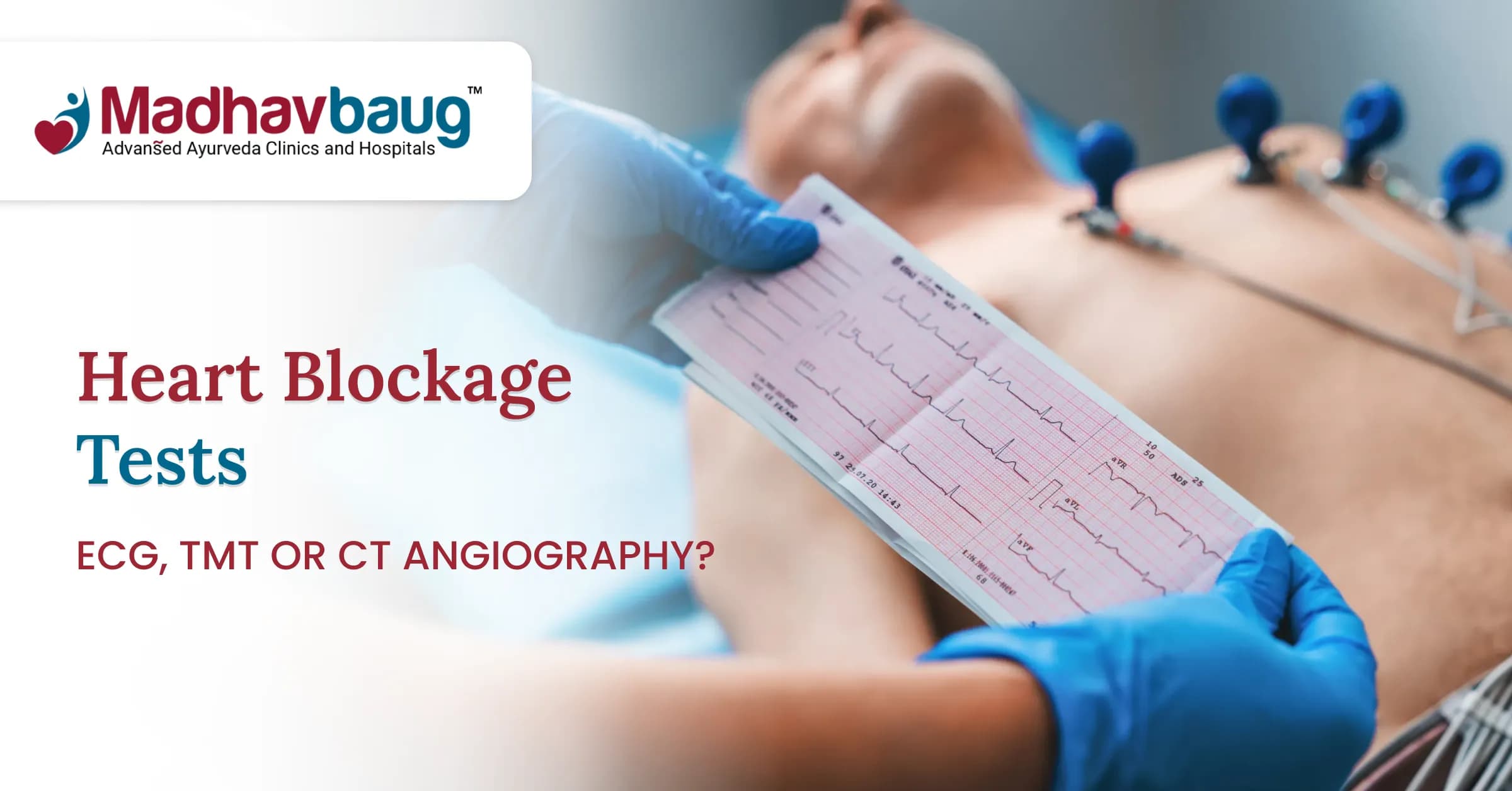
ECG test for heart blockage is the simplest and the fastest test that is done first in almost every patient with chest pain. ECG or electrocardiogram records the electrical activity of your heart through small stickers placed on your chest, arms and legs and the whole test takes around 5 minutes without any pain or radiation.
It can show signs of a heart attack, either an old one or one that is going on, reduced blood supply to the heart muscle and an irregular heartbeat. However, a normal ECG does not rule out heart blockage because the ECG may look completely normal when you are resting even if the arteries are narrow and that is why your doctor may suggest further tests.
TMT Test for Heart Blockage
TMT test for heart blockage is done to see how your heart behaves when it has to work harder. TMT means treadmill test and it is also called as stress test.
In this test you walk on a treadmill whose speed and slope increases every few minutes while your ECG, pulse and blood pressure are watched continuously. The doctor looks for changes in the ECG or symptoms like chest pain and breathlessness which may point to a blockage and the test takes around 15 to 30 minutes.
Make sure you wear comfortable shoes and loose clothes, avoid a heavy meal just before the test and ask your doctor whether you should take your regular medicines especially beta blockers because you should not stop any medicine on your own. TMT is not suitable if you have recently had a heart attack, unstable chest pain, severe breathlessness, very high blood pressure or a severely narrow heart valve and when you cannot walk properly due to knee problems your doctor may choose a stress echo or another test. TMT can also give a false result sometimes which means it may look positive without a blockage or look normal in spite of one so the doctor always reads it along with your symptoms.
What Is CT Angiography?
CT angiography is a scan in which a special dye is injected through a vein in your arm and CT pictures are taken to see the arteries of the heart. When it is done for the heart it is also called as CT coronary angiography.
Firstly, it is noninvasive which means no tube is passed into the heart arteries. Now the dye makes the arteries visible in the scan so that the doctor can see whether there is any narrowing or plaque inside and also how much. The scan itself takes only a few minutes and the whole process including preparation takes around an hour.
CT angiography is often used for patients who have chest pain with a medium chance of blockage and a normal or unclear ECG or TMT result. Studies say that in patients with stable chest pain adding CT angiography to the usual tests led to fewer heart attacks over five years because the blockages could be found and treated on time (SCOT-HEART Investigators, 2018). A normal CT angiography also gives a good assurance that there is no major blockage.
However, CT angiography may not give a clear picture when the heartbeat is very fast or irregular or when there is a lot of calcium in the arteries. It also cannot open a blockage and in such cases the doctor may suggest coronary angiography.
How to Prepare for CT Angiography and Is It Safe?
CT angiography needs some preparation and it is generally safe when it is done for the right patient. Following are the general points which your doctor or the scan centre may change according to your condition.
- Do not eat anything for around 4 to 6 hours before the scan or as per the instructions of the hospital.
- Avoid tea, coffee, cold drinks and tobacco on the day of the test because they increase the heart rate.
- Tell your doctor about any kidney problem, allergy to contrast dye, pregnancy and the medicines you take especially metformin.
- The doctor may give you a tablet to slow your heart rate and a tablet under the tongue to widen the arteries so that the pictures are clear.
- You may feel warmth, a metallic taste or a feeling of passing urine when the dye is injected and this passes within a minute.
The dye can affect the kidneys in some people so your kidney function is usually checked before the scan. The radiation dose is small and in most patients the benefit of finding a blockage is much more than this small risk.
“Many patients come to me saying that the ECG was normal so there cannot be any blockage. I always explain to them that a normal ECG at rest does not rule out a blockage and that is why the right test at the right time matters whether it is a TMT or a CT angiography. What I would never want is that a patient ignores the chest discomfort only because one report was normal.”
– Dr. Priyadarshini Bhalekar, Zonal Medical Head, Madhavbaug
Other Heart Blockage Tests
Other heart blockage tests that your doctor may suggest are 2D echo, stress echo, nuclear scan and coronary angiography. A 2D echo is an ultrasound of the heart which shows how well your heart is pumping and whether any part of the muscle has become weak but it does not show the blockage directly. Stress echo is an echo done before and after exercise or after a medicine that raises the heart rate and it is helpful for those who cannot walk on a treadmill. A CT calcium score is a quick scan done without dye that measures the calcium in your heart arteries. It helps the doctor judge your future risk of heart disease in some people without symptoms but it cannot show how narrow an artery is.
Coronary angiography which is also called as cath angiography is the most exact heart blockage test. A thin tube is passed through the wrist or groin up to the heart arteries and dye is injected to take X ray pictures. It is done under local anaesthesia and takes around 30 minutes and the advantage is that if a serious blockage is found the doctor can open it by angioplasty in the same sitting.
Serious problems are uncommon but there can be bleeding at the puncture site or an allergy to the dye so it is usually kept for patients who have a high chance of blockage or a heart attack.
Is There a Blood Test for Heart Blockage?
There is no blood test that can directly show a blockage in the heart arteries. Blood tests instead check the risk factors behind heart blockage and help your doctor decide which heart blockage test you need. A lipid profile checks your cholesterol, HbA1c and fasting sugar check for diabetes and a kidney function test is usually done before CT angiography because of the dye. When someone comes to the hospital with chest pain a troponin blood test is done along with the ECG to see whether the heart muscle is getting damaged which is a sign of a heart attack. So a normal blood report does not mean your heart arteries are clear and your doctor may still advise an ECG, TMT or CT angiography based on your symptoms.
Which Heart Blockage Test Is Right for You?
Which heart blockage test is right for you depends on your symptoms, your age, your risk factors, whether you are able to walk on a treadmill and what your ECG shows. Guidelines say that a resting ECG is done in almost everyone with chest pain and after that either a stress test such as TMT or CT angiography is chosen depending on the chance of blockage (Gulati et al., 2021; Knuuti et al., 2020).
In simple words when the chance of blockage is low a simple test like ECG or TMT may be enough and when it is medium CT angiography is often preferred while in a high chance or when a heart attack is going on the doctor goes straight to coronary angiography. There is also no reliable way to check heart blockage at home so these tests have to be done under a doctor’s guidance. Not everyone without symptoms needs CT angiography so please do not get it done on your own without a doctor’s advice.
How Madhavbaug Can Help You Manage Heart Blockage
Heart blockage develops slowly over many years of unhealthy food habits, lack of activity, smoking, uncontrolled sugar and high cholesterol. Finding it early with the right heart blockage test gives you a chance to control it before a heart attack happens and the treatment should ideally include lifestyle changes to lower the chance of it getting worse.
| Clinical Insight “In my experience, many patients ignore mild chest discomfort or breathlessness for months because it comes and goes. At Madhavbaug, we look at the patient’s reports, symptoms, food habits, sugar levels and overall health before planning the care. Along with regular monitoring, our Ayurvedic therapies and diet guidance are meant to work together with the treatment given by your cardiologist and not to replace it. If you have any symptoms or risk factors, do not wait for a heart attack and ask your doctor which heart blockage test is right for you.” Dr. Pravin Jayram Ghadigaonkar, BAMS, MD, PhD (Scholar) Preventive Cardiology 20+ Years of Clinical Experience, Head Medical Operations & Patient Improvement, Madhavbaug |
Madhavbaug offers sampurna hridaya shuddhi in which the root cause of the blockage is analysed. This approach includes understanding your prakriti and then planning Ayurvedic therapies including panchakarma with hridayadhara, a heart friendly diet kit and the MIB Pulse app system that continuously tracks your progress and readings so that your doctor can review your progress regularly.
If you have been advised an ECG, TMT or CT angiography or you have risk factors and want to take care of your heart in a proper and organised way you can visit your nearest Madhavbaug clinic.
Looking for guidance on your heart health?
Frequently Asked Questions
What is the heart blockage test name?
There is no single heart blockage test. The common tests are ECG, 2D echo, TMT, CT angiography and coronary angiography and your doctor chooses the one that suits your symptoms.
Which is the best test for heart blockage?
Coronary angiography is the most exact test but it is not needed in everyone. CT angiography is a good noninvasive option for many patients and the best test for you depends on your symptoms and risk so your cardiologist will decide.
Can ECG detect heart blockage?
ECG can show signs of a heart attack or poor blood supply but it can be normal even when you have a blockage so one normal ECG does not rule it out.
Is there a blood test for heart blockage?
No blood test can directly show a blockage. Tests like lipid profile, HbA1c and kidney function check your risk while troponin is done in an emergency to check for a heart attack. Your doctor will still need an ECG, TMT or CT angiography to look for a blockage.
Is TMT enough to detect heart blockage?
TMT is a useful first test when your symptoms come on exertion but it can sometimes be falsely positive or negative so your doctor may suggest CT angiography or coronary angiography if there is any doubt.
What is CT angiography?
CT angiography is a scan that uses a dye injected in a vein and a CT machine to take pictures of the heart arteries and show narrowing or blockage without passing any tube into the heart.
How long does CT angiography take?
The scan takes only a few minutes while the whole process including preparation and rest afterwards takes around an hour.
Is CT angiography safe?
It is generally safe but it uses a small dose of radiation and a dye which can affect the kidneys in some people. Tell your doctor about any kidney problem, allergy or medicines like metformin before the test.
CT angiography vs coronary angiography which is better?
CT angiography is noninvasive and used to find a blockage while coronary angiography is invasive but it can treat the blockage with angioplasty in the same sitting. So neither is better for everyone and the choice depends on your condition.
Do I need a heart blockage test if I have no symptoms?
Not everyone does. If you have diabetes, high blood pressure, high cholesterol, a smoking habit or a family history of heart disease you should speak to your doctor who will decide whether any heart blockage test is needed.
References
Gulati M, et al. (2021). 2021 AHA/ACC/ASE/CHEST/SAEM/SCCT/SCMR Guideline for the Evaluation and Diagnosis of Chest Pain. Circulation, 144(22).
Joshi P, et al. (2007). Risk factors for early myocardial infarction in South Asians compared with individuals in other countries. JAMA, 297(3).
Knuuti J, et al. (2020). 2019 ESC Guidelines for the diagnosis and management of chronic coronary syndromes. European Heart Journal, 41(3).
SCOT-HEART Investigators. (2018). Coronary CT angiography and 5 year risk of myocardial infarction. New England Journal of Medicine, 379(10).




 Locate a Centre

