


If you’ve been searching for how to check heart blockage at home, you’re probably worrying about a parent’s chest tightness, or you’ve just felt something odd in your own chest and want an answer before your next appointment.
That fear and worry about wanting immediate clarity is completely understandable because this is one of those health questions where the honest answer may not be easy to digest. There is no home test, no device or a symptom checklist that can reliably confirm or rule out a blocked coronary artery.
This article explains symptoms of heart blockage, heart blockage tests, exactly why home checks fall short, what genuinely useful self-awareness looks like, and how Madhavbaug’s diagnostic-first approach helps you get a real answer instead of a guess.
How to Check Heart Blockage at Home
The bitter truth is that there is no home test for heart blockage. Coronary artery blockage is a structural and physical narrowing of an artery wall. No wearable, smartwatch, pulse oximeter or home pulse check can see inside an artery. They can only estimate heart rate, rhythm, or blood oxygen at the skin’s surface.
A comprehensive review of wearable photoplethysmography technology (the sensor tech behind most fitness bands and smartwatches) confirms these devices show real promise for tracking heart rate and rhythm patterns over time, but remain fundamentally limited as diagnostic tools for underlying cardiovascular disease, especially something structural like arterial narrowing (Charlton et al., 2022).
Thus, these devices can detect that something might be worth checking, but they cannot tell you whether or where an artery is blocked.
The same applies to symptom-based self-assessment. There is no heart blockage test result by listening to your body alone, because as the next section explains, a genuinely severe blockage can exist without producing any symptoms at all.
Emergency Symptoms: Act First, Read Later
Before anything else, if you or someone with you is currently experiencing chest pain or pressure that doesn’t ease with rest, pain spreading to the jaw, arm, neck or back, sudden breathlessness, cold sweat, or fainting, please stop reading this article and seek emergency medical help immediately. What follows is meant for understanding your risk and planning a proper clinical evaluation, not for use during an active emergency.
A Risk-Factor Self-Check
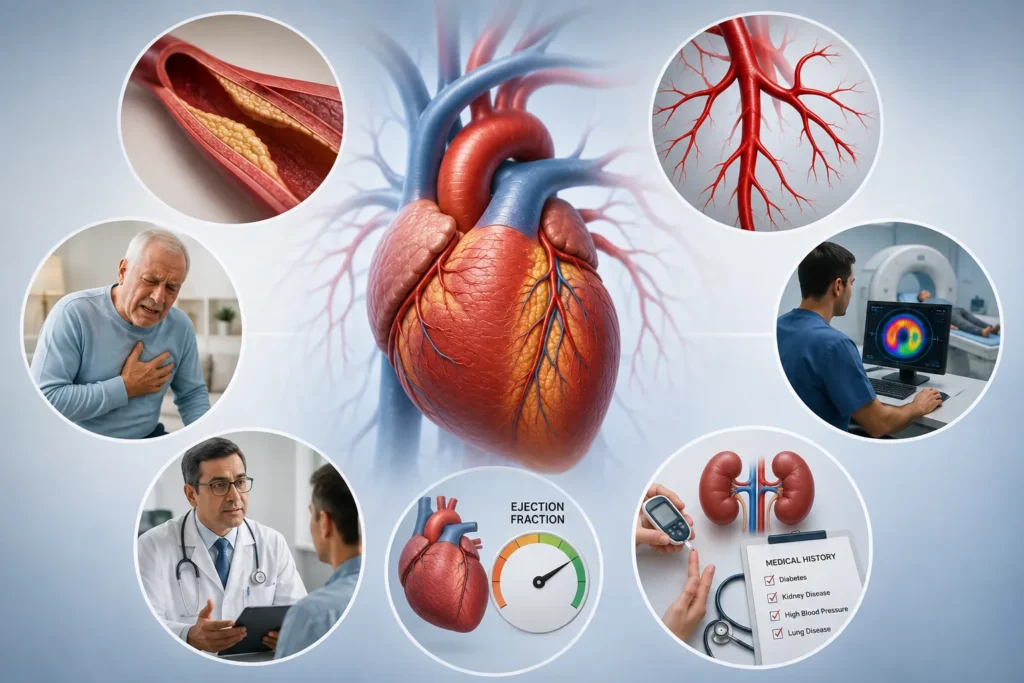
While there is no test to detect coronary artery blockage at home, you can assess your risk factors, which you can bring to a doctor.
Ask yourself:
- Do you have high blood pressure, high cholesterol, or diabetes, either diagnosed or suspected?
- Do you smoke, or did you smoke for a significant period?
- Is there a family history of heart disease, especially at a younger age?
- Are you overweight, particularly with fat concentrated around the abdomen?
- Is your lifestyle largely sedentary?
- Are you over 45 (men) or 55 (women), which are commonly used risk-stratification ages?
- Do you have high stress levels or poor sleep patterns?
None of this confirms or rules out a blockage on its own, but a cluster of these factors indicates that you should take a proper clinical evaluation rather than a wait-and-see approach.
Symptoms of Heart Blockage
Heart blockage may usually be asymptomatic at the start. Symptoms usually appear at a very later stage. When present, symptoms of heart blockage typically include:
- Chest discomfort, tightness, heaviness or pressure, especially with exertion
- Breathlessness that’s disproportionate to activity
- Unusual fatigue
- Pain radiating to the jaw, arm, neck, or back
- Palpitations or dizziness
- Cold sweats without an obvious cause
Symptoms such as chest discomfort, breathlessness, unusual fatigue or dizziness should not be ignored. A proper cardiac assessment can help identify potential concerns and guide you towards the right next step.
Why home-based judgement may genuinely be risky?
Significant coronary blockage can exist without producing any of these symptoms at all. Silent, or asymptomatic, myocardial ischaemia (where the heart muscle is short of blood flow without triggering pain) is a clinical condition that may carry the same level of heart risk as people who experience symptoms like chest pain (Conti, Bavry and Petersen, 2012).
What ECG Can and Cannot Show
The heart blockage test mainly includes an ECG. The following table includes the advantages and limitations of an ECG test.
| Investigation | What It Can Detect | Limitation |
| Resting 12-Lead ECG | Abnormal heart rhythm, evidence of a previous heart attack, or changes during an ongoing cardiac event | A normal ECG does not rule out blocked heart arteries. It may miss many people who have significant coronary artery disease. |
| Coronary Angiography | Shows the location and severity of blockages in the coronary arteries | Considered the reference standard for confirming coronary artery disease. |
Why a Normal ECG Is Not Enough as a Heart Blockage Test
| Finding | What It Means |
| Sensitivity: 29% | A resting ECG correctly identifies only about 29 out of 100 people who actually have coronary artery disease. Many cases may be missed. |
| Specificity: 67% | A resting ECG correctly identifies about 67 out of 100 people who do not have coronary artery disease. |
Clinical Takeaway
A normal resting ECG should not be considered proof that your heart arteries are clear, especially if you have symptoms or risk factors such as diabetes, high blood pressure, high cholesterol, smoking, or a family history of heart disease. Further evaluation may be required, for which you can visit your nearest Madhavbaug centre immediately.
What Heart Blockage Tests Actually Confirms a Blockage
This is where a real diagnosis happens, and it’s exactly the diagnostic pathway Madhavbaug builds every cardiac care plan around before any treatment decision is made:
- 2D Echocardiogram (Echo)
Assesses how well your heart is pumping (ejection fraction), chamber size, and valve function; doesn’t directly visualise coronary arteries, but shows how the heart is coping.
- Treadmill Test (TMT) / stress test
Evaluates how your heart responds to controlled physical exertion, often revealing ischaemia that a resting ECG misses entirely
- CT Coronary Angiography
A non-invasive scan that provides detailed imaging of the coronary arteries themselves, useful for confirming or ruling out blockage without an invasive procedure
- Invasive Coronary Angiography
The gold-standard, catheter-based test that directly visualises blockages and their exact severity and location, typically used when non-invasive tests suggest significant disease
At Madhavbaug, this diagnostic sequence of heart blockage tests is an essential first step for every patient, because it’s the only way to move from “I’m worried” to an actual, confirmed answer about your coronary arteries.
It’s also the same evaluation used to determine whether a structured, doctor-supervised, non-surgical care plan is appropriate for you. To know more, visit your nearest Madhavbaug clinic.

Get a Real Answer, Not a Guess
Worry without answers is exhausting, and it’s exactly the situation this article is meant to help you move past. Instead of searching for the ways on how to check heart blockage at home, the safest and most effective next step is a proper clinical evaluation.
To understand the diagnostic role of ECG in more depth, read our guide on whether an ECG can detect heart blockages, and learn to recognise 5 early signs of heart blockages.
If you’re also exploring what treatment could look like after a diagnosis, our page on Ayurvedic reversal treatment for heart blockage explains Madhavbaug’s doctor-supervised, diagnostic-first approach. It includes an integrated approach combining traditional Ayurveda treatment alone with modern diagnostics. Madhavbuag believes that the healing is holistic and not isolated, and so in order to eliminate the disease from the root cause, Madhavbuag combines Panchakarma, diet, exercise and continuous monitoring systems as a combined treatment approach.
When you’re ready to get real answers about your heart, find your nearest Madhavbaug clinic and book a proper cardiac assessment. The clarity you’re looking for starts with an actual test, not another search.
Central Content: Searching for answers about heart blockage can create more uncertainty. Get your heart health evaluated by a doctor and understand what your symptoms may actually mean.
Frequently Asked Questions
- How can I check for heart blockage at home?
You cannot reliably check for heart blockage at home. No smartwatch, pulse oximeter or symptom checklist can confirm or rule out arterial narrowing. This requires clinical tests like an ECG, echocardiogram, TMT, or coronary angiography performed and interpreted by a doctor.
- What is the most accurate test to detect heart blockage?
Invasive coronary angiography is considered the gold-standard test for detecting and measuring coronary artery blockage, while CT coronary angiography offers a reliable non-invasive alternative for many patients, guided by your cardiologist’s assessment.
- Can you have a heart blockage with no symptoms?
Yes. Silent ischaemia (significant blood flow restriction without noticeable symptoms) is well documented and carries the same risk as symptomatic blockage (Conti, Bavry and Petersen, 2012), which is why symptom absence alone should never be treated as reassurance.
- Does a normal ECG mean my arteries are clear?
No. Resting ECG has notably limited sensitivity for detecting coronary artery disease, with research showing it misses a substantial proportion of confirmed cases compared to angiography (Ghadrdoost, Haghjoo and Firouzi, 2015). A normal ECG reduces likelihood but does not rule out blockage.
- Can a smartwatch detect a heart blockage?
No. Smartwatches and fitness trackers can monitor heart rate and rhythm patterns but are not diagnostic tools for structural coronary artery blockage (Charlton et al., 2022). They may prompt you to seek evaluation but cannot replace one.
References
- Charlton, P.H., Kyriacou, P.A., Mant, J., Marozas, V., Chowienczyk, P. and Alastruey, J. (2022) ‘Wearable Photoplethysmography for Cardiovascular Monitoring’, Proceedings of the IEEE, 110(3), pp.355–381.
- Conti, C.R., Bavry, A.A. and Petersen, J.W. (2012) ‘Silent ischemia: clinical relevance’, Journal of the American College of Cardiology, 59(5), pp.435–441.
- Ghadrdoost, B., Haghjoo, M. and Firouzi, A. (2015) ‘Accuracy of cardiogoniometry compared with electrocardiography in the diagnosis of coronary artery disease’, Research in Cardiovascular Medicine, 4(2), e25547.
- Theofilis, P., Antonopoulos, A.S., Sagris, M., Papanikolaou, A., Oikonomou, E., Tsioufis, K. and Tousoulis, D. (2024) ‘Silent Myocardial Ischemia: From Pathophysiology to Diagnosis and Treatment’, Biomedicines, 12(2), 259.




 Locate a Centre
