
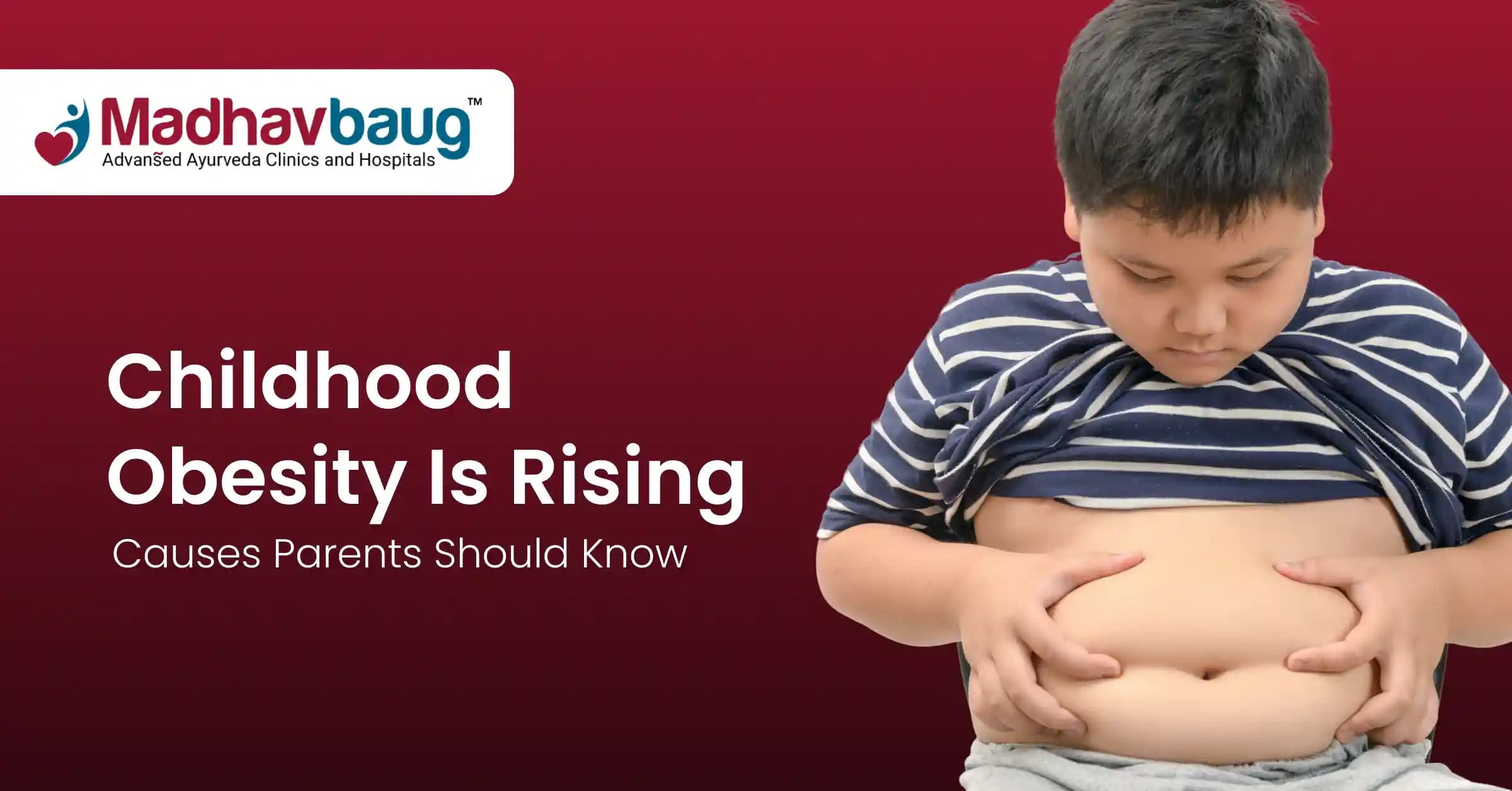
Rates of excess weight have been on the rise lately and are rapidly making their way into every modern household. Weight gain in a child may often be dismissed as “baby fat.” However, modern clinical care and Ayurveda agree that extreme shifts in metabolism in early life can result in lifelong ailments later. Understanding the exact causes of child weight gain can be the first step towards ensuring a bright and healthy future for your children.
At Madhavbaug, we identify the root cause of why children store excess fat and provide the parents with actionable pathways to childhood obesity prevention.
What are the symptoms of Childhood Obesity?
Early warning signs show up in every srruugle, it is important to understand that childhood obesity may manifest in a variety of physical and behavioural symptoms:
- Acanthosis Nigricans (dark or velvety skin patches around the neck and/or armpits)
- Restless sleep at night due to loud snoring or gasping for air
- Shortness of breath or breathing heavily even with mild physical exertion
- Frequent complaints of joint pain or pain in the knee and lower back
- Rapid weight gain not proportional to typical growth spurts in height
- Persistently low energy and chronic fatigue
- Frequent cravings for sugary foods
- Low self esteem due to body image issues and social withdrawal
How to Accurately Assess Your Child’s Weight?
Many parents think visual checks or clothing sizes are enough to judge their child’s growth, but, clinical tracking is important in identifying early warning signs before they turn into lifestyle disorders.
How to calculate BMI for Children?
Evaluating a child’s weight is complex as their body composition may change frequently with their growth. Pediatricians track Body Mass Index or BMI to determine if a child is over the proportionate weight.
Adult BMI uses fixed, flat numerical ranges (e.g., 25+ is overweight).
Child BMI must be plotted on a growth percentile chart relative to the child’s age and gender.
A child’s BMI calculation is translated into a percentile rank:
- Healthy Weight: Between the 5th and 85th percentiles.
- Overweight: 85th to less than the 95th percentile.
- Obesity: 95th percentile or higher.
Monitoring these percentiles over time will help you better understand your child’s weight trajectory and take action before it becomes too severe.
What are the primary causes of Child Weight Gain?
Paediatric weight gain is a result of a combination of environmental factors and underlying physiological imbalances.
Low-Nutrient Diets that are heavy in calories
Today’s food landscape is full of processed foods and sugary beverages. Consumption of fast foods and packed snacks has become regular. These provide empty calories that can overwhelm a child’s liver and pancreas while they are developing leading to accelerated fat accumulation. (Lee et al., 2024) .
High Screen-Time
A rise in the use of technological devices such as smartphones, tablets and video games have led to a decline in outdoor play. Slowing down your child’s resting metabolic rate, prolong periods of sitting can cause storage of fat tissue instead of active burning of it during play (Mitáš et al., 2020).
High Academic & Social Stress
Children face immense competition and pressure to perform well in academics, competitive exams and on social media. The chronic stress from these sources leading to a continuous release of cortisol signals the body to store fat and disrupts typical insulin responses.
The Ayurvedic Perspective: Bala Sthaulya and Kapha Imbalance
From the Ayurvedic perspective, childhood is called the Bala Avastha, which is a phase of life dominated by the Kapha Dosha, which helps the growth of tissue, bone density and development (Abhishek et al., 2026). However, when a child regularly consumes Sleshmala Ahara (heavy, cold, excessively sweet, or ultra-processed foods), this natural Kapha spikes out of control.
This imbalance can trigger a breakdown in the child’s metabolism:
Digestive fire or Agni turns Sluggish
The child’s internal Agni (digestive fire) becomes weak and sluggish.
Formation of Metabolic waste or Ama
Food turns into toxic metabolic waste or Ama, instead of of being efficiently converted into energy (Abhishek et al., 2026).
Reduced effectiveness of the Meda Dhatu
When Ama corrupts the Meda Dhatu, fat is no longer processed normally, instead, it accumulates as dense, stagnant deposits. According to Ayurveda, it forms the foundation of Bala Sthaulya, or pediatric obesity (Tripathy and Panda, 2025).
What are the Long-Term Health Risks of Unmanaged Pediatric Obesity?
When childhood weight gain goes unchecked, it poses serious medical risks earlier than earlier generations may have experienced.
Early-Onset Type 2 Diabetes
Excess fat tissue can cause severe resistance to insulin and can exhaust the child’s developing pancreas, causing a rise in blood glucose levels.
Hypertension & Vascular Strain
Childhood weight gain can cause a strain on the small blood vessels of a child, which forces the heart to pump with more effort, increasing the risk for cardiovascular difficulties.
Fatty Liver Disease (NAFLD)
Diets high in fructose and sugar can cause accumulation of fat in the child’s liver, which can, in turn, compromise the detoxification process of the body.
What are the Do’s and Don’ts of Childhood Obesity?
Implementing effective childhood obesity prevention starts with simple, consistent changes to your family’s daily routine.
The Do’s:
- Prioritize Whole Grains
- Encourage Gadget-Free Meals
- Ensure Regular Bedtimes
The Don’ts:
- Avoid Liquid Calories
- Do Not Force-Feed
- Avoid Cold, Heavy Snacks
Madhavbaug’s Integrated, Non-Surgical Treatment Approach
Relying on severe calorie restriction or crash dieting is dangerous for a growing child. To restore a healthy weight for children, you need a medically supervised strategy that gently repairs metabolism without depleting essential nutrients.
Madhavbaug offers a clinically validated, research-backed Ayurvedic treatment for weight loss customized to safely address pediatric metabolic concerns:
Personalized Pediatric Diet Therapy
Our expert doctors design low-glycemic, nutrient-dense nutrition plans tailored to support your child’s natural development while safely encouraging the burning of stored fat layers.
Gentle Panchakarma & Detoxification Therapies
- Udwarthanam: A specialized external treatment utilizing a dry, herbal powder massage. This process stimulates local blood circulation, breaks down subcutaneous fat, and eliminates built-up Ama (Mishra et al., 2024).
- Deepana & Pachana: Internal administration of mild, natural herbs like Triphala, Turmeric, and Ginger under medical guidance to ignite a sluggish Agni and regulate fat metabolism (Panahi et al., 2023).
Therapeutic Yoga and Movement
We guide children through engaging, structured physical movements and therapeutic breathing exercises (Pranayama) designed to improve insulin sensitivity, manage stress, and naturally balance Kapha.
Continuous Metabolic Monitoring
Through advanced diagnostic tracking and medical supervision, our doctors track your child’s weight reduction, blood pressure markers, and overall metabolic health to ensure safe, lasting success.
Take Action for Your Child’s Future
Childhood obesity is not simply a cosmetic concern or something a child will automatically outgrow always. It is a critical metabolic warning sign that requires early, gentle intervention.
Protect your child’s long-term cardiovascular health and restore their vibrant energy naturally. Schedule a comprehensive clinical metabolic assessment at your nearest Madhavbaug clinic to explore our specialized childhood obesity treatment programs today.
Frequently Asked Questions
Q1. What is childhood obesity?
Childhood obesity is a complex medical condition where a child’s body weight is significantly higher than healthy levels for their age and gender. Clinically, it is diagnosed when a child’s BMI registers at or above the 95th percentile on standardized growth charts.
Q2. What are the causes of childhood obesity?
The primary child weight gain causes include a high intake of ultra-processed foods, hidden trans fats, and sugar-laden drinks, paired with a sedentary lifestyle (excessive screen time). Genetic predispositions, chronic stress, and a sluggish Ayurvedic Agni (digestive fire) also accelerate fat storage.
Q3. What are the 6 C’s of childhood obesity?
The 6 C’s represent the socio-environmental factors driving pediatric weight gain: Cell (genetics/biology), Child (eating behaviors and activity), Container (parenting styles and family habits), Co-culture (neighborhood and school environments), Community (institutional policies), and Country (national food policies and media influence).
Q4. What are the diseases caused by obesity?
Unmanaged pediatric obesity can trigger early-onset chronic lifestyle diseases, including Type 2 diabetes, high blood pressure (juvenile hypertension), Non-Alcoholic Fatty Liver Disease (NAFLD), sleep apnea, and accelerated long-term cardiovascular risks.
Q5. What are the long-term effects of childhood obesity?
Children carrying excess weight are highly likely to remain obese into adulthood, exposing them to chronic health risks much earlier in life. Over time, this leads to permanent vascular damage, premature heart disease, severe joint degeneration, metabolic syndrome, and a significantly reduced overall life expectancy.
References
Abhishek, R.H., Shailaja, U., Rao, P. and Akhil, N., 2026. Ayurvedic Understanding and Management of Childhood Obesity (Sthoulya in Baala): A Case Report. International Journal of Ayurvedic Medicine, 17(1), pp. 510–515.
Bhardwaj, A. and Kukkal, S., 2022. Sthulta (obesity) an Agnijanya vyadi and its management through Ayurveda-A Review. International Research Journal of Ayurveda and Yoga, 5(12), pp. 86–89.
Lange, E. and Pałkowska-Goździk, E., 2025. The effect of a low-energy and low-glycemic diet on adipose tissue metabolism and energy expenditure in women with excess body weight. Nutrients, 17(23), p. 3789.
Lee, S., Kim, J., Cho, Y. and Park, H., 2024. Association Between Ultraprocessed Food Consumption and Metabolic Disorders in Children and Adolescents with Obesity. Nutrients, 16(20), p. 3470.


 Locate a Centre
