
You have just been told you have coronary artery disease. Or maybe the doctor has mentioned a blockage in your heart arteries. The next question most people ask is, ‘Do I need surgery?’
The answer, in many cases, is no.
Non-surgical treatment for coronary artery disease has advanced significantly, and for thousands of patients across India, surgery has not been the first step or even a necessary one. Depending on the severity of your condition, there are several effective alternatives to heart surgery that can manage symptoms, slow disease progression, and, often, support meaningful reversal of arterial damage.
At Madhavbaug, we have been doing exactly this work for years, combining the precision of modern cardiac diagnostics with the healing depth of classical Ayurveda to treat heart blockage without surgery, safely and under full medical supervision.
Concerned about heart blockage? Book a consultation with Madhavbaug today and find out if non-surgical reversal is right for you.
What Is Coronary Artery Disease and Why Does It Happen?
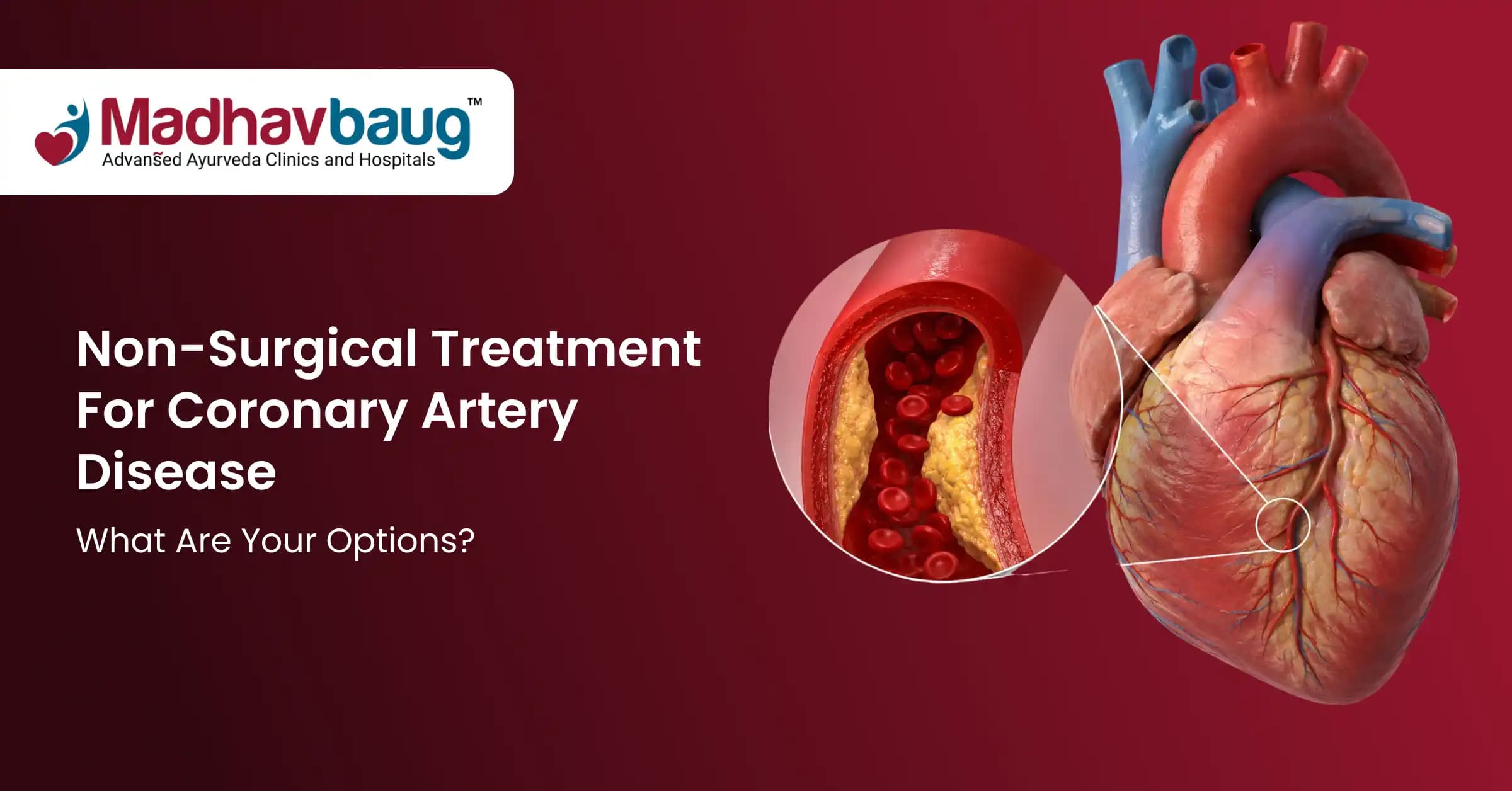
Coronary artery disease, or CAD, occurs when the arteries supplying blood to the heart muscle become narrowed or blocked due to a gradual buildup of plaque inside the artery walls. Plaque is made up of cholesterol, fat, calcium, and other substances that accumulate over time, restricting blood flow and oxygen supply to the heart.
In Ayurveda, this condition is known as Hridroga. It occurs when Ama (toxins) and Medo Dhatu (unhealthy fats) accumulate in the arteries, leading to restricted circulation and weakened cardiac function. This closely corresponds to what modern medicine calls Coronary Artery Disease.
As the arteries narrow, you may experience:
- Chest pain or tightness, especially during physical activity
- Shortness of breath and difficulty with everyday activities
- Unexplained fatigue or weakness
- Irregular heartbeat or palpitations
- Swelling in the legs, feet, or abdomen
- Cold or numb extremities due to poor circulation
- In severe cases, a heart attack
The risk factors that drive CAD are largely lifestyle-related:
- High cholesterol and triglyceride levels
- High blood pressure and uncontrolled diabetes
- Obesity, particularly abdominal fat
- Smoking, alcohol, and sedentary habits
- Chronic stress and anxiety
- Accumulation of Ama due to poor digestion and lack of detoxification
Because lifestyle and metabolic dysfunction drive this condition, they can also be systematically addressed to reverse it. This approach is the foundation of heart blockage treatment without surgery at Madhavbaug.
Is Surgery Always Necessary for Heart Blockage?
Not always. The need for surgery depends on the severity and location of the blockage, how many arteries are affected, your current symptoms, and your overall health.
For many patients with stable coronary artery disease, coronary artery disease treatment without surgery is not just possible but clinically recommended as the first line of approach. Surgery is typically considered when:
- Blockages are severe or located in critical arteries
- Multiple arteries are significantly affected
- Symptoms are not improving with other treatments
- There is immediate and high risk of heart attack
For everyone else, there is a real and credible window to treat, stabilise, and improve the condition through non-surgical means. Knowing your alternatives to heart surgery is, therefore, not just useful; it is essential.
What Does Madhavbaug’s Non-Surgical Treatment for Coronary Artery Disease Include?
How Does Madhavbaug Use Modern Diagnostics?
Before any treatment begins, Madhavbaug conducts a thorough cardiac evaluation using advanced diagnostic tools.
A core part of this evaluation is Stress Testing, and the reasoning behind it matters. Modern cardiology has established that blockage percentage alone does not determine disease severity. Major studies including COURAGE, ISCHEMIA, ORBITA, and MASS-II demonstrated that in stable coronary artery disease, functional significance is often more important than anatomical appearance. Stress testing identifies exercise-induced ischemia and evaluates how well the heart actually performs under load, not just what it looks like on a scan.
At Madhavbaug, stress testing is performed before the Blockage Management Program begins and repeated after completion of therapy. This allows doctors to objectively track changes in exercise capacity, ischemic burden, symptom improvement, and overall cardiovascular performance across the course of treatment.
The full diagnostic workup includes:
- Treadmill Test (TMT) to measure exercise tolerance and cardiac stress response
- 2D Echocardiography to assess heart structure and function, with particular attention to ejection fraction, stroke volume, end diastolic volume, pulmonary artery systolic pressure, fractional shortening, and septal wall motion. In low EF patients, Madhavbaug’s treatment targets reverse cardiac remodeling: as myocardial blood supply improves and ischemia reduces, serial 2D Echo assessments often demonstrate measurable recovery across all these parameters, providing objective evidence of functional improvement rather than just symptomatic relief
- ECG to evaluate heart rhythm and electrical activity
- Lipid profile, blood sugar, and inflammatory markers
Madhavbaug also uses the MIB Pulse App for continuous monitoring throughout the programme, enabling real-time tracking of key health markers and progress over time.
What Is Panchakarma and How Does It Help Reverse Heart Blockage?
Panchakarma is a cornerstone of Madhavbaug’s non-surgical treatment for coronary artery disease and one of the most powerful tools available for addressing heart blockage without surgery. It is not simply a detox therapy. It is a deep rejuvenation process that works on multiple levels of cardiovascular health simultaneously.
Its clinical relevance extends beyond traditional Ayurvedic principles. A peer-reviewed pilot study published in the Journal of Hilaris evaluated Ischemia Reversal Therapy as an add-on treatment for ischemic heart disease using SPECT myocardial perfusion imaging, a gold-standard nuclear imaging tool for measuring actual blood flow to the heart muscle. The findings demonstrated measurable improvement in myocardial perfusion following the therapy protocol, providing objective evidence that this approach does more than manage symptoms.
Here is what Panchakarma therapy does for the heart:
- Removes Ama (toxins) that clog arteries and impair circulation
- Reduces inflammation in blood vessels, a primary driver of plaque build-up
- Breaks down visceral fat that contributes to arterial narrowing
- Improves blood viscosity for smoother, healthier circulation
- Reduces oxidative stress that damages arterial walls
How Does Diet Support Heart Blockage Reversal?
Diet is one of the most direct and powerful tools in coronary artery disease treatment without surgery. At Madhavbaug, dietary interventions are personalised and grounded in both Ayurvedic food principles and modern cardiac nutrition science.
Key dietary principles followed:
- A whole food diet low in saturated fat, trans fat, and refined sugar
- Emphasis on fibre-rich foods, legumes, and complex carbohydrates
- Inclusion of cardioprotective Indian foods like dal, ragi, amla, turmeric, and leafy vegetables
Diet counselling at Madhavbaug is practical and rooted in Indian food culture, making it sustainable for long-term adherence.
What Does the Exercise Programme Look Like?
Physical activity is a medically essential component of any non-surgical treatment for coronary artery disease.
Each patient receives a customised exercise plan that includes:
- Structured walking programmes
- Yoga
- Pranayama breathing
- Progression of intensity under continuous medical monitoring
Regular supervised exercise at Madhavbaug improves oxygen efficiency, supports healthy blood pressure, reduces visceral fat, and directly contributes to heart blockage reversal over time.
What Makes Madhavbaug’s Non-Surgical Approach Different?
Most conventional treatments for coronary artery disease focus primarily on managing symptoms or mechanically correcting narrowed arteries through medication or procedures. While these have their place, they often do not address the root cause of the blockage.
Here is how Madhavbaug’s heart blockage treatment without surgery differs:
- Conventional care manages symptoms. Madhavbaug works to reverse the underlying metabolic and circulatory causes.
- Conventional care uses medication to control cholesterol. Madhavbaug focuses on correcting lipid metabolism through diet, detoxification, and lifestyle.
- Conventional care offers limited focus on vascular inflammation. Madhavbaug actively works to reduce arterial inflammation and stiffness as part of treatment.
All treatments at Madhavbaug are conducted under qualified medical supervision, with continuous monitoring to ensure safety and individual suitability.
Surgery Is One Option, Not the Only Option
Ready to explore non-surgical treatment for coronary artery disease? Book a consultation with Madhavbaug today and take the first step towards reversing your heart blockage without surgery.
Frequently Asked Questions
- Can coronary artery disease be treated without surgery?
Yes, for many patients with stable CAD, non-surgical treatment combining lifestyle therapy, Ayurveda, Panchakarma, and medication management is highly effective.
- What is Madhavbaug’s approach to heart blockage treatment without surgery?Madhavbaug uses a combination of modern cardiac diagnostics, personalised Panchakarma therapy, herbal medicine, dietary intervention, and supervised exercise to treat heart blockage without surgery.
- How does Panchakarma help in coronary artery disease treatment?Panchakarma removes arterial toxins, reduces vascular inflammation, improves blood circulation, and supports cholesterol metabolism, making it a powerful non-invasive treatment for heart blockage.
- Is non-surgical treatment for coronary artery disease safe?Yes. At Madhavbaug, all non-surgical treatments are conducted under qualified medical supervision with continuous diagnostic monitoring to ensure safety and effectiveness.
- How is Madhavbaug’s treatment different from conventional heart disease management?Madhavbaug addresses the root metabolic and circulatory causes of CAD rather than only managing symptoms.


 Locate a Centre
