


Key Takeaways
|
Tests during Ayurvedic treatment for a chronic condition like diabetes, hypertension, heart disease, or obesity include traditional Ayurveda assessments with modern clinical blood tests and assessment tests to track the response of the treatment plan. This guide explains why regular testing matters, which health markers are commonly tracked, and how follow-up testing helps doctors assess your response to treatment over time.
Why Does Ayurvedic Treatment Involve Regular Testing?
Regular testing during Ayurvedic treatment is required to confirm your treatment plan is actually working or not. It is important to detect anything that needs adjustment. For a chronic condition, feeling better does not mean that there is improvement in the readings, and so monitoring both is important.
This is also the clearest sign of evidence-based Ayurvedic care. A doctor who reviews your test results at regular intervals and adjusts your plan based on the readings is practising medicine that can be monitored and improved.
It is an important question to ask any Ayurvedic doctor: “Which health tests for Ayurvedic treatment will you be suggesting, and how often will you be monitoring my Ayurvedic treatment?”
“We treat test results as part of the conversation. If a patient’s readings aren’t improving in the right direction by day 60, that tells us something needs to change in the plan. Our testing schedule is what makes that possible.”
— Dr. Bipin Gond, Zonal Medical Head, Madhavbaug
If you want your Ayurvedic treatment to be backed by regular, objective testing, a consultation is the first step toward monitored, evidence-based Ayurvedic care.
What Health Tests Are Done During Ayurvedic Treatment?
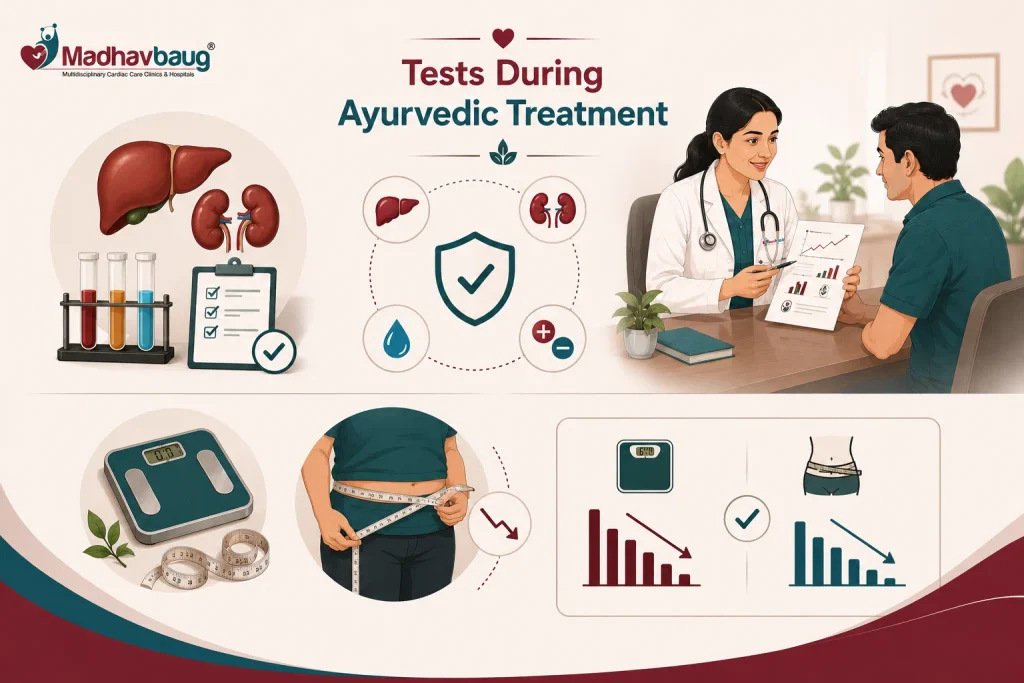
The health tests during Ayurvedic treatment are not the same for everyone. They depend on your condition, existing health problems, medicines and the type of treatment being considered. For example, someone with diabetes needs closer monitoring of blood sugar, while someone with hypertension needs regular blood pressure checks. Patients with heart or metabolic concerns may also need cholesterol, weight and waist measurements, while liver and kidney tests may be considered when longer courses of herbal formulations are involved.
| Health Tests | What It Helps Monitor | Conditions |
| Blood sugar and HbA1c | Current glucose levels and longer-term blood sugar control | Diabetes |
| Blood pressure | Changes in blood pressure over time and sometimes with 24-hour monitoring | Hypertension |
| Lipid profile | LDL, HDL and triglyceride levels linked to cardiovascular risk | Heart disease and metabolic conditions |
| Weight and waist circumference | Changes in body weight and abdominal fat | Obesity and metabolic conditions |
| Liver function tests | Liver health and any changes that may need attention during treatment | Particularly relevant with longer courses of herbal formulations |
| Kidney function tests | Kidney health and overall safety during treatment | Depending on the condition, medicines and treatment plan |
These tests are generally used alongside your symptoms, medical history and clinical assessment. A single reading can provide useful information, but repeated measurements are what show whether there is a meaningful trend over time.
That is why the next question is not simply “What tests are done?” but “Which blood tests matter for my ayurvedic treatment?”
For diabetes, blood sugar and HbA1c are important to monitor. For hypertension, the focus shifts to blood pressure and its pattern over time. For heart disease and obesity, cholesterol, weight, waist circumference and other relevant readings may also become important.
How Is Blood Sugar Monitored During Ayurvedic Treatment?
Blood sugar monitoring during Ayurvedic treatment for diabetes typically involves tracking both immediate glucose levels and HbA1c, a marker that reflects your average blood sugar over the past two to three months, at set points through your treatment. HbA1c specifically matters because it shows a trend, not just a single day’s reading.
In Madhavbaug’s own published research on a 90-day Panchakarma-based programme, patients with a baseline HbA1c of 6.6–9.0% were tracked at day 1, 30, 60, and 90, with average levels falling to 6.12% by the end of the programme (Kshirsagar, Lakariya and Khan, 2024).
This kind of structured, repeated testing is what an actual, documented result is for your doctor to act on. If your numbers aren’t improving as expected, that’s the signal to revisit your diabetes treatment plan.
How Is Blood Pressure Monitored During Ayurvedic Treatment?
Blood pressure monitoring during Ayurvedic treatment for hypertension usually involves readings taken at your consultation and follow-up visits, and sometimes over a 24-hour period.
Madhavbaug’s own retrospective research on a Panchakarma-based programme in patients with a known history of hypertension found significant improvement in blood pressure alongside exercise capacity after a minimum of 7 sessions (Sane et al., 2018).
The value here isn’t the treatment alone. It’s the treatment paired with a testing schedule that can actually confirm whether your hypertension is sustainably improving over time.
| Clinical Insight “Patients often bring in a single good blood pressure reading and feel reassured by it. We explain that one reading is a snapshot. What we’re actually watching for is the trend across several visits, which is a much more honest picture of how the treatment is working.” Dr. Gurudatta Amin, BAMS, MD, PGDEMS, 19+ Years of Clinical Experience, CMO, Madhavbaug |
Why Monitor Cholesterol and Lipid Levels during Ayurvedic Treatment?
Lipid profile testing, covering LDL, HDL, and triglycerides, matters during Ayurvedic treatment for heart disease and obesity because cardiovascular risk depends heavily on these numbers. Improvement in these readings shows that the treatment plan is working.
In a Madhavbaug study tracking cardiac patients on a Panchakarma-based programme over 90 days, HDL cholesterol improved from an average of 27.66 to 31.94 mmol/l with improvements in weight and abdominal girth over the same period (Muramkar, Kulthe and Ghadigaonkar, 2024).
Lipid testing is typically repeated at intervals throughout treatment, since this is what shows whether dietary and therapeutic changes are actually shifting your cardiovascular risk.
Why Are Liver and Kidney Function Tests Important?
Liver and kidney function tests are important during Ayurvedic treatment because the liver and kidneys play a central role in metabolism, processing nutrients and medicines, removing waste products, and maintaining the body’s fluid and electrolyte balance. Monitoring these functions gives your doctor useful information about how your body is responding to treatment and whether any part of the treatment plan needs to be adjusted.
The liver helps process nutrients and many substances used by the body, while the kidneys filter the blood and help regulate water, sodium, potassium and other electrolytes. This makes liver and kidney function tests useful when planning and monitoring treatment, particularly for people with chronic conditions or those undergoing longer treatment programmes.
Why Track Weight and Waist Circumference?
Weight and waist circumference are tracked during Ayurvedic treatment for obesity and related metabolic conditions because they’re simple markers that reflect real change in body composition and cardiovascular risk. Waist circumference is closely linked to the belly fat that is dangerous and affects metabolic risk.
In the same Madhavbaug study on cardiac patients, average weight fell from 68.31 kg to 63.82 kg, and abdominal girth from 93.56 cm to 88.22 cm over a 90-day Panchakarma-based programme (Muramkar, Kulthe and Ghadigaonkar, 2024).
These measurements are quick to take at every visit, which is exactly why they’re one of the most consistently tracked markers across almost any lifestyle disease programme, whatever your primary diagnosis.
How Is Ayurvedic Treatment Monitored Over Time?
Monitoring Ayurvedic treatment for chronic conditions includes your doctor comparing symptoms, examination findings and measurable health markers over time to see whether the treatment is producing a meaningful change. Blood sugar, HbA1c, blood pressure, cholesterol, weight and waist circumference are examples of measurements that can show progress more clearly than any single visit can.
The monitoring schedule depends on your condition and treatment plan. Some measurements may be checked at every visit, while blood tests and other investigations may be repeated at specific intervals. A structured approach commonly starts with baseline testing, followed by reassessment around day 30, day 60 and day 90, with further monitoring based on your health needs.
How Madhavbaug Monitors Your Progress
At Madhavbaug, monitoring is built into the treatment process. Our doctors review your test results, health readings and response to treatment during follow-up visits and use that information to decide whether the plan needs to continue or be adjusted.
Madhavbaug also uses digital tools such as the MIB Pulse app to support ongoing health tracking and follow-up. This can make it easier to keep relevant health information together and gives patients and doctors a clearer view of changes over time. For chronic conditions, this kind of continuous monitoring can be useful because treatment decisions are based on a pattern of readings.
This approach is particularly relevant for conditions such as diabetes, hypertension, heart disease and obesity, where progress is usually measured over weeks and months.
Madhavbaug’s published research also follows patients at defined points during structured programmes, including assessments at day 1, 30, 60 and 90, instead of relying only on how patients feel at the end of treatment.
The goal is straightforward. Know where you started, track what changes, and use those changes to guide the next step in treatment. That leads to an important practical question, “How often should these tests actually be repeated during Ayurvedic treatment?”
What Does the Follow-Up Testing Schedule Look Like?
A typical evidence-led Ayurvedic testing schedule for a chronic condition follows a definite pattern usually built around baseline testing followed by reassessment at regular intervals through your treatment. Here’s what that generally looks like:
| Baseline tests at first consultation ↓ Reassessment at ~day 30 ↓ Reassessment at ~day 60 ↓ Full reassessment at ~day 90 ↓ Ongoing periodic monitoring based on your condition |
Which specific tests are repeated at each point depends on your condition. A diabetes-focused plan will prioritise glucose and HbA1c, while a cardiac-focused plan will prioritise lipids, blood pressure, and cardiac markers, with liver and kidney function checked at baseline and periodically.
This is also why the monitoring plan should be decided before treatment begins. During a consultation, your doctor can review your diagnosis, existing reports, medicines and current health status to determine which measurements need to be tracked and when they should be repeated.
At Madhavbaug, this assessment forms part of the process of developing a personalised Ayurvedic treatment and monitoring plan. If you are considering Ayurvedic treatment for a chronic condition and want to understand which tests you may need and how your progress can be followed, a consultation can help you get a clearer plan based on your individual health needs.
Book a Consultation
The only way to know exactly which tests your own treatment plan should include is a proper clinical assessment, since the right testing schedule depends on your specific condition, its severity, and how you respond over time.
Madhavbaug’s network of over 350 clinics and hospitals across India combines Ayurvedic treatment for diabetes, heart disease, obesity and hypertension with structured, regular testing under the supervision of NCISM-registered Ayurvedic physicians. Book a consultation at your nearest Madhavbaug clinic to understand which health tests are relevant for your condition, how often they should be repeated, and how your progress can be monitored throughout your treatment.
If you want to understand exactly which tests will track your progress and safety during treatment, a consultation is the clearest way to get a plan built around your specific condition.
Frequently Asked Questions
What health tests are done during Ayurvedic treatment?
For chronic conditions, this typically includes blood sugar and HbA1c for diabetes, blood pressure monitoring for hypertension, a lipid profile and weight/waist measurements for cardiac and metabolic conditions, and liver and kidney function tests, particularly for anyone on longer courses of herbal formulations. Which tests apply, and how often, depends on your specific diagnosis.
Why are blood tests needed for Ayurvedic treatment?
Blood tests give your doctor objective, trackable evidence of whether your treatment is working. They’re also how a doctor catches early signs of anything that needs adjusting, including any effect on liver or kidney function during longer courses of herbal treatment.
How is Ayurvedic treatment monitored over time?
Monitoring typically follows a set schedule, with baseline tests at your first consultation and reassessments at defined points, often around day 30, 60, and 90 for a structured programme, tracking the specific markers relevant to your condition. Your doctor adjusts your treatment plan based on what these results show.
Are liver function tests necessary during Ayurvedic treatment?
For many patients, especially those on longer courses of complex herbal formulations, yes. Documented research has found that Ayurvedic herbal formulations carry an uncommon but real risk of affecting the liver, which is exactly why baseline and periodic liver function testing is a sensible, standard part of supervised treatment.
How often should blood sugar be checked during Ayurvedic treatment for diabetes?
This varies by individual, but structured programmes often check blood sugar and HbA1c at baseline and again at intervals such as day 30, 60, and 90, so trends can be tracked over time instead of relying on a single reading.
Does Ayurvedic treatment replace regular blood tests with pulse or Prakriti assessment?
No. Prakriti assessment and clinical evaluation add personalising context to your treatment, but they work alongside objective test results, not instead of them, in an evidence-led Ayurvedic practice.
Related Reading
- Smart BP Monitors and Ayurveda
- Continuous Glucose Monitoring and Ayurveda
- Early Detection and Prevention for Diabetes, BP and Heart Disease
- Prediabetes and Ayurveda: A 90-Day Lifestyle Action Plan
- Ayurvedic Medicine for High BP: Safety and Evidence
- Our Published Research
References
Kshirsagar, J., Lakariya, A. and Khan, S. (2024) ‘Impact of ayurvedic panchakarma along with lifestyle modification in restoring glucose tolerance in type 2 diabetics‘, International Journal of Basic & Clinical Pharmacology, 13(5), pp. 669–672.
Sane, R., Gond, B., Raje, G., Walzade, K., Badre, A. and Mandole, R. (2018) ‘Ischemia Reversal Program (IRP) in patients suffering from ischemic heart disease (IHD) with known history of hypertension: a retrospective study‘, Journal of Ayurveda Medical Sciences, 3(2), pp. 377–383.
Muramkar, P.S., Kulthe, N. and Ghadigaonkar, P. (2024) ‘Effect of ayurveda-based panchakarma and lifestyle modification on global longitudinal strain in cardiac disorder patients‘, International Journal of Advances in Medicine, 11(6), pp. 566–570.
Philips, C.A., Ahamed, R., Rajesh, S., George, T., Mohanan, M. and Augustine, P. (2020) ‘Comprehensive review of hepatotoxicity associated with traditional Indian Ayurvedic herbs‘, World Journal of Hepatology, 12(9), pp. 574–595.




 Locate a Centre
