
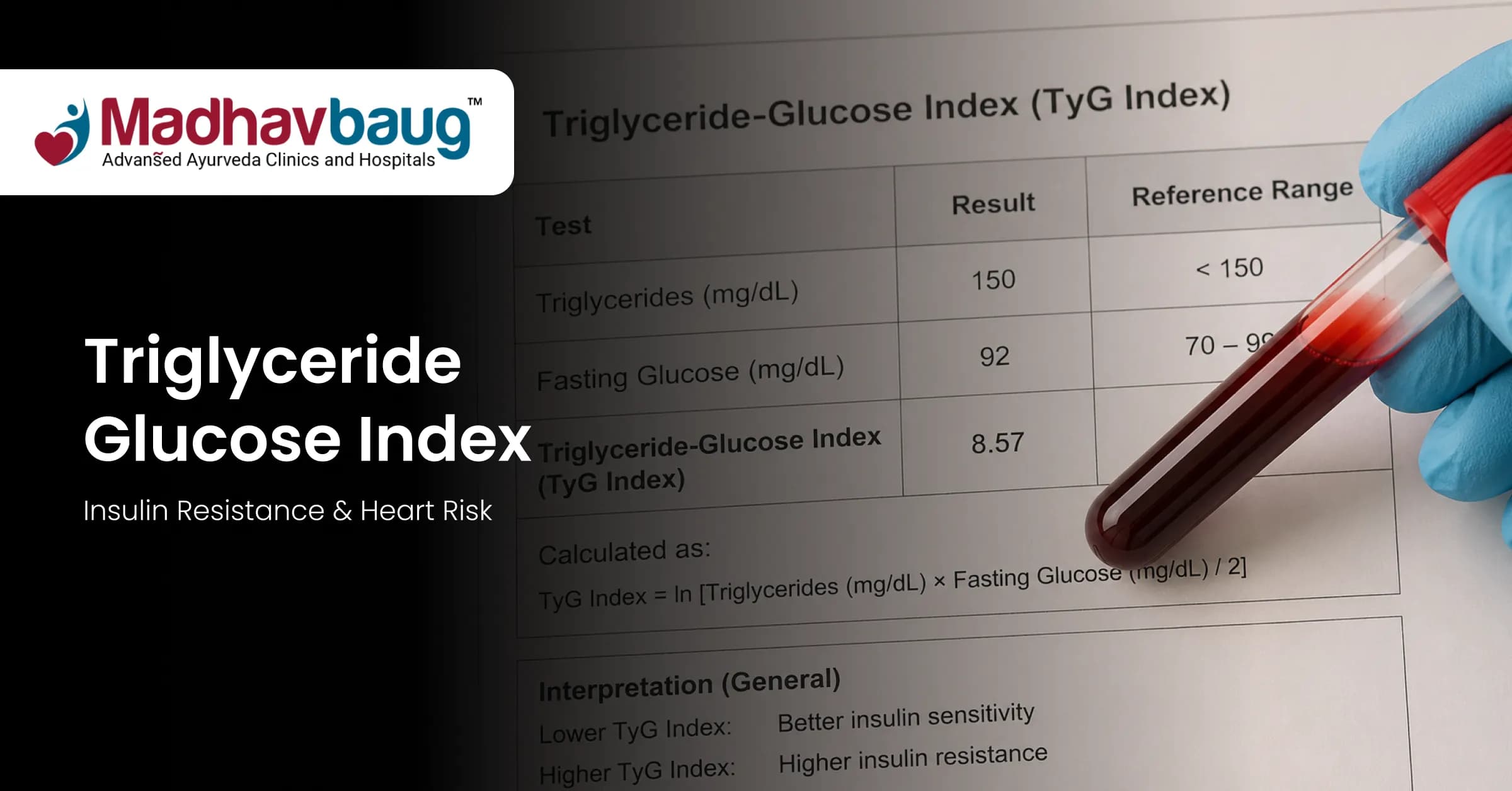

Cholesterol and blood sugar reports can look normal on their own, yet there may be a risk for developing diabetes or heart disease. That is because these two numbers can hide a problem when checked separately but become visible once they are looked at together. This is what the triglyceride-glucose index is designed to catch.
At Madhavbaug, the Triglyceride-Glucose Index (TyG) is taken seriously and is treated as a starting point to make necessary changes rather than waiting till full diabetes develops, an approach backed by the brand’s own published research and clinical trials.
This guide explains what the TyG index measures, how it connects to insulin resistance and heart health, and why the cut-offs are not something you should interpret on your own.
What Is the Triglyceride-Glucose Index?
The TyG index combines two values from a routine blood test, your fasting triglyceride level and your fasting blood glucose level, into a single number.
Triglycerides are a type of fat in your blood. When triglyceride levels stay high for too long, along with high blood sugar, it can signal that your body may indicate an imbalance in insulin.
The TyG index was first developed as a simple alternative to more complex insulin resistance tests (Guerrero-Romero et al., 2010), since fasting triglycerides and fasting glucose are already part of a standard blood test.
The calculation itself is something your doctor or lab will handle, not something you need to do yourself.
What makes the TyG index useful is that it brings these two values together to give a fuller picture of how your body is handling sugar and fat, rather than looking at either one alone.
It is worth being clear that the TyG index is used only for screening and is not a diagnostic tool. A raised result is a signal to discuss further testing with a doctor, not a confirmation of any specific condition.
How the TyG Index Relates to Insulin Resistance
A raised TyG index usually points to insulin resistance. In simple terms, this means your cells stop responding to insulin, so the body keeps making more of it just to maintain blood sugar levels. If this goes on for too long, it can raise your risk for type 2 diabetes and heart disease.
Triglycerides and blood sugar tend to rise together. When the body becomes insulin resistant, the liver makes more triglycerides, and blood sugar gets harder to control. Checking both together, instead of just one, gives a clearer picture of what is actually going on.
Studies have confirmed that the TyG index is a reliable screening tool for insulin resistance and can perform really well when compared to standard tests (Chauhan et al., 2026).
Who Should Pay Attention to the TyG Index?
A few groups tend to come across this index more than others, mostly after a routine blood test. It includes people with:
- A family history of diabetes
- Borderline or high triglycerides on an otherwise normal blood report
- Extra weight around the belly
- Ongoing treatment for high blood pressure or early heart disease
For this last group, the TyG index is often checked as part of a wider picture, since a doctor managing diabetes, blood pressure or heart disease is usually looking at several blood results together, given how closely these conditions overlap.
What Are the Limits of the TyG Index, and Why Do Cut-Offs Vary?
Unlike a blood pressure or blood sugar reading, the TyG index does not come with one universal cut-off that applies to everyone.
Research shows that TyG values above roughly 4.5 to 4.7 can be a warning sign, and one should consult a doctor if that is the case.
At the same time, it is important to understand that studies have proposed different values for raised results, and these can change in different settings (Sánchez-García et al., 2020).
| What can affect TyG cut-offs | Why it matters |
| Population studied | Cut-offs developed in one country or group may not be the same for others |
| Laboratory methods | Small differences in how triglycerides and glucose are measured can change the result |
| Body weight and existing conditions | Underlying health factors can impact the results |
Because of this variation, the same TyG number can mean different things for different people. A doctor interpreting the result will usually weigh it against your overall health profile, rather than comparing it to a single fixed number.
Triglycerides, Glucose and Heart Risk
When triglycerides and blood sugar remain high together for a longer period, they place extra strain on blood vessels, which can raise heart disease risk.
A study following patients with high blood pressure (Dakota et al., 2025) found that a higher TyG index was linked to a greater chance of heart attack and stroke.
Similarly, another study (Moon et al., 2023) found that a rising TyG index predicted future heart disease.
This is why the TyG index has now found its place in heart disease screening, which is also why understanding and preventing heart disease often means looking at tests like this one well before symptoms appear.
Tests to Discuss With Your Doctor
The TyG index works best as a starting point and not a final result. If your number looks raised, a few follow-up tests can help get a clearer picture before deciding on next steps.
| Test | What it checks |
| HbA1c | Average blood sugar over the past three months |
| Fasting blood sugar test | Blood sugar levels after an overnight fast |
| Fasting lipid profile | Triglycerides, high-density lipoprotein (HDL), and low-density lipoprotein (LDL) levels in detail |
| Fasting insulin (if available) | A more direct insulin resistance test |
| Blood pressure check | Since insulin resistance is often linked to high blood pressure |
A doctor will usually look at the results and will also consider your weight, waist size, and family history, rather than relying on any single number. This combined view, the same approach used across diabetes, hypertension, and heart disease care at Madhavbaug, is what makes early care possible before complications develop.
If your reports come back with a few borderline numbers rather than one clearly abnormal result, it is worth discussing with a doctor, since insulin resistance often shows up as several mild changes way before any single test shows high numbers.
Ayurvedic Tips to Improve Insulin Health
At Madhavbaug, lowering insulin resistance is approached as a daily lifestyle correction and not a one-time fix. Working on these habits matters because they are often what cause the imbalance in the first place and what help reverse it too.
This is the philosophy behind the brand’s Ayurvedic Diet and Lifestyle Guide, which works on the root cause of the problem.
Panchakarma and structured care
Madhavbaug’s diabetes reversal programme brings these elements together into one personalised plan.
Panchakarma detox therapies include:
- Virechana (therapeutic purgation): Clears toxins from the gut and liver and restores digestive strength (Agni), supporting better glucose regulation
- Basti (medicated enema): Helps with detoxification and regulates fat metabolism.
- Swedan (induced sweating therapy): Heat therapy helps eliminate toxins through sweating while also reducing stress
Together, these Panchakarma therapies are designed to rejuvenate the organs involved in glucose metabolism and support the body’s own insulin response.
Alongside these therapies, targeted Ayurvedic herbal medicines work to support insulin sensitivity, protect against complications, and address the root cause of diabetes.
Diet and eating habits
For people managing insulin resistance linked to high blood sugar, Madhavbaug’s Prameha Diet Kit is a 28-day Ayurvedic meal plan, which is built around an 800-calorie structure, slow-release carbohydrates, pulses and millets, and balanced plant-based protein. It is specifically designed to improve insulin sensitivity while reducing fat stored in the liver and around the belly.
Along with this, eating mindfully, eating slowly and stopping before you feel full help avoid the repeated blood sugar spikes that come with overeating.
Movement and daily routine
Madhavbaug’s programme incorporates Dinacharya, the Ayurvedic practice of keeping a consistent daily rhythm, into patient routines, including regular mealtimes, sleeping early, and waking before sunrise. This structured rhythm is paired with movement recommendations to help the body use glucose more efficiently over time.
Stress and monitoring
Stress plays a bigger role here than most people realise. Higher stress hormone levels can actively worsen insulin resistance. Patients are guided through simple daily practices, such as meditation or deep breathing, as part of their overall plan.
The goal is to restore the body’s natural insulin response over time, rather than only managing the symptoms that come with it.
Final Thoughts
The TyG index is a simple, low-cost way to identify insulin resistance early, before it shows up as prediabetes or high cholesterol on a standard report. On its own, it cannot diagnose anything, but as part of a routine check, paired with the right follow-up tests and consistent lifestyle changes, it can help you start prevention early, before complications develop.
A number like this is easy to overlook without the right guidance. Book a consultation with Madhavbaug to understand what yours means and what to do next.
Frequently Asked Questions (FAQs)
What is the triglyceride-glucose index?
The triglyceride-glucose (TyG) index is a calculation that combines fasting triglyceride and fasting blood glucose levels into a single number and is used as a screening tool for insulin resistance.
How do you calculate the TyG index?
The TyG index is calculated by combining your fasting triglycerides and fasting glucose levels using a simple formula. You don’t need to work it out yourself; your doctor or lab can calculate it directly from a standard fasting blood test report.
What is a normal triglyceride-glucose index?
There is no single fixed normal value as such, since cut-offs vary across different people. Research has generally placed raised TyG values in the range of 4.5 to 4.7 and above, but this should always be interpreted by a doctor rather than compared against one universal number.
What is a good TyG index score?
A lower TyG index generally reflects better insulin sensitivity, while a higher value suggests greater insulin resistance. Since exact cut-offs differ, what counts as a good score is best discussed with a doctor alongside your other test results, rather than judged against a single figure.
Should I get tested for the TyG index if I feel fine?
Insulin resistance often develops without obvious symptoms. If you have risk factors such as a family history of diabetes, weight gain around your belly, or borderline cholesterol, it is worth asking your doctor whether checking your TyG index makes sense, even without symptoms.
References
- Guerrero-Romero F, Simental-Mendía LE, González-Ortiz M, Martínez-Abundis E, Ramos-Zavala MG, Hernández-González SO, Jacques-Camarena O, Rodríguez-Morán M. The product of triglycerides and glucose, a simple measure of insulin sensitivity. Comparison with the euglycemic-hyperinsulinemic clamp. J Clin Endocrinol Metab. 2010;95(7):3347-3351.
- Chauhan R, Jain S, Malukar N, Pathak J, Ajmera M, Mishra S, Verma M. Utility of surrogate markers for insulin resistance: homeostasis model assessment for insulin resistance (HOMA-IR) and triglyceride-glucose (TyG) index in identifying metabolic syndrome among adults from resource-limited settings. touchREVIEWS in Endocrinology. 2026;22(1):45-53.
- Sánchez-García A, Rodríguez-Gutiérrez R, Mancillas-Adame L, González-Nava V, Díaz González-Colmenero A, Solis RC, Álvarez-Villalobos NA, González-González JG. Diagnostic accuracy of the triglyceride and glucose index for insulin resistance: a systematic review. Int J Endocrinol. 2020;2020:4678526.
- Dakota I, Huang W, Wijayanto MA, Nurhafizah A, Khairunnisa AR, Rachmayanti S, Yuliana E, Sunjaya AF, Siswanto BB. Prognostic value of triglyceride-glucose index on predicting major adverse cardiovascular events in hypertensive patients: a systematic review and meta-analysis. Am J Prev Cardiol. 2025;22:100996.
- Moon JH, Kim Y, Oh TJ, Moon JH, Kwak SH, Park KS, Jang HC, Choi SH, Cho NH. Triglyceride-glucose index predicts future atherosclerotic cardiovascular diseases: a 16-year follow-up in a prospective, community-dwelling cohort study. Endocrinol Metab (Seoul). 2023;38(4):406-417.





 Locate a Centre
