
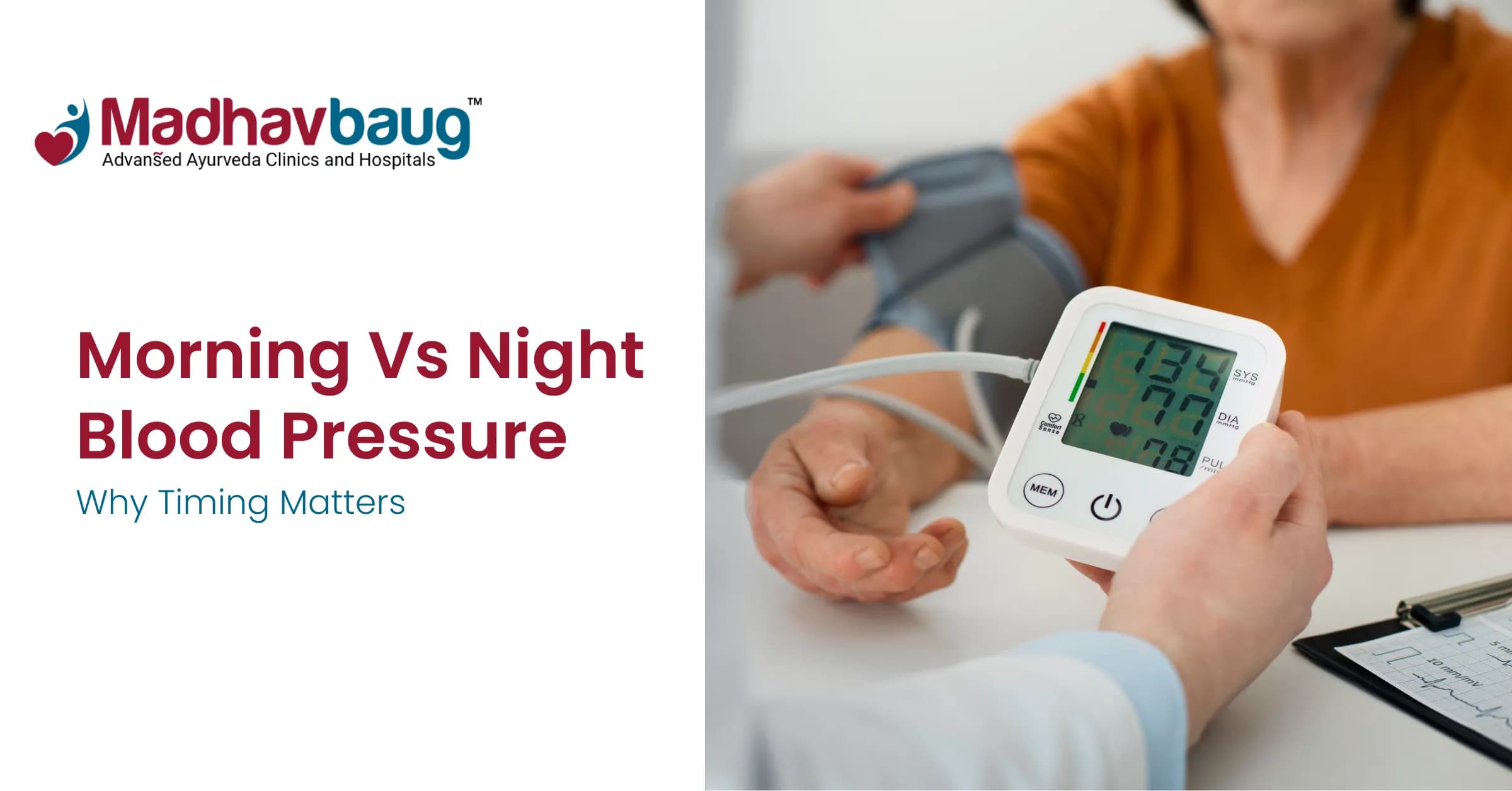
You check your blood pressure in the morning and the reading looks fine. You check again at night and it is noticeably different. Such variation happens to a lot of people. Your blood pressure is supposed to change throughout the day. What you should pay attention to is that the readings are within a healthy range and that you are measuring at the right times to understand what is going on with your heart.
This is not a small detail. Knowing when to check, what to look for, and the difference between your morning and nighttime readings can improve your blood pressure management.
Why Blood Pressure Changes Through the Day
Your body runs on a 24-hour biological cycle called the circadian rhythm. This cycle takes care of your sleep, hormones, digestion, and blood pressure. Blood pressure is not a fixed number; it rises and falls in a predictable pattern every single day.
Here is a table to help you understand a typical blood pressure cycle:
| Time of Day | What Happens to Blood Pressure |
| Early morning (6 AM to 10 AM) | Sharp rise due to hormone release |
| Mid-morning to afternoon | Gradual decrease to normal range |
| Evening | Another smaller rise could be seen |
| During sleep | There should be a drop of 10 to 20%. |
| 3 AM to 5 AM | Typically at its lowest |
Understanding this rhythm is the foundation of effective blood pressure tracking.
The Morning Blood Pressure Reading
When you wake up, your body does not ease into the day quietly. Stress hormones rise as part of the body’s natural waking mechanism. This causes a rise in blood pressure, often referred to as the morning surge.
For most people, blood pressure peaks between 6 AM and 10 AM. This period is also the window when heart attacks and strokes occur most frequently, which is why morning blood pressure is a very important reading.
What to Watch for in Morning Readings:
- A reading that is continuously high before you eat, take medication, or move around is a clear indicator that your blood pressure is not being controlled overnight.
- A very sharp rise in your blood pressure in the morning, even in people whose overall blood pressure appears managed, is linked to higher heart risk.
- The morning reading is supposed to be your baseline blood pressure reading after a night of proper rest
How to Take a Morning Reading Correctly:
- Sit quietly for 5 minutes before measuring
- Measure before eating, drinking tea or coffee, or taking medication
- Take two readings, one minute apart, and note the average
- Measure at the same time every morning
The Nighttime Blood Pressure Reading
Here is something that surprises many people: nighttime blood pressure is now being considered a stronger predictor of heart risk than morning readings.
During healthy sleep, blood pressure naturally dips by 10 to 20%. This is called nocturnal dipping, and it gives your heart and blood vessels a small window to recover and repair. When this dip does not happen, or when blood pressure starts to rise instead of lowering at night, the heart is under continuous strain with no recovery period.
The four nighttime blood pressure patterns:
| Pattern | What It Means | Risk Level |
| Dipper | 10 to 20 % drop during sleep | Normal and healthy |
| Non-dipper | Less than 10 % drop | Elevated risk |
| Extreme dipper | More than 20 % drop | May indicate other issues |
| Riser | BP increases during sleep | Highest Heart risk |
People with no decrease or rise in blood pressure at night are more prone to stroke, heart failure, and kidney disease, even when their daytime readings appear normal. This phenomenon is why relying only on daytime readings can give a dangerously incomplete picture.
Morning vs Night: A Direct Comparison
| Factor | Morning BP | Nighttime BP |
| What controls it | Hormone activity | Nervous system at rest, sleep quality |
| What it tells you | Baseline and effectiveness of your medication | Heart’s recovery and hidden hypertension |
| Risk if elevated | Stroke, heart attack risk in morning hours | Organ damage, uncontrolled hypertension |
| How to check | Before eating, medication, or activity | Through a home monitor or a 24-hour ambulatory device |
| Most useful for | Daily tracking and medication routine | Identifying masked hypertension |
When Home BP Monitoring Becomes Essential
If your readings at a clinic seem normal but you have symptoms like early morning headaches, fatigue, or irregular readings at different times of day, monitoring your blood pressure at home provides the information that a single clinic visit cannot.
Good home monitoring habits:
- Check at the same time daily: once in the morning and once in the evening
- Log every reading with the date and time
- Share the readings with your doctor regularly
- Avoid measuring immediately after eating, exercise, or stress
Home blood pressure tracking over two to four weeks gives a far more accurate picture than any single reading.
Not Sure What Your Readings Mean?
If your morning readings and nighttime patterns are inconsistent, or if you have been managing hypertension and are not seeing the results you expected, a structured evaluation can help identify what is really going on.
Madhavbaug Advanced Ayurveda Clinics and Hospitals specialise in cardiovascular care, including blood pressure management. Our team assesses your full blood pressure pattern, lifestyle, and any underlying imbalances to create a personalised treatment plan that works.
Book a consultation at your nearest Madhavbaug centre today.
What Ayurveda Says About Blood Pressure Timing
Ayurveda has its own deeply detailed understanding of the body’s daily rhythm, and it maps closely onto what modern research is now confirming about blood pressure.
In Ayurveda, the day is divided into cycles governed by the three doshas: Vata, Pitta, and Kapha. Each dosha has a timing in which peak activity takes place and disruption in those periods directly affects the heart and blood vessels.
As Dr Partap Chauhan, founder of Jiva Ayurveda and one of India’s leading Ayurvedic physicians, has long observed, blood pressure fluctuations are rarely just a physical problem. They reflect the state of the body’s internal rhythms, and restoring those rhythms is what brings lasting stability.
How the Doshas Relate to Blood Pressure Timing:
The early morning hours, from 2 AM to 6 AM, are governed by Vata. When Vata is increased, the body is overstimulated, adding to the morning surge in blood pressure. People with a Vata-dominant constitution or Vata imbalance are more prone to sharp morning spikes.
From 10 AM to 2 PM and again from 10 PM to 2 AM, Pitta dominates. Pitta manages heat, inflammation, and circulation. An increased Pitta creates heat in the blood, raises pressure, and disrupts the nighttime dip. .
How Ayurveda Regulates Blood Pressure:
Dinacharya (structured daily routine): Going to bed before 10 PM and waking before 6 AM aligns with the body’s doshic cycles and supports a healthy nighttime dip in blood pressure. This is one of Ayurveda’s most powerful and underused hypertension prevention tools.
Arjuna (Terminalia arjuna): Ayurveda’s primary heart herb. It strengthens the cardiac muscle, supports healthy heart function, and helps regulate blood pressure over time. It is most effective when taken routinely.
Ashwagandha (Withania somnifera): Works on the hormone responses, which directly reduce the intensity of the morning blood pressure surge. It also supports restful sleep, which protects the nighttime dip.
Brahmi (Bacopa monnieri): Calms the body and supports the depth of sleep, both of which are important for maintaining healthy nighttime blood pressure patterns.
Shirodhara: A medicated oil therapy applied to the forehead that has a measurable calming effect on the body. It lowers stress hormones, slows heart rate, and helps restore the nighttime dip for people who do not experience any decrease in their blood pressure at night.
Panchakarma: Ayurveda’s body cleansing protocols, particularly Virechana (therapeutic cleansing) and Basti (medicated enema), clear accumulated toxins from the blood channels and reduce vascular inflammation over the treatment period.
Pranayama: Anulom Vilom and Bhramari breathing are both recommended as part of the daily routine. Practised in a routine, they reduce sympathetic nervous system activity, bring down stress hormones, and support both morning and nighttime blood pressure stability.
The Ayurvedic approach recognises that blood pressure is not just a number to be pushed down with medication. It is a signal from the body about how well its internal rhythms, digestion, stress response, and sleep are functioning. Addressing all of these together produces lasting results.
Take the Next Step Towards Stable Blood Pressure
Whether it is a morning surge that you cannot seem to bring under control, nighttime readings that are not dipping as they should, or fluctuating patterns that your current treatment is not resolving, there is a structured and personalised path forward.
Madhavbaug Advanced Ayurveda Clinics and Hospitals combine classical Ayurvedic treatment with evidence-based lifestyle protocols to address the full picture of your blood pressure health. Our team has helped thousands of patients bring their numbers under control sustainably, without depending on medication alone.
Visit your nearest Madhavbaug centre or book an online consultation.
This article is for informational purposes only. Please consult a qualified healthcare professional before making any changes to your treatment plan.
Frequently Asked Questions
Q: Which BP reading is more important, morning or night?
Both are important. Morning and evening readings give the most complete picture of your blood pressure.
Q: Is it better to have high blood pressure at night or in the morning?
Neither. It’s better to have normal BP at both times. However, high BP at night (nighttime hypertension) is more dangerous, as it suggests uncontrolled hypertension and organ damage risk.
Q: Why is BP high in the morning and normal at night?
BP rises in the morning due to the release of cortisol and adrenaline, which wake your body up. This is a natural circadian rhythm. If it drops normally at night, your body is recovering well.
Q: What is the “silent killer” blood pressure?
High blood pressure (hypertension) is called the “silent killer” because it typically has no symptoms but can lead to heart attack, stroke, and kidney disease without you knowing.
Q: What time of day is BP highest?
BP peaks in the early morning (6 AM–10 AM) and can also rise slightly in midday. It’s typically lowest during sleep (3 AM–5 AM).
References:
- Takeshi Fujiwara, Satoshi Hoshide, Hiroshi Kanegae, Masafumi Nishizawa, Kazoumi Kario, 2018, Reliability of morning, before‐dinner, and at‐bedtime home blood pressure measurements in patients with hypertension, available at https://pmc.ncbi.nlm.nih.gov/articles/PMC8030996/



 Locate a Centre
