


Key Takeaways
|
If you’re taking high blood pressure treatment and considering Ayurveda alongside it, safety is the right first question to ask. This guide covers whether Ayurveda with blood pressure medicine is safe, the real risks and interactions to know about, how blood pressure should be monitored, the warning signs of blood pressure dropping too low, and why any medicine change needs to go through your doctor.
Can You Combine Ayurveda With Blood Pressure Medicine?
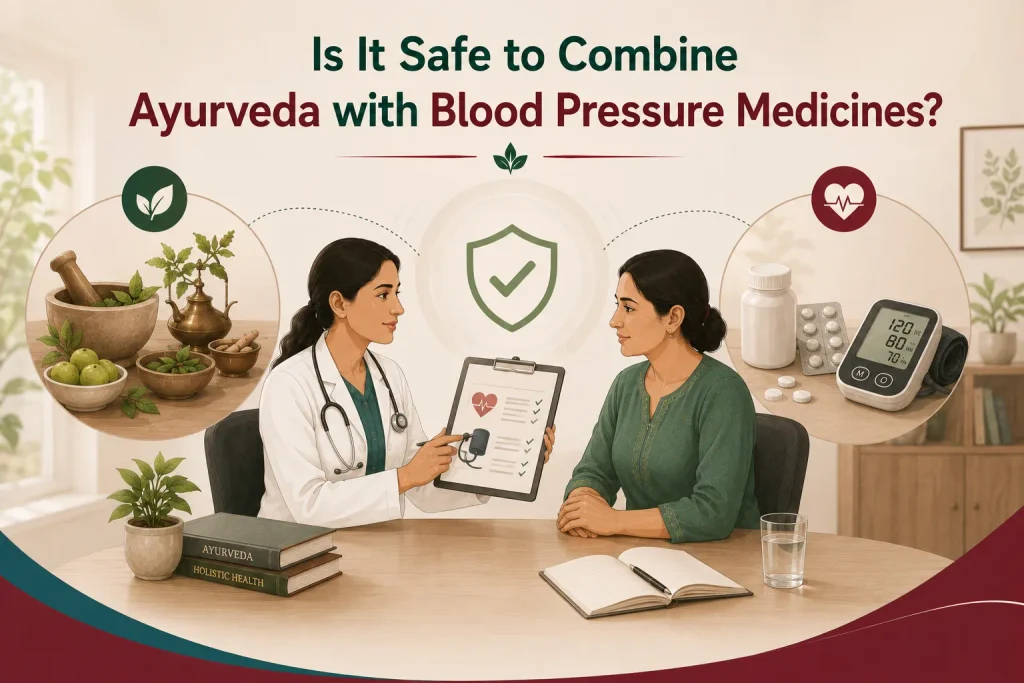
Yes, Ayurveda can generally be used alongside blood pressure medicine, but only under proper medical supervision. The key requirement is that your Ayurvedic doctor knows exactly what blood pressure medicine you’re taking and at what dose. Managing hypertension naturally typically works through diet, Panchakarma-based therapies, and herbal formulations, alongside your existing medicine.
“After starting Ayurveda treatment, the blood pressure is monitored strictly. If blood pressures come down, then only then are allopathic medicines tapered with regular follow-up and monitoring.”
—Dr. Deepali Joshi, Clinic Head, B.A.M.S., Preventive Cardiologist.
If you’re taking blood pressure medicine but considering Ayurveda treatment to avoid lifelong medication, a consultation is the safest way to combine both under proper supervision.
What Are the Risks of Taking Ayurveda and BP Medicine Together?
Taking Ayurvedic treatment alongside blood pressure medicine requires proper medical supervision. The main concern is whether a particular herbal formulation or therapy could affect your blood pressure or change the way your existing medicine works.
At Madhavbaug, integrative care is planned around your existing medical treatment. Before recommending Ayurvedic treatment, our doctor reviews your current medicines, supplements, health history, blood pressure readings and relevant test reports. This helps identify possible risks and interactions and select an approach that is appropriate for your health needs.
Some herbs can affect blood pressure or interfere with certain medicines. Liquorice, for example, can raise blood pressure and may affect blood pressure control. This is why patients should tell their doctor about all herbal products, supplements and home remedies they are taking. A 2024 review also found that several unrecognised herbal products can interact with medicines used to treat high blood pressure (Nyulas et al., 2024).
How Madhavbaug Manages These Risks
| Current medicines and supplements reviewed ↓ High blood pressure symptoms and relevant reports assessed ↓ Possible medicine and herb interactions considered ↓ Ayurvedic treatment selected according to individual needs ↓ Blood pressure and response monitored during follow-ups ↓ Treatment adjusted when required |
This allows Ayurvedic hypertension treatment to be incorporated while continuing appropriate medical monitoring. Blood pressure medicines should not be stopped or reduced without guidance from the doctor managing your treatment.
| Clinical Insight “Patients often assume that natural products cannot affect their medicines. Some herbs can influence blood pressure or change how medicines work. That is why we review everything a patient is taking before planning Ayurvedic treatment and continue to monitor their response during follow-ups.” Dr. Gurudatta Amin, BAMS, MD, PGDEMS, 19+ Years of Clinical Experience, CMO, Madhavbaug |
How Should Blood Pressure Be Monitored When Combining Ayurvedic Medicine with BP Tablets?
Blood pressure should be checked regularly when you’re combining treatments, since this is what confirms the two are working together safely, not against each other. Monitoring becomes more important when you’re on more than one form of treatment.
Madhavbaug’s published research on a Panchakarma-based programme in patients with a known history of hypertension found significant improvement in blood pressure and exercise capacity after a minimum of 7 sessions (Sane et al., 2018).
Research of Ayurvedic interventions for essential hypertension found meaningful reductions in blood pressure compared with placebo (Deshmukh et al., 2025).
These results come from monitored, supervised programmes, with blood pressure tracked throughout the treatment plan. This is what confirms whether your combined treatment is genuinely helping, and it’s also what detects early and warning signs of low blood pressure.
Can the Combination of Treatments Lead to Low Blood Pressure?
Combining treatments that both lower blood pressure may cause it to drop too low, so it’s worth knowing the warning signs. These include dizziness or light-headedness, especially on standing, unusual fatigue, blurred vision, fainting, or a noticeably slower or irregular heartbeat.
If you notice any of these symptoms while on combined treatment, contact your doctor immediately instead of waiting for your next scheduled visit. This is exactly the kind of change your monitoring follow-up schedule is planned for, but symptoms between visits still need prompt attention.
Don’t adjust either medicine yourself in response to these symptoms. Contact your doctor and let them guide the next step.
How Madhavbaug Supports Safe Integrative Care
At Madhavbaug, before starting Ayurvedic treatment, the doctor reviews your blood pressure readings, current medicines, health history and relevant test reports. This helps the doctor choose appropriate therapies and identify factors that may affect your blood pressure.
The treatment is then monitored through regular follow-ups so that changes in blood pressure or symptoms can be identified early.
| Step | What Happens |
| Review | Your current medicines, supplements, health history and blood pressure readings are reviewed. |
| Assessment | Relevant reports and your current health condition are assessed before treatment is planned. |
| Personalised Care | An ayurvedic diet plan, lifestyle and exercise guide, therapies or formulations may be recommended based on your individual needs. |
| Monitoring | Blood pressure and your response to treatment are checked during follow-ups. |
| Adjustment | The treatment plan can be modified if your blood pressure, symptoms or other health markers change. |
This approach is particularly important if you are already taking medicines for hypertension, heart disease or other chronic conditions. Do not reduce or stop prescribed blood pressure medicine because your readings improve unless the doctor managing your medication advises you to do so.
Book a Consultation
If you are taking blood pressure medicine and considering Ayurvedic treatment, a consultation can help determine how the two can be managed together safely. Our doctors review your current treatment, recent reports and blood pressure readings before recommending an appropriate Ayurvedic approach.
Madhavbaug provides Ayurvedic care for hypertension and heart disease across its 350+ clinics and hospitals in India, with treatment planned around the patient’s existing health needs and regular monitoring. Consultations are conducted under the supervision of our NCISM-registered doctors, with relevant health measurements reviewed during follow-up visits.
If you want to explore Ayurvedic treatment while continuing your blood pressure medicine, book a consultation at your nearest Madhavbaug clinic to have your current treatment and health status reviewed together.
If you’re on blood pressure medicine and want to explore Ayurveda safely alongside it, a consultation is the place to start.
Frequently Asked Questions
Is it safe to take Ayurvedic medicine with blood pressure tablets?
It can be when a qualified doctor knows your full medicine list and monitors your blood pressure regularly. Some herbs, like liquorice, are documented to interact with blood pressure medicines, which is why supervision, not self-directed combination, is what makes this safe.
Can Ayurveda and allopathic BP medicine be taken together?
Yes, this is a common approach, with Ayurvedic treatment used alongside prescribed blood pressure medicine. Any change to your medicine dose should only be made by your doctor based on monitored results.
Will Ayurveda reduce my need for blood pressure medicine?
It’s possible, but this decision is based on your monitored results over time and is made only by your doctor. Never reduce or stop your blood pressure medicine on your own, even if you feel your blood pressure has improved.
What symptoms suggest my blood pressure has dropped too low?
Dizziness or light-headedness, especially on standing, unusual fatigue, blurred vision, fainting, or a noticeably slower or irregular heartbeat can all suggest low blood pressure. Contact your doctor promptly if you notice these while on combined treatment.
Should I tell my Ayurvedic doctor everything I’m taking for blood pressure?
Yes, including your exact medicine names and dosages. Research on patients with chronic conditions has found that many don’t disclose full treatment details, often simply because they weren’t asked. A complete list is what allows your doctor to check for interactions and monitor you safely.
Related Reading
- Ayurvedic Medicine for High BP: Safety and Evidence
- Managing Hypertension Naturally with Ayurveda
- Morning Blood Pressure Surge: Causes, Risks and Routine
- 5 Ways Recommended by Ayurveda to Control Blood …
- High Blood Pressure Treatment Without Lifelong Medication
- Sustainable Relief from Constantly High Blood Pressure
References
Nyulas, K-I., Simon-Szabó, Z., Pál, S., Fodor, M-A., Dénes, L., Cseh, M.J., Barabás-Hajdu, E., Csipor, B., Szakács, J., Preg, Z., Germán-Salló, M. and Nemes-Nagy, E. (2024) ‘Cardiovascular effects of herbal products and their interaction with antihypertensive drugs — comprehensive review‘, International Journal of Molecular Sciences, 25(12), article 6388.
Deshmukh, S., Choudhary, K., Ahmad, A., Reddy, G., Rao, B.C.S., Srikanth, N. and Acharya, R. (2025) ‘Effectiveness and safety of Ayurvedic intervention in essential hypertension: a systematic review with meta-analysis‘, Frontiers in Pharmacology.
Sane, R., Gond, B., Raje, G., Walzade, K., Badre, A. and Mandole, R. (2018) ‘Ischemia Reversal Program (IRP) in patients suffering from ischemic heart disease (IHD) with known history of hypertension: a retrospective study‘, Journal of Ayurveda Medical Sciences, 3(2), pp. 377–383.
Foley, H., Steel, A., McIntyre, E., Harnett, J., Sibbritt, D. and Adams, J. (2021) ‘Disclosure of conventional and complementary medicine use to medical doctors and complementary medicine practitioners: a survey of rates and reasons amongst those with chronic conditions‘, PLoS ONE, 16(11), e0258901.




 Locate a Centre
