

| Quick answer Chest discomfort remains the most common heart-attack symptom in women, but women are more likely to experience additional symptoms such as breathlessness, nausea, unusual fatigue, dizziness, and back or jaw discomfort. Women are also more likely to have non-obstructive or small-vessel disease, while PCOS, early menopause and pregnancy complications can add important lifetime risk information. |
| Emergency warning Seek emergency medical care immediately for new or persistent chest pressure, squeezing or discomfort, especially when accompanied by breathlessness, sweating, nausea, fainting, marked weakness, or pain spreading to the arm, jaw, neck or back. Do not wait for symptoms to become “classic.” |
Introduction
Cardiovascular disease is the leading cause of death globally, and ischaemic heart disease remains the world’s single largest cause of death.[1] Yet heart disease in women is still frequently recognised late because symptoms, risk histories and patterns of coronary disease do not always fit the stereotype of a middle-aged man with crushing chest pain.
The encouraging message is that many major risk factors like high blood pressure, diabetes, abnormal cholesterol, tobacco exposure, inactivity and central obesity, can be identified and treated. The key is a personalised assessment that includes both traditional risk factors and a woman’s reproductive and hormonal history.
1. What is coronary artery disease?
Coronary artery disease (CAD), also called coronary heart disease or ischaemic heart disease, develops when the heart muscle does not receive enough oxygen-rich blood. Atherosclerotic plaque in the coronary arteries is a common cause, but CAD is not limited to a single large blockage.
Clinicians may describe several patterns:
- Obstructive CAD: one or more larger coronary arteries are significantly narrowed by plaque.
- Non-obstructive CAD: plaque or impaired blood flow is present without a major artery being severely narrowed.
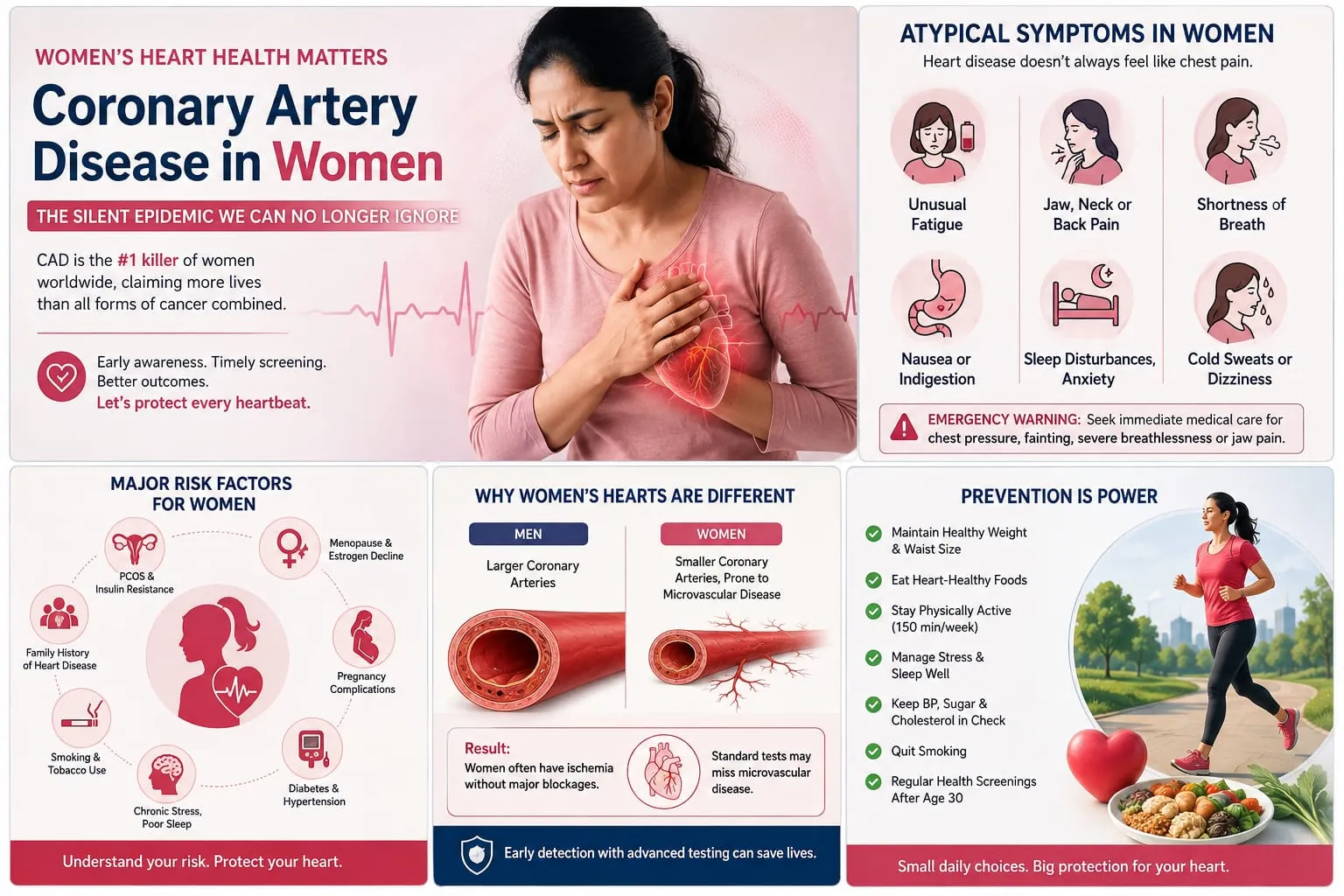
- Coronary microvascular dysfunction: the small vessels within the heart do not dilate or function normally. This pattern is more common in women and may not be visible on a conventional angiogram.
Because women are more likely to experience non-obstructive disease and coronary microvascular disease, a report showing “no major blockage” does not always explain persistent, exertional or stress-related symptoms.[2]
2. Why coronary artery disease may be missed in women
Chest pain is still important
A common misconception is that women usually have a heart attack without chest pain. In reality, chest pain or discomfort remains the most common symptom in both women and men. Women are, however, more likely to report additional symptoms, sometimes before or alongside chest discomfort, including breathlessness, nausea, fatigue and back or jaw pain.[3]
Small-vessel and non-obstructive disease
Some women experience ischaemia with no obstructive coronary arteries (often called INOCA) or coronary microvascular dysfunction. Symptoms may occur during exercise, routine activity or emotional stress. Diagnosis can require a cardiologist to look beyond a standard angiogram and choose tests based on the clinical picture.
Risk history can be incomplete
Traditional risk calculators are useful, but they may not fully capture pregnancy complications, premature menopause, PCOS, autoimmune disease, social stress and other factors that influence risk in women. A complete history can change how aggressively risk factors are monitored and treated.[4]
3. CAD symptoms in women: what to notice
Symptoms vary from person to person, and no list can confirm or rule out heart disease. Possible warning signs include:
- Chest pressure, squeezing, tightness, heaviness, burning or discomfort.
- Shortness of breath during activity or at rest.
- Unusual or disproportionate fatigue, weakness or reduced exercise tolerance.
- Pain or discomfort in one or both arms, the upper back, shoulders, neck or jaw.
- Nausea, vomiting, indigestion-like discomfort or upper-abdominal pain.
- Cold sweating, light-headedness, fainting or a sudden feeling that something is seriously wrong.
- Sleep disturbance or unexplained anxiety occurring with other physical symptoms.
What is a “silent” heart attack?
A silent or unrecognised heart attack produces mild, unusual or overlooked symptoms rather than no biological event. It can occur in women and men and is more likely in people with diabetes. New fatigue, breathlessness, indigestion-like discomfort or a sudden decline in stamina should not be dismissed when risk factors are present.
4. Heart-disease risk factors that matter for women
Traditional risk factors
The strongest prevention plan starts with the fundamentals:
- High blood pressure or untreated hypertension.
- Diabetes, prediabetes or insulin resistance.
- High LDL cholesterol, elevated triglycerides, low HDL cholesterol, or other lipid abnormalities.
- Smoking, smokeless tobacco and second-hand smoke exposure.
- Central obesity, physical inactivity and low cardiorespiratory fitness.
- Chronic kidney disease, sleep apnoea and inflammatory or autoimmune conditions.
- Family history of premature cardiovascular disease.
- Chronic stress, depression, poor sleep and barriers to timely healthcare.
Risk factors often cluster. For example, metabolic syndrome combines abdominal adiposity, abnormal blood pressure, blood glucose and lipids. Waist measures can add useful context because BMI alone may not reflect central fat distribution; read more about waist-to-height ratio and cardiometabolic risk.
PCOS and heart disease risk
Polycystic ovary syndrome (PCOS) is not simply a menstrual or fertility condition. Many women with PCOS have insulin resistance, central weight gain, high triglycerides, low HDL cholesterol, sleep apnoea or elevated blood pressure. These factors can raise lifetime cardiovascular risk. PCOS does not mean that CAD is inevitable, but it is a reason to monitor metabolic health early and consistently.
Women with PCOS should discuss blood pressure, glucose or HbA1c, lipids, weight trajectory, waist measures, sleep and family history with a clinician. For related information, see Madhavbaug’s overview of hormonal imbalance, obesity, diabetes and hypertension.
Menopause and early menopause
Cardiovascular risk rises with age, and the menopause transition is often accompanied by changes in body-fat distribution, blood pressure, lipids and glucose regulation. Menopause should therefore prompt a review of overall risk.
Premature menopause, usually defined as menopause before age 40, is associated with higher lifetime coronary risk and should be included in the medical history.[2] Menopausal hormone therapy should not be started solely to prevent heart disease; decisions about it require an individual discussion of symptoms, timing and personal risks.
Pregnancy-related risk signals
A history of pre-eclampsia, gestational hypertension, gestational diabetes, preterm birth or delivering a small-for-gestational-age baby can signal higher long-term cardiovascular risk.[6] These events should remain in the permanent medical record and inform follow-up of blood pressure, glucose, lipids and lifestyle after pregnancy.
5. Screening and diagnosis: the right test for the right woman
There is no single heart-screening package that every woman needs at the same age. The safest approach is risk-based assessment. A clinician may begin with:
- A detailed symptom, family, pregnancy, menstrual and menopause history.
- Repeated, correctly measured blood pressure.
- A lipid profile and glucose assessment, with HbA1c when appropriate.
- Weight trend, waist measurement, physical activity, sleep, tobacco and medication review.
- Kidney function and other tests selected from the history and examination.
Madhavbaug’s article on early detection and preventive health checks offers a useful starting point, but the final schedule should be individualised by a qualified clinician.
Tests used when CAD is suspected
- ECG: records the heart’s electrical activity. A normal ECG does not rule out CAD.
- Cardiac troponin blood testing: used urgently when an acute heart attack is suspected.
- Echocardiography: evaluates heart structure, pumping and valve function.
- Exercise testing or stress imaging: assesses symptoms and evidence of ischaemia under stress.
- Coronary CT angiography (CCTA): visualises coronary plaque and narrowing when clinically appropriate.
- Invasive coronary angiography: used when the probability or consequences of obstructive disease justify it, or when treatment may be required.
- Specialist testing for microvascular dysfunction: may include measures of coronary flow reserve or other functional assessment in selected patients.
| What not to do Do not promote annual ECGs, stress tests, coronary-calcium scans or CCTA for every asymptomatic woman. Resting or exercise ECG screening is not recommended for low-risk asymptomatic adults, and coronary-calcium scoring is generally used selectively when it could change a prevention decision. |
Coronary artery calcium (CAC) scoring can help refine risk in selected adults when a decision about preventive treatment remains uncertain after a clinical risk assessment.[5] It is not a universal test and does not evaluate soft plaque or microvascular disease in the same way as other investigations.
6. Prevention: a practical heart-health checklist
The most effective prevention plan combines daily habits with medical treatment when indicated. The American Heart Association’s Life’s Essential 8 framework includes diet, activity, nicotine exposure, sleep, body weight, blood lipids, blood glucose and blood pressure.[7]
- Know your numbers: blood pressure, glucose/HbA1c and lipids. Then, set personalised targets with your clinician.
- Avoid tobacco and nicotine exposure completely.
- Aim for at least 150 minutes of moderate aerobic activity or 75 minutes of vigorous activity each week, plus muscle-strengthening activity on two days, unless your clinician advises otherwise.
- Choose a plant-forward eating pattern rich in vegetables, pulses, fruit, whole grains, nuts and seeds; include appropriate protein sources and limit excess salt, added sugar, trans fat and ultra-processed foods.
- Address central weight gain with sustainable nutrition, activity, sleep and medical support rather than crash diets.
- Prioritise regular sleep and seek assessment for loud snoring, witnessed pauses in breathing or persistent daytime sleepiness.
- Take prescribed medicines consistently. Do not stop blood-pressure, diabetes, antiplatelet or cholesterol medicines without medical advice.
- Review pregnancy complications, PCOS, premature menopause and autoimmune disease during preventive visits.
For women monitoring blood pressure, this explanation of hypertension stages and treatment options can support, but not replace, a personalised clinical plan.
7. Recovery and cardiac rehabilitation
Cardiac rehabilitation is a medically supervised secondary-prevention programme for eligible people after a heart attack, angioplasty, bypass surgery and certain other cardiac diagnoses. It combines assessment, monitored exercise, nutrition support, risk-factor treatment, medication adherence and psychosocial care.[8]
There is no universal “two-to-four-week” starting rule. The timing and intensity depend on the event, procedure, symptoms and medical stability. Rehabilitation may begin with education and light activity in hospital and progress after discharge under the care team’s guidance.
Women are referred to and complete cardiac rehabilitation less often than men, even though they benefit. Ask the treating cardiologist about referral, transport or home-based options, and read Madhavbaug’s guidance on post-angioplasty care and rehabilitation.
8. Physician-guided integrative care at Madhavbaug
At Madhavbaug, a physician-guided cardiometabolic plan may bring together clinical assessment, review of cardiac reports, nutrition, supervised physical activity, stress management and appropriately selected Ayurvedic interventions. The plan should be tailored to the individual’s diagnosis, symptoms, medicines, fitness and treatment goals.
Integrative care must complement emergency treatment, cardiology evaluation, guideline-directed medicines, angioplasty or bypass surgery when these are indicated. Ayurvedic medicines and procedures should be used only under qualified supervision because suitability, interactions and safety vary from person to person.
People with stable CAD can learn more about Madhavbaug’s discussion of non-surgical management options for coronary artery disease and its physician-supervised heart-blockage care programme. Treatment decisions must still be made after individual medical assessment.
| Take the next step Concerned about chest symptoms or your long-term heart risk? Arrange a clinician-led assessment. For non-emergency appointments, use the Madhavbaug clinic locator. For possible heart-attack symptoms, seek emergency medical care immediately instead of booking a routine consultation. |
Find a Madhavbaug clinic near you
9. Myth vs fact
| Myth: A normal angiogram means the heart is completely healthy. |
| Fact: A conventional angiogram can rule out major obstructive disease but may not identify coronary microvascular dysfunction or every cause of chest symptoms. |
| Myth: Women do not usually have chest pain during a heart attack. |
| Fact: Chest pain or discomfort remains the most common symptom. Women are more likely to have additional symptoms such as breathlessness, nausea, fatigue, and back or jaw discomfort. |
| Myth: Young women do not need to think about heart health. |
| Fact: PCOS, diabetes, smoking, severe hypertension, autoimmune disease, familial lipid disorders and pregnancy complications can create meaningful risk well before menopause. |
| Myth: Lifestyle or Ayurvedic care can replace prescribed cardiac medicines or urgent procedures. |
| Fact: Lifestyle and supervised integrative care may support risk-factor control, but they should not replace emergency care or evidence-based treatment prescribed for the individual. |
Frequently asked questions
- What are the early warning signs of CAD in women?
Possible signs include chest pressure or discomfort, unusual fatigue, breathlessness, reduced exercise tolerance, nausea, cold sweating, dizziness, and pain in the arm, back, neck or jaw. Symptoms cannot be safely diagnosed online; urgent or new symptoms require prompt medical assessment. - How does PCOS affect heart-disease risk?
PCOS is commonly associated with insulin resistance, central obesity, abnormal lipids, sleep apnoea and high blood pressure. These linked risk factors are important targets for early monitoring and treatment. - Why does heart risk rise around menopause?
Age remains a major driver of risk, while the menopause transition can coincide with higher LDL cholesterol, central fat, blood pressure and glucose. Premature menopause is an additional risk signal that should be discussed with a clinician. - Can I have heart disease if my main coronary arteries look normal?
Yes. Some patients have non-obstructive CAD, coronary microvascular dysfunction or another cardiac cause of symptoms. Persistent exertional or stress-related symptoms may need specialist evaluation even after a normal angiogram. - Should every woman have a calcium score or CT coronary angiogram?
No. CAC and CCTA answer different clinical questions and expose patients to cost and, in some cases, radiation or contrast. They should be selected when the result is likely to change diagnosis or treatment. - Can coronary artery disease be reversed?
Risk can often be reduced substantially, symptoms can improve, plaque can be stabilised and disease progression can sometimes slow or regress with intensive treatment. “Reversal” should not be used as a cure guarantee; outcomes depend on disease severity, adherence and individual response.
References and evidence sources
- World Health Organization. Cardiovascular diseases (CVDs). Updated 31 July 2025.
- National Heart, Lung, and Blood Institute. Coronary Heart Disease: Women and Heart Disease. Updated 27 December 2024.
- American Heart Association. Women vs. Men: Heart Attack Symptoms.
- Mehta LS, Velarde GP, Lewey J, et al. Cardiovascular Disease Risk Factors in Women: The Impact of Race and Ethnicity. AHA Scientific Statement; ACC key points, 2023.
- American College of Cardiology/American Heart Association. 2019 Guideline on the Primary Prevention of Cardiovascular Disease: Top Things to Know.
- European Society of Cardiology. 2025 Guidelines for the Management of Cardiovascular Disease and Pregnancy.
- American Heart Association. Life’s Essential 8.
- American Heart Association. What Is Cardiac Rehabilitation? Reviewed 24 April 2024.
- U.S. Preventive Services Task Force. Screening for Cardiovascular Disease Risk With Electrocardiography: Recommendation Statement. JAMA. 2018.
- Scharnroth Pravda M, Rapoport N, Vaknin-Assa H, et al. Coronary Artery Disease in Women: A Comprehensive Appraisal. Journal of Clinical Medicine. 2021;10(20):4664.





 Locate a Centre
