

Key Takeaways
|
When you see HDL cholesterol on a blood report, it refers to the amount of cholesterol carried by high-density lipoprotein in your blood. HDL is commonly called “good cholesterol” because it helps carry cholesterol away from the blood vessels and back towards the liver, where it can be processed and removed.
If you are checking your cholesterol, a lipid profile test usually reports HDL along with LDL, total cholesterol and triglycerides. For older adults, these numbers are often considered together with blood pressure, blood sugar, weight, existing heart conditions and current medicines.
What Is HDL Cholesterol and What Does HDL Mean?
HDL stands for high-density lipoprotein.
To understand the HDL cholesterol meaning, think of HDL as a carrier that moves cholesterol through your bloodstream. Some cholesterol is needed by the body for normal functions.
HDL helps transport cholesterol from tissues and blood vessel walls towards the liver. This is one reason it is often described as “good cholesterol”.
Research has found that HDL cholesterol levels are linked with cardiovascular health. However, HDL is only one part of the cholesterol picture. A person’s overall heart health depends on several factors, not just one blood test number (Barter et al., 2007).
Want to understand what your HDL level means for your heart health?
What Is HDL Cholesterol in a Blood Test?
An HDL cholesterol blood test tells you how much HDL cholesterol is present in your blood.
It is usually reported in mg/dL on Indian laboratory reports and is commonly included in a lipid profile.
Your report may show:
| Cholesterol test | What it tells you |
| HDL cholesterol | Amount of HDL cholesterol in the blood |
| LDL cholesterol | Amount of LDL cholesterol in the blood |
| Total cholesterol | Overall amount of cholesterol measured in the blood |
| Triglycerides | Amount of another type of fat in the blood |
The HDL number should not be read separately from the rest of the report. For example, a person may have a reasonable HDL level but still have high LDL cholesterol or high triglycerides.
This is why looking at the total cholesterol vs HDL ratio can be useful when you are trying to understand how different cholesterol numbers relate to each other.
What Are Healthy HDL Cholesterol Levels?
An HDL cholesterol level of 60 mg/dL or higher is generally considered healthy and favourable for heart health. HDL is often called “good cholesterol” because it helps transport excess cholesterol away from the arteries.
As a general reference, HDL levels are often considered more favourable when they are:
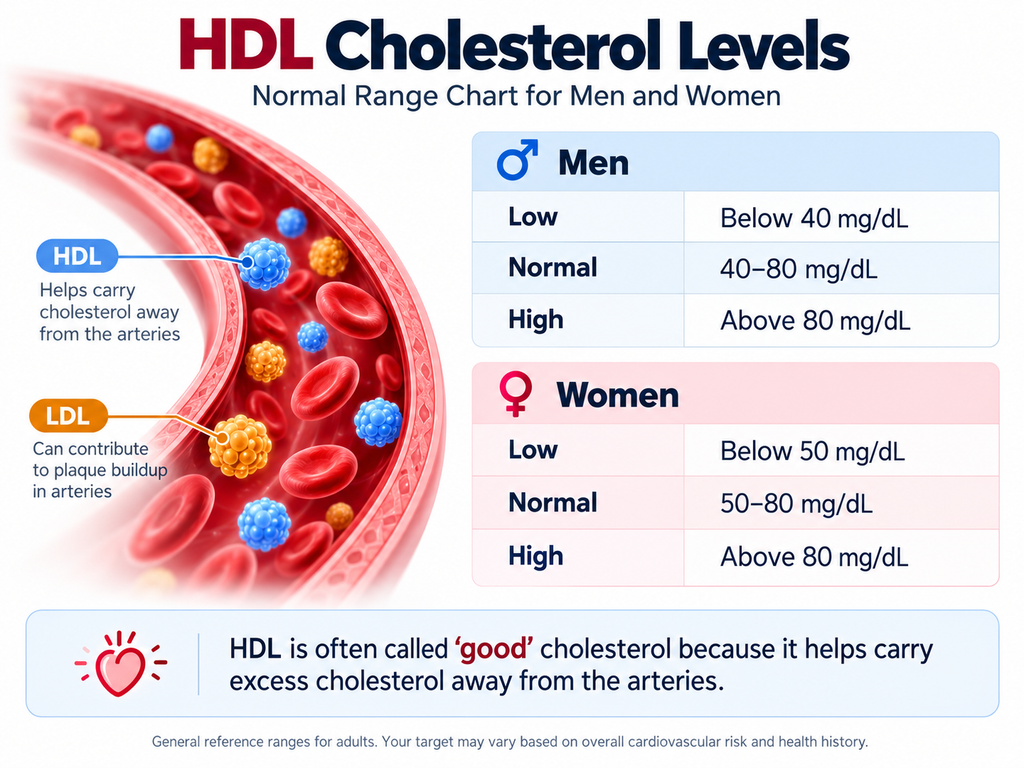
These are general reference points, not personal treatment targets.
Your doctor may interpret your HDL differently depending on your age, blood pressure, diabetes, smoking history, previous heart disease, LDL level and other health factors.
Research involving older adults has also found that low HDL is associated with a higher risk of heart-related outcomes. A study found that those in the lowest HDL group had a higher risk of ischaemic heart disease (Elgendy et al., 2023).
This does not mean that HDL alone can predict whether someone will develop heart disease. It is one part of the overall health picture.
What Does Low HDL Cholesterol Mean?
Low HDL cholesterol means your blood has less of the “good” cholesterol that helps carry excess cholesterol away from the arteries. In general, HDL below 40 mg/dL in men and below 50 mg/dL in women is considered low and may be associated with a higher risk of heart disease.
Low HDL has been associated with a higher risk of cardiovascular disease in several studies. Research found an inverse relationship between HDL cholesterol and cardiovascular mortality across different age groups, including older adults (SCORE Investigators, 2009).
“A low HDL level is one part of the cholesterol profile. We also look at LDL, triglycerides, blood pressure, blood sugar and other risk factors to understand a person’s overall cardiovascular health.”
— Dr. Bipin Gond, Zonal Medical Head, Madhavbaug
Another study found that lower HDL cholesterol was associated with a higher risk of heart attack, although the relationship between cholesterol measures and health outcomes in older adults can be different from that seen in younger people (Psaty et al., 2004).
For this reason, a low HDL result should be discussed with your doctor, especially if you also have diabetes, high blood pressure or a previous heart condition.
What Can Lower HDL Cholesterol?
Low HDL cholesterol can be linked to physical inactivity, smoking, being overweight, an unhealthy diet, diabetes and other metabolic health problems. Age and certain health conditions can also affect HDL levels.
Several everyday factors can be linked with lower HDL levels, including:
- Lack of regular physical activity
- Smoking
- Being overweight
- Poor diet quality
- Diabetes and other metabolic health problems
Age and other health conditions can also influence cholesterol levels.
Improving your heart health through healthy food, regular activity, weight management and control of blood pressure and blood sugar is more useful.
What Does High HDL Cholesterol Mean?
High HDL cholesterol means your blood has a higher level of HDL which is often called “good cholesterol.” An HDL level of 60 mg/dL or higher is generally considered favourable and is associated with better heart health.
However, HDL is only one part of your cholesterol profile. Very high HDL levels may have different associations with health outcomes, so your HDL should be interpreted along with LDL cholesterol, triglycerides, total cholesterol and other heart health factors.
Research in older adults has found that the relationship between HDL and health outcomes can be more complex at very high levels. (Huang et al., 2019). This is why you should not try to raise your HDL number on your own through supplements or major diet changes.
If your HDL is high on a routine report, your doctor can look at it together with LDL, triglycerides, total cholesterol and your other health information.
Why Does HDL Matter After 60?
HDL matters after 60 because it helps carry excess cholesterol away from the arteries, supporting healthy blood vessels and cardiovascular health. Maintaining a healthy HDL level becomes part of protecting heart health as you age, especially when other risk factors such as high blood pressure, diabetes or high LDL cholesterol may also be present.
An HDL level of 60 mg/dL or higher is generally considered favourable. However, HDL is only one part of your cholesterol profile. After 60, your doctor may also consider LDL cholesterol, triglycerides, total cholesterol, blood pressure, blood sugar, weight and existing health conditions when assessing your heart health. The healthy range for cholesterol can also vary across different age groups, including your 30s, 40s, 50s and beyond.
Regular physical activity, a balanced diet, healthy weight and good control of blood pressure and blood sugar can help support healthy cholesterol levels and cardiovascular health after 60.
| Clinical Insight “In patients over 60, I often see that HDL is only one part of the picture. A person may have a healthy HDL level but still need attention to blood pressure, blood sugar, LDL cholesterol, weight and daily activity. Looking at these factors together helps us understand their heart health more clearly and plan the right lifestyle changes.” Dr. Gurudatta Amin, BAMS, MD, PGDEMS, 19+ Years of Clinical Experience, CMO, Madhavbaug |
Can Lifestyle Changes Support Healthy HDL Levels?
Yes. Daily habits can support healthier cholesterol levels and overall heart health.
For many older adults, small and regular changes are easier to follow than sudden, strict changes.
A heart-friendly routine may include more vegetables, fruits, whole grains, dals and other pulses. It can also mean reducing frequent intake of deep-fried foods and foods high in unhealthy fats.
Regular movement can help as well. Depending on your health and mobility, this could include walking, gentle yoga or simple exercises recommended by your doctor.
If you smoke, stopping can also support heart health.
For senior citizens with diabetes, high blood pressure or an existing heart condition, talk to your doctor before making major changes to your diet or exercise routine. Do not stop, start or change prescribed medicines based only on your HDL cholesterol report.
When Should You Check Your HDL Cholesterol?
HDL cholesterol is usually checked as part of a lipid profile.
Your doctor may suggest checking your cholesterol if you have:
- Diabetes
- High blood pressure
- A family history of heart disease or high cholesterol
- Previous heart disease
- Previous abnormal cholesterol results
- Other cardiovascular risk factors
For older adults, keeping previous reports is also helpful. Your doctor can compare the current HDL, LDL and triglyceride results with earlier reports and understand how your cholesterol pattern has changed over time.
If you are arranging a test for an elderly parent, a family member can accompany them, help arrange the test and keep previous reports and current medicine details ready for the ayurvedic consultation.
HDL Cholesterol and Heart Health at Madhavbaug
At Madhavbaug, HDL cholesterol is considered as part of the wider picture of your cardiovascular and metabolic health.
Your recent cholesterol report can be reviewed along with previous reports, blood pressure, blood sugar, weight, current medicines and relevant medical history.
Based on your health assessment, diet planning and lifestyle guidance may be included to support practical changes in your daily routine along with your prescribed treatment plan.
If you already have diabetes, high blood pressure or a heart condition, your cholesterol results need to be understood in relation to these conditions as well.
Have You Checked Your HDL Recently?
If you have not had a cholesterol test recently, a lipid profile test can show your HDL along with LDL, total cholesterol and triglycerides.
If you already have a report, keep your previous reports and current medicine list ready when you meet a doctor. You can also visit your nearest Madhavbaug centre for a clinical consultation.
Have a recent cholesterol report?Understand Your Report With a Madhavbaug Doctor
Frequently Asked Questions
What is HDL cholesterol?
HDL cholesterol is cholesterol carried by high-density lipoprotein in the blood. It is commonly called “good cholesterol” because HDL helps carry cholesterol towards the liver.
What is the full form of HDL cholesterol?
HDL stands for high-density lipoprotein. HDL cholesterol refers to the cholesterol carried by these particles in the blood.
What is a good HDL cholesterol level?
HDL levels of around 40 mg/dL or higher in men and 50 mg/dL or higher in women are commonly considered more favourable. However, your doctor should interpret the result along with your other cholesterol numbers and overall heart health.
What does low HDL cholesterol mean?
Low HDL means there is less HDL cholesterol in the blood than the level generally considered favourable. Low HDL has been linked with a higher risk of cardiovascular problems, but HDL is only one part of a cholesterol report.
What does high HDL cholesterol mean?
A high HDL level usually means there is more HDL cholesterol in the blood. Higher HDL is generally associated with better cardiovascular health, but very high levels do not automatically mean lower risk. Your complete cholesterol report should be considered.
How can I improve my HDL cholesterol naturally?
Regular physical activity, healthy food choices, maintaining a healthy weight and avoiding smoking can support healthier cholesterol levels and overall heart health. Speak with your doctor before making major changes if you have a heart condition, diabetes or take regular medicines.
References
Barter, P., Gotto, A.M., LaRosa, J.C., Maroni, J., Szarek, M., Grundy, S.M., Kastelein, J.J.P., Bittner, V. and Fruchart, J.C. (2007) ‘HDL cholesterol, very low levels of LDL cholesterol, and cardiovascular events’, New England Journal of Medicine, 357(13), pp. 1301–1310.
Elgendy, I.Y. et al. (2023) ‘Association Between Lipid Profile Measurements and Mortality Outcomes Among Older Adults in a Primary Care Setting: A Retrospective Cohort Study’.
Huang, Y.Q., Liu, L., Huang, J.Y., Lo, K., Chen, C.L., Yu, X.L. and Feng, Y.Q. (2019) ‘High-Density Lipoprotein Cholesterol and All-Cause and Cause-Specific Mortality Among the Elderly’, Journal of Clinical Endocrinology & Metabolism, 104(8), pp. 3370–3378.
Psaty, B.M. et al. (2004) ‘The association between lipid levels and the risks of incident myocardial infarction, stroke, and total mortality: The Cardiovascular Health Study’, Journal of the American Geriatrics Society.
SCORE Investigators (2009) ‘HDL cholesterol protects against cardiovascular disease in both genders, at all ages and at all levels of risk’, European Heart Journal.





 Locate a Centre

