

Key Takeaways
|
If you are comparing total cholesterol, LDL, and HDL, LDL is more important for assessing cholesterol-related heart risk, but no single cholesterol number provides a complete picture. Total cholesterol gives an overall measure, LDL shows the amount of cholesterol carried by low-density lipoproteins, and HDL helps carry cholesterol away from the arteries. A lipid profile brings these numbers together with triglycerides to give a clearer picture of your cholesterol health.
What Is the Difference Between HDL and LDL Cholesterol?
HDL, LDL and total cholesterol are three different measurements in a cholesterol report. LDL is commonly called “bad cholesterol,” HDL is called “good cholesterol,” and total cholesterol represents the overall amount of cholesterol in your blood. Each number gives different information about your heart health.
LDL stands for low-density lipoprotein. It carries cholesterol through the blood to different parts of the body. When LDL-containing particles become retained in the artery wall, they can contribute to plaque formation. This is why LDL is commonly called “bad cholesterol” [Ference et al., 2017].
HDL stands for high-density lipoprotein. It helps transport cholesterol from tissues towards the liver, where it can be processed and removed from the body. This is why HDL is commonly called “good cholesterol” [Rosenson et al., 2012].
Total cholesterol is the overall amount of cholesterol measured in your blood. It includes cholesterol carried by different lipoproteins, including LDL and HDL, and is usually reported along with LDL, HDL and triglycerides as part of a lipid profile. Total cholesterol provides a broad picture, while LDL and HDL give more specific information about the different lipoproteins carrying cholesterol.
So, when people search for the HDL and LDL difference, the simplest way to understand it is:
| Cholesterol type | What it means | Why it matters |
| LDL | Low-density lipoprotein | Higher levels can contribute to plaque buildup in arteries. |
| HDL | High-density lipoprotein | Helps transport cholesterol towards the liver |
| Total cholesterol | Overall cholesterol measurement | Gives a broad view of cholesterol in the blood |
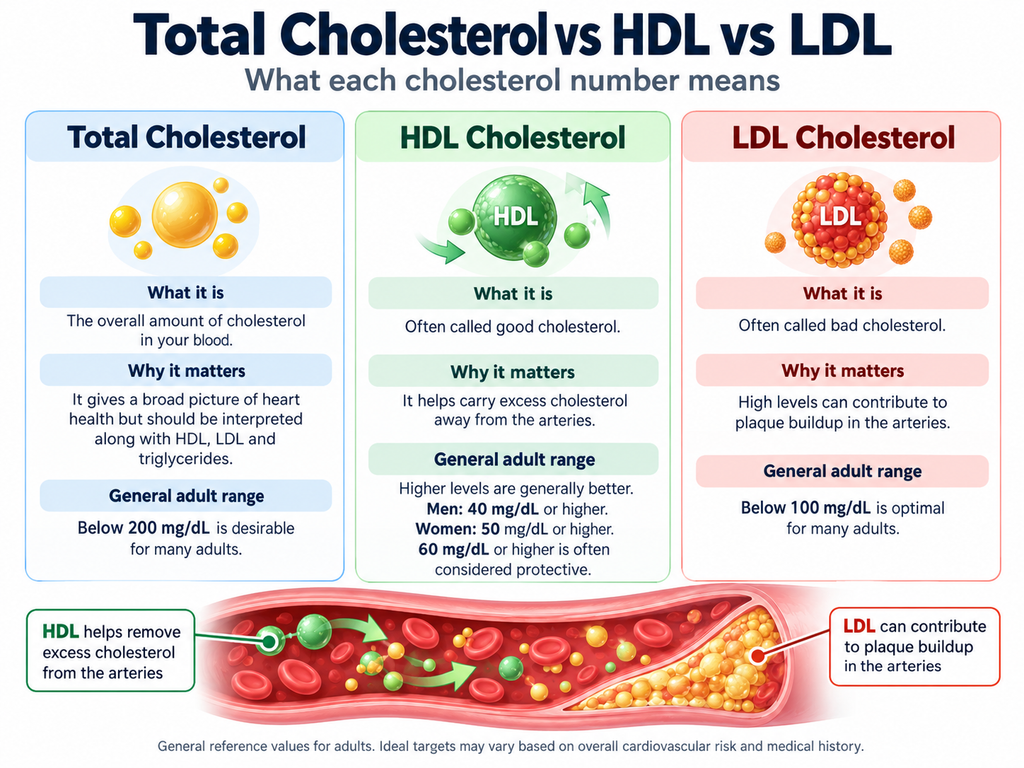
HDL and LDL are therefore not two versions of the same cholesterol. They are different lipoproteins that transport cholesterol in different ways.
Want to understand what your HDL, LDL and total cholesterol levels mean for your heart health?
HDL vs LDL Which Is Good?
HDL is commonly called “good cholesterol”, while LDL is called “bad cholesterol”. HDL helps carry cholesterol away from the arteries, while higher LDL can contribute to plaque buildup in the arteries. Both numbers are important when understanding your cholesterol profile.
An HDL level of 60 mg/dL or higher is generally considered favourable. HDL below 40 mg/dL in men and below 50 mg/dL in women is generally considered low.
For LDL, there is no single healthy level for everyone. Your LDL goal depends on your overall cardiovascular risk, with lower targets often used for people at higher risk [Ference et al., 2017; Blumenthal et al., 2026].
So, when comparing HDL vs LDL, the focus is not simply on which one is “good.” A healthy cholesterol profile considers both along with total cholesterol and triglycerides.
What Is Total Cholesterol?
Total cholesterol is the overall amount of cholesterol measured in your blood. It is one of the numbers reported in a standard lipid profile along with LDL cholesterol, HDL cholesterol and triglycerides.
A total cholesterol result can provide a useful starting point, but it does not show how that cholesterol is distributed between different lipoproteins.
For example, two people can have a similar total cholesterol level while having different LDL, HDL and triglyceride results. Their overall cardiovascular risk may therefore be different.
Research found that measuring LDL and HDL provides additional information for predicting coronary heart disease risk beyond total cholesterol alone [Castelli et al., 1992].
This is why looking only at total cholesterol vs HDL or total cholesterol alone does not give a complete picture.
Is LDL More Important Than Total Cholesterol?
When you compare total cholesterol vs LDL, LDL cholesterol is usually the number your doctor looks at more closely for heart health. This is because high LDL can lead to cholesterol buildup in the arteries.
Total cholesterol tells you how much cholesterol is present in your blood overall. LDL tells you how much cholesterol is carried by LDL. Both numbers are useful, but they tell you different things.
High LDL cholesterol can contribute to plaque buildup in the arteries and increase the risk of heart disease [Ference et al., 2017].
So, cholesterol vs LDL is not about choosing one number and ignoring the other. Total cholesterol gives you the overall number, while LDL helps show the amount of cholesterol that can contribute to plaque buildup.
Your doctor may also check HDL, triglycerides, blood pressure and blood sugar to understand your overall heart health.
What Does a Lipid Profile Tell You?
A lipid profile brings the main cholesterol and blood fat measurements together. It commonly reports:
| Test | What it tells you |
| Total cholesterol | Overall amount of cholesterol measured in the blood |
| LDL cholesterol | Cholesterol carried by LDL particles |
| HDL cholesterol | Cholesterol carried by HDL particles |
| Triglycerides | Another type of fat found in the blood |
A lipid profile test can therefore show whether your cholesterol pattern involves high LDL, low HDL, high triglycerides or a combination of these findings.
The results are more useful when compared with your previous reports. A single report gives you a snapshot, while repeated results can help your doctor understand how your cholesterol pattern is changing over time.
“When patients see a cholesterol report, they often focus on the total cholesterol number. I usually explain that LDL deserves attention because it can contribute to plaque buildup in the arteries. We also look at HDL, triglycerides and the person’s overall health before deciding what the numbers mean for them.”
– Dr. Priyadarshini Bhalekar, Zonal Medical Head, Madhavbaug
Why Is LDL Usually Given More Attention?
LDL is often given more attention because LDL-containing lipoproteins are involved in the development of atherosclerosis. When these particles buildup in the artery wall, they can lead to plaque formation and progression.
Research has found that reducing LDL lowers the risk of major cardiovascular events, supporting LDL as an important target in cholesterol management [Ference et al., 2017].
This does not make HDL or total cholesterol unimportant. HDL provides information about another part of cholesterol transport, while total cholesterol gives an overall measurement.
What If HDL Is Good but LDL Is High?
If your HDL is good but your LDL is high, you can still have a higher risk of cholesterol buildup in your arteries. A healthy HDL level does not protect you completely from the effects of high LDL cholesterol.
For example, if your HDL is 60 mg/dL or higher but your LDL is elevated, the high LDL still needs attention. LDL can contribute to plaque buildup in the arteries, which can increase the risk of heart disease [Ference et al., 2017].
This is why HDL vs LDL is not simply about which number is good or bad. HDL and LDL have different roles, and a healthy HDL level does not make a high LDL level healthy.
What If Total Cholesterol Is High but HDL Is Also High?
If your total cholesterol is high but your HDL is also high, the high total cholesterol does not always mean that your LDL is high. HDL is part of total cholesterol, so a higher HDL level can contribute to a higher total cholesterol result.
To understand what the result means, look at your LDL, HDL and triglycerides along with total cholesterol. For example, a high total cholesterol level with healthy HDL and normal LDL may have a different meaning from high total cholesterol with high LDL.
This is why total cholesterol vs HDL should not be judged by looking at one number alone. Your complete lipid profile gives a clearer picture of your cholesterol levels and heart health [Castelli et al., 1992].
| Clinical Insight “A high total cholesterol result does not always mean that a patient has high LDL. We often see patients with higher HDL contributing to the total cholesterol number. That is why we review the complete lipid profile and compare the LDL, HDL and triglyceride values before deciding whether further changes are needed.” Dr. Pravin Jayram Ghadigaonkar, BAMS, MD, PhD (Scholar) – Preventive Cardiology 20+ Years of Clinical Experience, Head Medical Operations & Patient Improvement, Madhavbaug |
How Do Age and Health Conditions Affect Cholesterol Goals?
Your age and health conditions can affect what your cholesterol numbers mean and what LDL level may be right for you. A person with diabetes, high blood pressure or previous heart disease may have different cholesterol goals from someone without these conditions.
As you get older, your doctor may look at your LDL, HDL and total cholesterol along with blood pressure, blood sugar, weight, medicines and your heart health history. These factors help determine your overall cardiovascular risk and the right cholesterol goal [Blumenthal et al., 2026].
Understanding normal cholesterol levels by age can help you understand your report, but your personal cholesterol goal depends on your overall health and heart disease risk.
Can Lifestyle Changes Improve Your Cholesterol Profile?
Lifestyle changes can help improve your cholesterol profile, including LDL cholesterol and triglycerides, while supporting healthy HDL levels. The effect can vary from person to person depending on diet, activity, weight and other health factors.
Focus on habits that support your overall lipid profile. Regular physical activity, maintaining a healthy weight and choosing more vegetables, fruits, whole grains, pulses, nuts and seeds can help support healthier cholesterol levels. Reducing foods high in saturated and trans fats can also help manage LDL cholesterol.
The goal is not to change just one number. A healthier cholesterol profile means keeping LDL and triglycerides in a healthy range while maintaining favourable HDL levels.
If you have diabetes, high blood pressure, previous heart disease or are taking cholesterol medicines, your lifestyle plan should be based on your individual health needs and discussed with your doctor.
Understanding Your Cholesterol Report at Madhavbaug
At Madhavbaug, your cholesterol report is looked at as part of your overall cardiovascular and metabolic health. Your LDL, HDL, total cholesterol and triglycerides can be reviewed together to understand your overall lipid profile.
Based on your health assessment, your treatment plan may include personalised diet guidance, lifestyle changes, physical activity recommendations and doctor-guided Ayurvedic and Panchakarma therapies where appropriate. Progress can also be monitored through follow-up assessments and relevant health measurements.
Understanding your cholesterol report is not just about knowing whether one number is high or low. It is about understanding what your LDL, HDL and total cholesterol mean together and what they indicate about your overall heart health, including the role of evidence for Ayurvedic heart treatment in a broader heart-care approach.
If you have concerns about your cholesterol levels or want to understand your lipid profile better, visit your nearest Madhavbaug centre for a health assessment and discuss your report with a doctor.
Want to understand your cholesterol report better?
Frequently Asked Questions
Which is more important, HDL or LDL?
LDL generally receives more attention when managing cholesterol-related cardiovascular risk because elevated LDL can contribute to plaque buildup in the arteries. HDL is also an important part of the cholesterol profile.
What is the difference between HDL and LDL cholesterol?
HDL helps carry cholesterol towards the liver, while LDL carries cholesterol through the blood and can contribute to plaque buildup when levels are elevated.
Is HDL or LDL better?
HDL is commonly called “good cholesterol,” while LDL is commonly called “bad cholesterol.” Both provide different information about your cardiovascular health.
Which cholesterol number matters most?
LDL usually receives the most attention when assessing and managing cholesterol-related cardiovascular risk, but LDL, HDL, total cholesterol and triglycerides should be considered together.
Is total cholesterol more important than LDL?
No single number should be used on its own. Total cholesterol provides an overall measurement, while LDL gives more specific information about an important cholesterol-related cardiovascular risk factor.
Can you have high HDL and high LDL at the same time?
Yes. A person can have a healthy or high HDL level while also having high LDL. A healthy HDL level does not cancel out an elevated LDL level.
References
Castelli, W.P., Anderson, K., Wilson, P.W.F. and Levy, D. (1992) ‘Lipids and risk of coronary heart disease. The Framingham Study’, Annals of Epidemiology, 2(1–2), pp. 23–28.
Ference, B.A., Ginsberg, H.N., Graham, I., Ray, K.K., Packard, C.J. et al. (2017) ‘Low-density lipoproteins cause atherosclerotic cardiovascular disease. 1. Evidence from genetic, epidemiologic, and clinical studies’, European Heart Journal, 38(32), pp. 2459–2472.
Rosenson, R.S., Brewer, H.B. Jr., Ansell, B.J., Barter, P., Chapman, M.J. et al. (2012) ‘Dysfunctional HDL and atherosclerotic cardiovascular disease’, Nature Reviews Cardiology, 10, pp. 222–235.
Blumenthal, R.S., Morris, P.B., Gaudino, M., Johnson, H.M., Anderson, T.S. et al. (2026) ‘2026 ACC/AHA/AACVPR/ABC/ACPM/ADA/AGS/APhA/ASPC/NLA/PCNA Guideline on the Management of Dyslipidemia’, Journal of the American College of Cardiology, 87(19), pp. 2624–2757.





 Locate a Centre

