

Key Takeaways
|
If you’re managing a chronic condition and someone advised you some home remedies claiming them to be ayurvedic treatment, then you need to wait and think. Home remedies are not the same as Ayurvedic treatment, especially for treatment for chronic diseases, and so it is important to understand the difference between the home remedies vs Ayurvedic treatment for chronic disease. This guide compares home remedies with doctor-supervised Ayurvedic treatment, covers the real risks of relying on remedies alone for a chronic condition, and explains why diagnostics and monitoring make a genuine difference.
What’s the Difference Between Home Remedies and Ayurvedic Treatment?
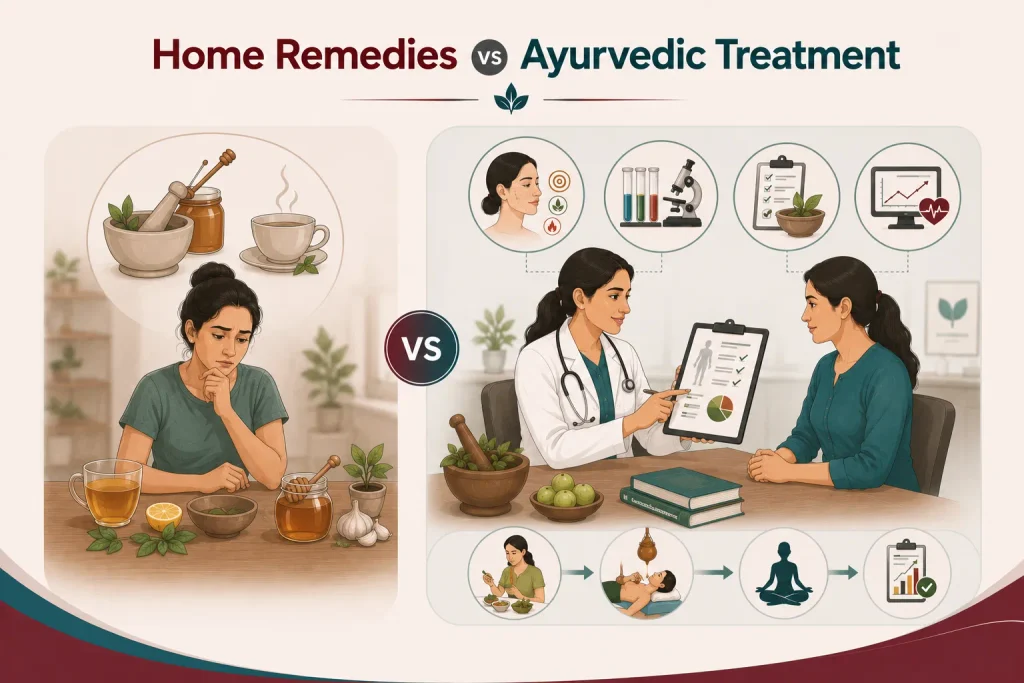
Home remedies are general, self-directed measures, like specific herbs, spices, or kitchen ingredients, used without a personalised assessment. Doctor-supervised Ayurvedic treatment is a structured plan, built around your specific diagnosis, test results, and Prakriti (body constitution), and adjusted over time based on how you respond.
The difference isn’t the source of the remedy. Many Ayurvedic formulations use the same herbs found in home remedies. The difference is evidence-based personalisation, dosage, and monitoring. A home remedy is the same for everyone who tries it. A supervised Ayurvedic plan is built for you specifically and monitored against your actual results.
| . | Home Remedies | Doctor-Supervised Ayurvedic Treatment |
Personalisation | Generic, the same for everyone | Based on your Prakriti, condition, and test results |
| Dosage | Often estimated or informal | Prescribed and monitored |
| Diagnostics | None | Blood tests, blood pressure, and other relevant monitoring |
| Adjustment over time | Rarely adjusted | Reviewed and adjusted at set checkpoints |
| Best suited for | General wellness, mild everyday complaints | Diagnosed chronic conditions needing tracked management |
What Are the Limits of Home Remedies for a Chronic Disease?
Home remedies can genuinely support everyday wellness, but they have real limits once a chronic disease like diabetes, hypertension, obesity or heart disease is involved. They aren’t personalised, they aren’t dosed to your specific needs, and there’s no way to check whether they’re actually working.
A chronic condition needs objective evidence of progress, like a blood sugar reading or a blood pressure surge, not just a sense of feeling better. Home remedies also don’t account for your Prakriti, your current test results, or how your condition might be progressing. This is exactly why a home remedy that helps a mild, occasional symptom often isn’t enough on its own for a diagnosed, ongoing condition.
“We’re not against home remedies. Many have genuine value for everyday wellness. But once someone has a diagnosis like diabetes or hypertension, the question changes from ‘Does this feel helpful?’ to ‘Is this actually improving my readings in the right direction?’ That second question needs testing, not just a remedy.”
— Dr. Cinni Vijay Pandey, Regional Medical Head, Madhavbaug
If home remedies alone aren’t giving you a clear picture of your chronic condition, a consultation can show you exactly where you stand.
What Risks Do Home Remedies Carry for Chronic Disease?
Relying on home remedies alone for a chronic condition carries three main risks:
- Delayed proper diagnosis
- Undisclosed interactions with your existing medicines
- With some unsupervised herbal products, genuine safety concerns.
On disclosure specifically, a large survey of people with chronic conditions found that many don’t tell their doctor about complementary remedies they’re using, most often simply because the doctor never asked (Foley et al., 2021). This matters because your doctor can’t check for interactions or adjust your plan around something they don’t know about.
| Clinical Insight “Patients rarely hide their home remedies on purpose. It usually just doesn’t occur to them that it’s relevant. But if someone’s on blood pressure medicine and also taking an unrecognised herbal product for the same thing, that’s exactly the combination we need to know about.” Dr. Gurudatta Amin, BAMS, MD, PGDEMS, 19+ Years of Clinical Experience, CMO, Madhavbaug |
Why Do Diagnostics Matter That Home Remedies Can’t Provide?
Diagnostics give you objective proof that a chronic condition is actually improving, something a home remedy alone can’t offer. Feeling better and a test result improving aren’t always the same thing, and for a condition like high blood pressure, type 2 diabetes or heart failure, the test result is what actually matters for your long-term health.
A doctor-supervised plan typically tracks blood sugar and HbA1c for insulin resistance and diabetes, blood pressure using smart BP monitors for hypertension, and lipid or cardiac markers for high cholesterol and heart disease at set points through treatment. No home remedy comes with this kind of built-in feedback loop. Without it, you genuinely don’t know whether your condition is improving, staying the same, or quietly getting worse.
What Does Doctor-Supervised Ayurvedic Treatment Add?
Doctor-supervised Ayurvedic treatment adds four things a home remedy can’t:
- A personalised assessment based on your Prakriti and current health
- Relevant diagnostic testing
- A structured treatment plan
- Ongoing monitoring with adjustments over time.
Together, these are what turn a general remedy into an actual, trackable treatment.
Madhavbaug’s own published research on structured, Panchakarma-based programmes illustrates this difference. In one study, patients with a baseline HbA1c of 6.6–9.0% saw levels fall to an average of 6.12% over a 90-day supervised programme (Kshirsagar, Lakariya and Khan, 2024).
This kind of measured, tracked result comes from a plan combining diet, therapies, and monitoring, not a single remedy used alone.
What Are the Red Flags to Watch For?
Home remedies may seem simple and convenient, but chronic diseases need monitoring and proper assessment. Certain signs indicate that it may be time to stop relying on self-care alone and speak with a qualified doctor.
Lack of Improvement
If you have already been diagnosed with diabetes, hypertension, weight management, hypercholesterolaemia (high cholesterol) or another chronic condition, but your symptoms or test results are not improving despite consistent use of home remedies, your treatment approach may need to be reassessed.
Prescription Medicine Use
Some herbs, supplements and other remedies can interact with prescription medicines or affect their action. Always tell your doctor about any home remedies or unrecognised herbal products or supplements you are taking, particularly if you use medicines regularly.
Worsening Symptoms
Symptoms that are becoming more frequent or severe should not be managed by simply trying another remedy or increasing the amount you take. New, worsening symptoms or warning signs may require a proper clinical evaluation to identify the underlying cause.
Lack of Recent Testing
You cannot always tell whether a chronic condition is improving based on symptoms alone. Depending on your condition, tests such as blood sugar, HbA1c, ECG, blood pressure, lipid profile or other relevant investigations may be needed to understand whether your health is actually changing.
Unclear Product Information
Be cautious with remedies or products that do not clearly state their ingredients, source, dosage, manufacturing details or directions for use. A product being labelled as “natural” does not automatically make it safe, especially when it is taken regularly or alongside prescription medicines.
If any of these situations apply to you, continuing to experiment with home remedies may not be the best next step. A supervised assessment can help determine what is causing your symptoms, whether your current approach is working and what further care may be appropriate.
How Madhavbaug Approaches Chronic Condition Management
At Madhavbaug, the first step is to understand your current health status instead of relying only on symptoms or home remedies. During a consultation, our doctors review your medical history, existing diagnoses, current medicines, lifestyle, symptoms and relevant diagnostic reports.
The process can be understood simply:
| Book a Consultation ↓ Health history & current medicines ↓ Relevant health measurements & diagnostic reports ↓ Ayurvedic assessment & clinical evaluation ↓ Treatment with personalised diet, lifestyle & exercise plan ↓ Regular follow-ups & progress monitoring ↓ Plan adjusted according to your response |
For chronic conditions such as diabetes, hypertension and heart disease, this approach brings together Ayurvedic assessment and measurable health information. Depending on your condition, relevant markers such as blood sugar, HbA1c, blood pressure, weight or lipid levels may be monitored over time.
The plan is not necessarily fixed from the first consultation. Follow-up assessments help the doctor understand how you are responding and whether aspects of your diet, lifestyle or Ayurvedic care need to be reviewed.
If you are taking prescription medicines, do not stop or change their dose on your own. Any medication changes should be discussed with the doctor.
Book a Consultation
The right time to move beyond home remedies is not the same for everyone. If your symptoms are persistent, your health markers are not improving, or you are unsure whether a remedy is suitable alongside your existing treatment, a clinical assessment can provide greater clarity.
Madhavbaug has a network of 350+ clinics and hospitals across India, providing Ayurvedic care for diabetes, obesity, hypertension and heart disease, supported by relevant diagnostic assessments and structured monitoring under the supervision of our NCISM-registered doctors.
If you have been relying on home remedies for a chronic condition, a consultation at our nearest Madhavbaug clinic can help you understand your current health status and whether a supervised, personalised approach may be more appropriate for your needs.
If you’re relying on home remedies for a chronic condition, a consultation can help you understand what proper diagnostics and medical supervision could add to your care.
Frequently Asked Questions
Are home remedies enough for chronic disease?
Home remedies can support everyday wellness, but they aren’t personalised, dosed, or monitored the way a doctor-supervised treatment plan is. For a diagnosed chronic condition like diabetes, hypertension, or heart disease, home remedies alone don’t provide the diagnostics or tracked adjustment needed to manage the condition safely over time.
Should I tell my doctor about home remedies I’m using?
Yes. Research on patients with chronic conditions found that many don’t disclose complementary remedies, often simply because their doctor didn’t ask. Your doctor needs this information to check for interactions with your prescribed medicines and adjust your treatment plan accordingly.
What’s the difference between Ayurvedic home remedies and doctor-supervised treatment?
Home remedies are general and self-directed, the same regardless of who’s using them. Doctor-supervised Ayurvedic treatment is personalised to your Prakriti, current health status, and test results, and includes ongoing monitoring and adjustment, none of which a home remedy provides on its own.
Can home remedies replace Ayurvedic treatment for chronic disease?
Not for a diagnosed chronic condition. Home remedies may support general wellness, but supervised Ayurvedic treatment adds diagnostics, personalisation, and monitoring that home remedies can’t replicate, which matters for tracking whether a chronic condition is actually improving.
Is it safe to combine home remedies with prescription medicines?
Not without telling your doctor. Combining unsupervised remedies with prescription medicines, particularly for conditions like hypertension or diabetes, can carry real interaction risks. Any remedy or supplement you’re using should be disclosed to your treating doctor.
When should I move from home remedies to supervised treatment?
If a diagnosed condition isn’t improving, symptoms are worsening, you haven’t had recent relevant tests, or you’re combining a remedy with prescription medicine without telling your doctor, these are all signs it’s time for a proper clinical assessment rather than continuing with home remedies alone.
Related Reading
- How to Prevent and Cure Heart Disease with Ayurveda
- Ayurvedic Medicine for Diabetes that Targets Root Cause
- High Blood Pressure Treatment Without Lifelong Medication
- The Link Between Lifestyle Data and Disease Reversal
References
Foley, H., Steel, A., McIntyre, E., Harnett, J., Sibbritt, D. and Adams, J. (2021) ‘Disclosure of conventional and complementary medicine use to medical doctors and complementary medicine practitioners: a survey of rates and reasons amongst those with chronic conditions‘, PLoS ONE, 16(11), e0258901.
Kshirsagar, J., Lakariya, A. and Khan, S. (2024) ‘Impact of ayurvedic panchakarma along with lifestyle modification in restoring glucose tolerance in type 2 diabetics‘, International Journal of Basic & Clinical Pharmacology, 13(5), pp. 669–672.


 Locate a Centre
