


Key Takeaways
|
If you’re managing a chronic condition and considering connected care and Ayurveda treatment, it is important to choose a certified Ayurvedic doctor. This guide covers what qualifications to look for, why chronic-disease-specific experience matters, how diagnostics and monitoring should factor into your care, what the evidence says about structured Ayurvedic treatment, the red flags to watch for, and a quick checklist to use before you book a consultation.
What Makes an Ayurvedic Doctor Qualified for Chronic Disease Care?
A qualified Ayurvedic doctor holds a Bachelor of Ayurvedic Medicine and Surgery (BAMS) degree or a postgraduate qualification such as an MD in Ayurveda and is registered with the National Commission for Indian System of Medicine (NCISM), the main body that has regulated Ayurvedic education and practice in India since 2020. This registration is what confirms a doctor has met recognised training standards and is not self-taught or folk.
A BAMS degree involves five and a half years of structured training, including a supervised clinical internship, covering both classical Ayurvedic texts and foundational modern anatomy and physiology. A doctor with a postgraduate MD in Ayurveda has typically gone on to specialise further, often in an area relevant to chronic disease management.
When you’re looking for care for a long-term condition, it’s important to ask, “What is your qualification, and are you NCISM-registered?”
A doctor confident in their training will answer this directly.
“At Madhavbaug, every consulting doctor is a qualified, registered Ayurvedic physician. But qualification is the starting point, not the whole picture. For a chronic condition, we also look at how much hands-on experience a doctor has specifically with that condition, because managing diabetes well and managing joint pain well draw on quite different clinical experience.”
— Dr. Priyadarshini Bhalekar, Zonal Medical Head, Madhavbaug
If you’re evaluating an Ayurvedic doctor for a chronic condition, a consultation is the clearest way to check their approach, qualifications, and how they plan to work alongside your existing care.
Why Does Experience With Chronic Disease Matter?
Chronic conditions like diabetes, hypertension, heart disease, and obesity behave differently from acute complaints, and a doctor’s day-to-day experience with your specific condition shapes how well they can read your response to treatment and adjust it over time. General Ayurvedic training covers the fundamentals, but managing a chronic condition well tends to come from repeated, focused clinical experience with that condition specifically.
A useful way to understand this is to ask directly about the doctor’s experience with patients like you. Years in practice is not the same as relevant expertise, and so it is important to check for the doctor’s details.
| Condition | What to Ask About Experience |
| Diabetes | How many patients with uncontrolled or long-standing diabetes has the doctor managed, and how does the doctor track their blood sugar over time? |
| Hypertension | How does the doctor approach a patient whose blood pressure isn’t settling despite medication? |
| Heart Disease | How does the doctor monitor cardiac markers during treatment? |
| Obesity | How does the doctor personalise a plan for someone with obesity linked to another condition, like PMOS or thyroid disease? |
A doctor who is an expert in these areas is more likely to have the condition-specific experience your treatment plan will actually depend on.
Does the Doctor Combine Ayurveda With Modern Diagnostics?
A doctor equipped to manage chronic disease will ask for relevant diagnostic tests such as blood sugar and HbA1c, blood pressure readings, an ECG, or metabolic measurements, instead of building a treatment plan on symptoms and pulse assessment alone. This combination is what allows a plan to be adjusted based on objective results, not just how you say you’re feeling.
This doesn’t mean Ayurvedic assessment tools like Prakriti (your individual body constitution) aren’t valuable, they add real, personalised context. In practice, Prakriti assessment works best alongside your test results and clinical history, and it’s an important factor to check for a doctor if they will review lab results and prescriptions with Ayurvedic assessment.
| Clinical Insight “Patients sometimes come in with months of test reports on their phone but don’t think to mention them until we ask directly. Reviewing those numbers changes how we build the plan, so it’s genuinely one of the first things we want to see.” Dr. Gurudatta Amin, BAMS, MD, PGDEMS, 19+ Years of Clinical Experience, CMO, Madhavbaug |
How Is Your Progress Monitored Over Time?
A doctor managing your chronic condition should have a defined follow-up schedule and a way of tracking whether your specific measurements, blood sugar, blood pressure, weight, or cardiac markers are actually improving. Monitoring is what turns a treatment plan into something that gets adjusted based on evidence.
Before you commit to ongoing care, it’s reasonable to ask how often you’ll be reassessed, what will specifically be measured at each follow-up, and how the plan might change if your numbers aren’t moving in the right direction after a few months.
A doctor who can answer this clearly, with a specific follow-up sequence in mind, is generally better positioned to manage a long-term condition.
What Does the Evidence Say About Structured, Doctor-Led Ayurvedic Care?
Structured, doctor-supervised Ayurvedic treatment has a growing evidence base for several chronic conditions, and patients themselves tend to choose Ayurvedic providers based specifically on trust built for safety and suitability for their condition.
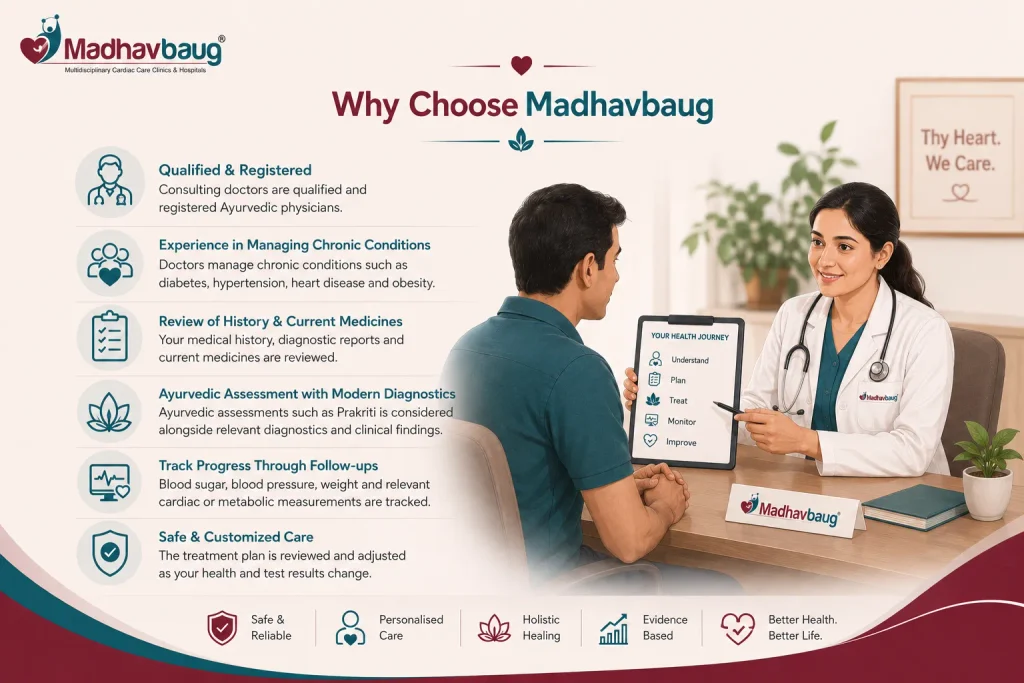
A survey of patients at an Ayurvedic teaching hospital found that safety and the perceived likelihood of the treatment helping their specific condition were the leading reasons patients chose Ayurveda as their care provider, ahead of factors like accessibility or affordability (Rastogi et al., 2023).
What these findings state is that the benefit was seen in structured, supervised protocols, not informal or self-directed use of Ayurvedic remedies. This is exactly why the doctor delivering your care, and how closely they monitor your response, matters as much as the treatment itself.
What Are the Red Flags to Watch For?
A few clear warning signs suggest a practitioner may not be the right fit for managing a chronic condition, and recognising them early can help you avoid delays or unnecessary risk to your health.
No visible registration or qualification
A practitioner unwilling or unable to confirm their BAMS/NCISM registration when asked.
No interest in your existing diagnosis, medicines, or reports
A treatment plan built without reviewing what you’re already taking or being treated for.
A guaranteed cure, especially for a chronic condition
Genuine practitioners describe realistic, monitored improvement, not certainty.
Instructions to stop prescription medicines abruptly
Medicine changes should always be coordinated with your treating physician, not directed unilaterally.
Unlabelled or unsourced products
Products without clear manufacturer details or dosage information carry real risk. Testing of some Ayurvedic products sold without proper sourcing has found concerning levels of heavy metals like lead, mercury, and arsenic, underscoring why sourcing and quality control genuinely matter (Saper et al., 2008).
No follow-up plan
Treatment is offered as a one-time fix, with no structure for reassessing your progress.
If you notice more than one of these, it’s worth pausing and seeking a second opinion before continuing.
Your Quick Checklist Before You Choose
Here’s a simple sequence to work through before committing to an Ayurvedic doctor for a chronic condition:
| Confirm BAMS/NCISM registration. ↓ Ask about condition-specific experience. ↓ Check they’ll review your existing tests and medicines. ↓ Ask how progress will be monitored and how often ↓ Watch for red flags throughout. |
Working through this sequence before your first visit takes a few minutes and can save you from a treatment path that isn’t actually built around your condition.
Why Madhavbaug Fits This Checklist
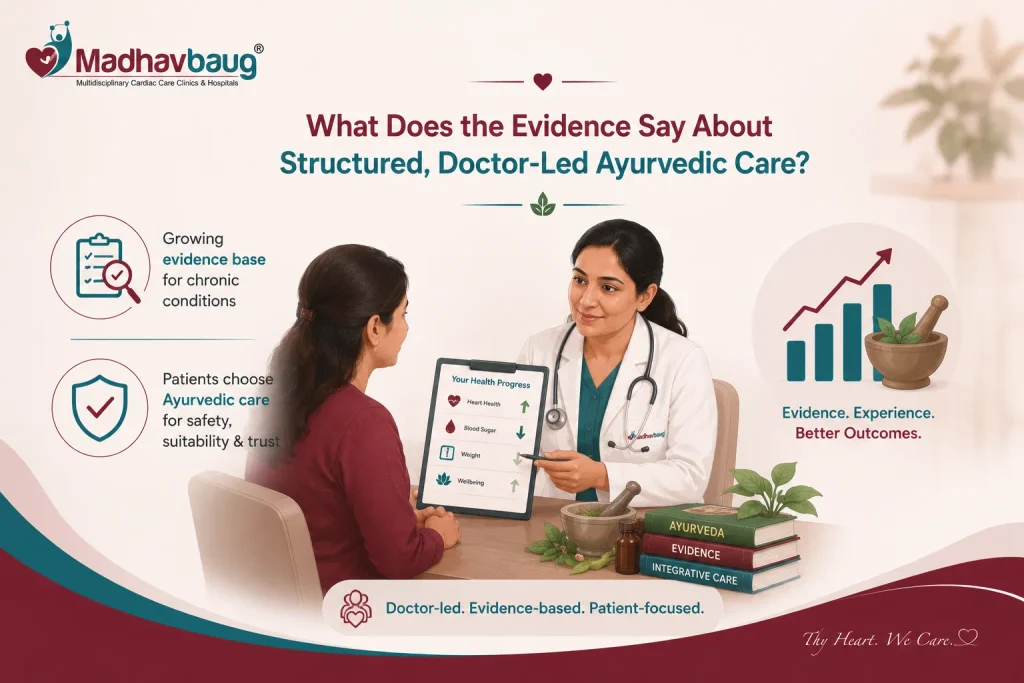
An Ayurvedic doctor for a chronic condition should involve more than simply looking for someone who offers Ayurvedic treatment. You need to know who is treating you, how familiar they are with your condition, whether they will review your existing medical information, and how your progress will be followed over time. These are also the important parts of Madhavbaug’s approach to chronic disease care.
| What You Should Check | Why Choose Madhavbaug |
| BAMS/NCISM registration | Madhavbaug’s consulting doctors are qualified and registered Ayurvedic physicians. |
| Experience with your condition | Doctors manage chronic conditions such as diabetes, hypertension, heart disease and obesity, with condition-specific clinical experience. |
| Review of existing tests and medicines | Your medical history, diagnostic reports and current medicines can be reviewed before the treatment plan is decided. |
| Modern diagnostics | Ayurvedic assessments such as Prakriti is considered alongside relevant diagnostic information and clinical findings. |
| Progress monitoring | Blood sugar, blood pressure, weight and relevant cardiac or metabolic measurements can be tracked through follow-ups. |
| Safety and treatment adjustments | The treatment plan can be reviewed as your health and test results change rather than being treated as a one-time prescription. |
For chronic conditions, that ongoing follow-up matters. Diabetes, hypertension, heart disease and obesity can change over time, so a treatment plan may also need to change when your symptoms, test results or response to treatment change. A defined monitoring plan helps make those decisions based on what is actually happening with your health.
This is why Madhavbaug’s approach brings qualified Ayurvedic physicians, condition-specific care, modern diagnostics, advanced technologies like continuous monitoring systems and structured follow-up together instead of treating the consultation as a one-time visit. If you are looking for a supervised Ayurvedic approach to managing your chronic condition, you can book a consultation at your nearest Madhavbaug clinic to discuss your health, treatment options and next steps.
Next Steps
The only way to properly evaluate whether an Ayurvedic doctor is the right fit for your chronic condition is a real consultation, since qualifications and experience only tell part of the story until you see how a doctor actually approaches your specific case.
Madhavbaug’s network of over 350 clinics and hospitals across India brings together NCISM-registered Ayurvedic physicians and modern diagnostics under one roof for the medically supervised treatment of diabetes, hypertension, heart disease, and obesity. Find your nearest centre using our clinic and hospital locator and take the first step toward a properly supervised treatment plan.
If you’re comparing Ayurvedic doctors for a chronic condition, Madhavbuag is a one step solution for holistic care
Frequently Asked Questions
How do I choose a qualified Ayurvedic doctor?
Start by confirming their BAMS (or higher) qualification and NCISM registration, then ask about their specific experience treating your condition, whether they review diagnostic tests alongside Ayurvedic assessment, and how they’ll monitor your progress over time. A doctor who answers these clearly and specifically is generally a safer choice than one who speaks only in general terms.
What is the best Ayurvedic doctor for chronic disease like?
The best fit isn’t necessarily the most well-known name, it’s a doctor with verifiable qualifications, hands-on experience with your specific chronic condition, and a practice that combines Ayurvedic assessment with relevant diagnostics and structured follow-up. Ask direct questions about their approach to patients like you before deciding.
What should I look for in an Ayurvedic doctor for lifestyle disease?
For a lifestyle disease such as diabetes, hypertension, obesity, or heart disease, look for a doctor who reviews your test reports and current medicines, explains how your Prakriti assessment fits alongside that data, and sets a clear schedule for monitoring your progress. Avoid anyone promising a guaranteed cure or discouraging you from continuing prescribed medicines on your own.
Can I see an Ayurvedic doctor while continuing my current medicines?
Yes, and a properly qualified Ayurvedic doctor will expect you to. You should continue your prescribed medicines and bring full details of them to your consultation, since any changes to dosage should only ever be made in coordination with your treating physician.
Is a BAMS degree the same as an MBBS?
No. BAMS (Bachelor of Ayurvedic Medicine and Surgery) and MBBS are separate degrees, regulated by different statutory bodies, the National Commission for Indian System of Medicine (NCISM) and the National Medical Commission (NMC) respectively. A BAMS-qualified doctor is trained and registered to practise Ayurveda specifically.
What questions should I ask before my first Ayurvedic consultation?
Useful questions include: What is your qualification and registration? How much experience do you have with my specific condition? Will you review my existing test results and medicines? How often will my progress be checked, and what will be measured? Will you coordinate with my current treating doctor? A confident, specific answer to each is a good sign.
Related Reading
- Finding the Right Diabetes Reversal Doctor
- The Link Between Lifestyle Data and Disease Reversal
- AI in Ayurveda and Personalised Metabolic Care
- Smart BP Monitors and Ayurveda
- Madhavbaug FAQS
- Madhavbaug Doctors
References
Rastogi, S., Tiwari, V., Jatav, S.P., Singh, N., Verma, S., Verma, S., Sharma, K.G., Pandey, P. and Singh, G. (2023) ‘A survey of patients visiting an Ayurvedic teaching hospital for factors influencing the decision to choose ayurveda as a health care provider‘, Journal of Ayurveda and Integrative Medicine, 14(1), article 100539.
Venkatesh, A., Johansson, L., Sivanandan, P.V., Gopakumar, S.P., Sankaranarayanan, K., Kessler, C.S., Ravani, S. and Puthiyedath, R. (2025) ‘Prakriti (constitutional typology) in Ayurveda: a critical review of Prakriti assessment tools and their scientific validity‘, Frontiers in Medicine, 12, article 1656249.
Saper, R.B., Phillips, R.S., Sehgal, A., Khouri, N., Davis, R.B., Paquin, J., Thuppil, V. and Kales, S.N. (2008) ‘Lead, mercury, and arsenic in US- and Indian-manufactured Ayurvedic medicines sold via the internet‘, JAMA, 300(8), pp. 915–923.



 Locate a Centre
