

Key Takeaways
|
Resistant hypertension is when your blood pressure readings still won’t come down despite taking multiple medicines as prescribed. You’re following all the medical advice, but still there is no improvement in the readings. Ayurveda for resistant hypertension has a specific pathway. This blog helps you understand what confirms resistant hypertension and how ayurveda works for resistant hypertension.
What is Resistant Hypertension?
Resistant hypertension is defined as blood pressure that stays above your target despite taking three or more antihypertensive medicines from different classes, with one of them being a diuretic. It also includes blood pressure that is controlled, but only with four or more medicines (Whelton et al., 2024).
It is different from ordinary uncontrolled hypertension because it indicates that something else from a standard treatment adjustment may be affecting it. This may include a measurement issue, a missed cause, or a genuinely severe form of the condition.
| Clinical Insight “When someone tells me their blood pressure won’t budge no matter what they try, my first response isn’t to add another medicine or another therapy. It’s to go back and confirm what we’re actually dealing with because the next steps depend entirely on getting that first part right.” Dr. Pravin Jayram Ghadigaonkar, BAMS, MD, PhD (Scholar) – Preventive Cardiology 20+ Years of Clinical Experience, Head Medical Operations & Patient Improvement, Madhavbaug |
Before the Ayurvedic treatment comes into the picture, your doctor confirms the reading is real. This means checking your blood pressure outside the clinic, going through your medicines to see if any doses have been missed, and ruling out frequent mistakes for wrong readings like the wrong cuff size. Once that’s done, and any secondary cause has been screened for, that’s the point where a supervised Ayurvedic treatment for resistant hypertension starts.
The Ayurvedic View of Resistant Hypertension
The Ayurvedic view of uncontrolled high blood pressure states an imbalance in two doshas, Vata and Pitta. Pitta governs heat and intensity in the body, and Pitta imbalance is linked to the kind of prolonged internal pressure that keeps blood pressure elevated. Vata governs movement and the nervous system, and Vata imbalance shows up as the restlessness, disrupted sleep, and increased stress response that often are a part of resistant hypertension.
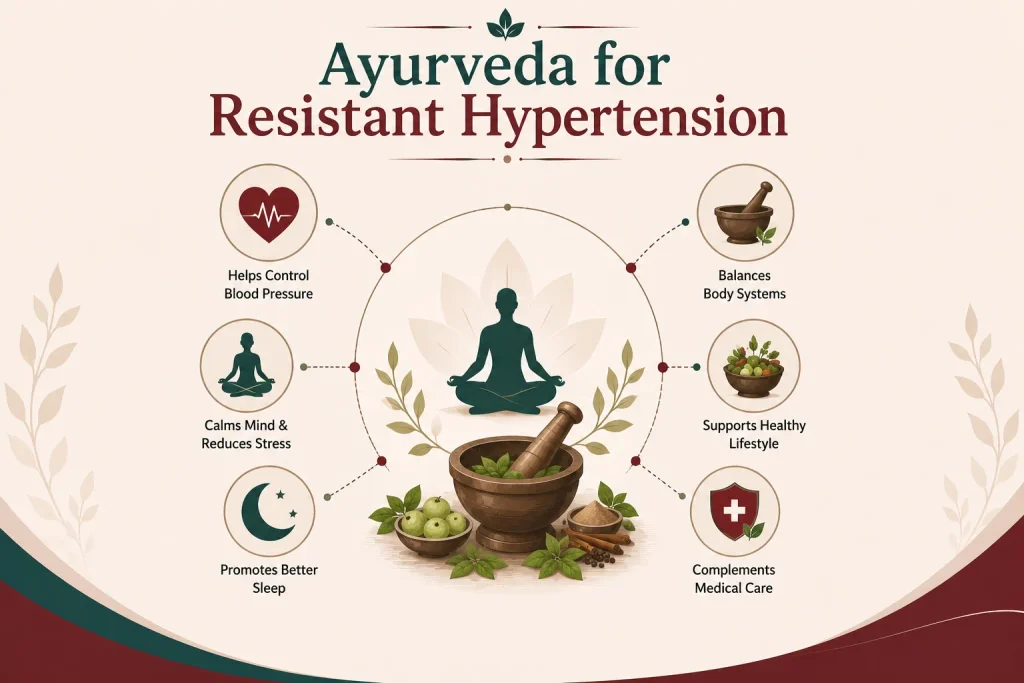
This is why Ayurvedic treatment for resistant hypertension isn’t built around one herb or one therapy. It’s built around calming this long-standing Vata-Pitta pattern through diet, herbal formulations, and a daily routine that reduces the load on your nervous system.
What Does a Resistant Hypertension Ayurvedic Treatment Include?
At a clinical level, an Ayurvedic treatment for resistant hypertension usually combines four things as follows:
- Panchakarma and herbal formulations
- Dietary changes
- Lifestyle and exercise guide
- Therapies that support circulation and stress reduction.
None of these replace your prescribed medicines without a doctor’s supervision.
| Component | What It Involves |
| Herbal formulations | Doctor-prescribed Ayurvedic formulations selected according to your health condition, Prakriti, current medicines and treatment requirements. |
| Panchakarma | Selected Panchakarma therapies may be included as part of the treatment plan, depending on your health condition, assessment and doctor’s recommendation. |
| Diet | Reduced sugar, salt and oil or heavy items and adding more fruit, vegetables and lighter meals. |
| Lifestyle and exercise guide | Breathing practices and gentle postures aimed at calming the nervous system. |
| Daily routine | Fixed sleep and wake times, regular meals, and reduced exposure to stress triggers. |
“Patients with resistant hypertension often come to us after trying everything conventional medicine offers. What we add isn’t a fifth medicine, it’s diet, herbal support, and a routine that takes some of the pressure off the system that’s been working overtime. That combination is what tends to move the numbers when medicines alone haven’t.”
— Dr. Gurudatta Amin, CMO, Madhavbaug
If your blood pressure has stayed high despite treatment, our doctors can explain what a supervised Ayurvedic add-on could look like alongside your current medicines.
Evidence-Based Ayurveda for Uncontrolled Hypertension
When blood pressure remains high despite treatment, the focus is not only on lowering the reading but also on understanding factors such as diet, stress and poor sleep, physical activity, weight and medication use that may be keeping it elevated. Ayurvedic treatment for uncontrolled hypertension includes personalised diet, yoga and pranayama, daily routine changes, selected herbal formulations and panchakarma where appropriate. These measures are used alongside regular BP monitoring and existing medical care.
| Approach | How It May Support Blood Pressure Management |
| Diet | Reducing excess salt, fried foods and other dietary factors that may contribute to high blood pressure. |
| Yoga & Pranayama | Gentle practices that may support stress management and relaxation. |
| Daily routine | Regular sleep, meals and physical activity to support overall cardiovascular health. |
| Herbal formulations | Selected formulations may be prescribed based on the individual’s health status and existing medicines. |
| Panchakarma | May be considered for selected patients after an individual assessment. |
| Monitoring | Regular blood pressure checks help determine whether the overall approach is working. |
Research on Ayurveda for high blood pressure is still growing. Some studies have found that Ayurvedic treatment, when added to regular medicines and lifestyle changes, may help lower blood pressure and, in some cases, reduce the need for medicines under a doctor’s supervision (Sharma et al., 2021; Ghaffari et al., 2020).
The Ayurvedic Treatment Process for Resistant Hypertension
| Book a Consultation ↓ Confirm resistant hypertension and rule out other causes. ↓ Review current medicines and daily routine. ↓ Assess Prakriti (constitution) and current Vata-Pitta imbalance. ↓ Add herbal formulations, diet and yoga alongside prescribed medicines. ↓ Track blood pressure at home and in the clinic together. ↓ Adjust medicine doses only with your doctor’s guidance. ↓ Reassess and fine-tune the plan over time. |
Your doctor builds this plan around your specific body type. Two people with resistant hypertension can end up with different combinations of herbs, diet changes, and routine adjustments, depending on their Prakriti, their current medicines, and what else is going on with their health.
Madhavbaug’s Approach to Resistant Hypertension
At Madhavbaug, our doctors start with the same evaluation your cardiologist would run. We start by confirming the reading is real, reviewing your full medicine list, and ruling out other causes. After this, a supervised Ayurvedic treatment plan is made which is built around your Prakriti, your current medicines, and your daily routine and monitors your blood pressure.
“We see patients who’ve already tried three, sometimes four medicines, and understandably want another option. What we offer is a coordinated addition once we’ve confirmed what’s actually driving the resistance, built around your specific case instead of a standard protocol.”
— Dr. Bipin Gond, Zonal Medical Head, Madhavbaug
With a network of over 350 clinics and hospitals across India, Madhavbaug brings Ayurvedic physicians and modern diagnostics together under one roof, so your evaluation, treatment, and monitoring happen as one coordinated process. If your blood pressure has stayed high despite treatment, book a consultation at your nearest clinic to find out where a supervised Ayurvedic treatment could genuinely fit into your care.
Interested in how an Ayurvedic treatment can help you tackle resistant hypertension?
Frequently Asked Questions
Can Ayurveda bring down blood pressure that hasn’t responded to medicines?
Research on Ayurvedic treatment, including herbal formulations like Sarpagandha Mishran and Emblica officinalis, has shown additional blood pressure reduction and, in some cases, allowed doses of conventional medicines to be safely reduced. This happens alongside prescribed treatment and under medical supervision.
What does an Ayurvedic add-on for resistant hypertension actually involve?
It typically combines herbal formulations prescribed by your doctor, dietary changes such as reduced salt and fried food, yoga and breathing practices, and a fixed daily routine. All of this is added to your existing blood pressure medicines.
Is it safe to add Ayurvedic treatment while I’m still on multiple BP medicines?
It can be when it’s supervised by a doctor who knows your full medicine list and monitors your blood pressure regularly. Any reduction in your conventional medicine dose should only happen under a doctor’s guidance, based on how your blood pressure actually responds.
How long does it take to see results from an Ayurvedic treatment?
In the research reviewed, meaningful changes, including the ability to reduce conventional medicine doses in some patients, were seen by three months and became more pronounced by six months. Your own timeline will depend on your specific case.
Should I try Ayurveda before getting my resistant hypertension properly evaluated?
No. Confirming true resistant hypertension, ruling out other causes, and reviewing your current medicines comes first. A supervised Ayurvedic treatment plan is something to discuss once that evaluation is complete, not before it.
Related reading
- Managing Hypertension Naturally with Ayurveda
- Ayurvedic Medicine for High BP: Safety and Evidence
- Sustainable Relief from Constantly High Blood Pressure
- 5 Ways Recommended by Ayurveda to Control Blood …
- High Blood Pressure Treatment Without Lifelong Medication
- How to Control High Blood Pressure Naturally
References
Whelton, P.K., Carey, R.M., Aronow, W.S. et al. (2024) ‘Definition and evaluation of resistant hypertension‘, in Evaluation and Management of Resistant Hypertension: Core Curriculum, American Journal of Kidney Diseases.
Sharma, R., Goyal, A., Singh, R., Khanduri, S., Ota, S., Goel, S., Rana, R.K., Singhal, R., Shahi, V.K., Srikanth, N., Swasticharan, L. and Dhiman, K.S. (2021) ‘Effect of Ayurveda intervention in the integrated management of essential hypertension: a retrospective observational study‘, Journal of Ayurveda and Integrative Medicine, 12(3), pp. 521–528.
Ghaffari, S., Navabzadeh, M., Ziaee, M., Ghobadi, A., Ghods, R. and Hashem-Dabaghian, F. (2020) ‘A randomized, triple-blind, placebo-controlled, add-on clinical trial to evaluate the efficacy of Emblica officinalis in uncontrolled hypertension‘, Evidence-Based Complementary and Alternative Medicine, 2020, article 8592869.




 Locate a Centre
