

Lowering blood pressure at home is an important part for those who have severe hypertension. Though medical supervision is a must, some safety steps are recommended, which may include lying down, closing eyes and practising slow breathing.
After checking for emergency and hypertensive crisis symptoms, if you are wondering what to do when blood pressure is high, then it is important to understand the difference between a high reading you can safely manage at home and a warning sign that needs emergency care.
After understanding these, safety steps can be followed at home for temporary relief.
What to Do When Blood Pressure Is High
If you have very high blood pressure, then you should first stop what you are doing. It is recommended for you to sit quietly and relax for five to ten minutes. It is advised to breathe slowly and deeply. (Bentley, T.G., et al 2023)
After this, if your blood pressure is still higher than 180/120 mm Hg or you have chest pain, difficulty in breathing or weakness, you need emergency medical attention.
Following are the detailed safety steps to be considered when the blood pressure is very high.
Step 1: Sit Down and Rest
Anxiety itself raises blood pressure, so the first step is simply to sit in a calm, quiet spot with your back supported and feet flat on the floor. Loosen tight clothing. Breathe slowly. Avoid standing up, walking around, or doing anything strenuous for the next several minutes.
Step 2: Recheck the BP Correctly
Rechecking the BP correctly is important because one reading may be inaccurate, especially if the cuff was positioned wrong, the person was talking or the person was involved in any physical activity.
Here’s the correct technique:
- Sit quietly for 5 minutes before measuring, and don’t measure immediately after stress or exertion
- Keep your back supported and feet flat, and don’t cross your legs
- Rest your arm on a table so the cuff is roughly at heart level
- Make sure the cuff size matches your arm because a cuff that’s too small can inflate the reading
- Stay silent and still during the measurement
- Take a second reading about 1–2 minutes after the first, and compare (Pickering, T.G., et al 2008)
If you’re not confident your monitor or technique is accurate, our guide on understanding blood pressure readings and what your numbers really mean breaks this down in more detail.
The correct BP monitor is equally important, so choosing a reliable smart BP monitor can help you avoid common measurement errors going forward.
Step 3: Do Not Take an Extra Dose or Try Unverified Remedies
An extra dose of blood pressure medicine may cause your pressure to fall too fast or too low, which may lead to fainting, falls, or reduced blood flow to the heart and brain, especially in older adults.
Unverified remedies aren’t dosed or tested for a crisis situation, and some can interact dangerously with medications the person is already taking. The right move is measured, not more medicine.
Even if you feel like you are not supposed to:
- Take an extra dose of your regular BP medicine
- Try a home remedy you’ve seen online, like hibiscus tea, excess garlic, apple cider vinegar, or holding your breath
- Take someone else’s BP medication, even if it seems similar to yours
Step 4: Note Down the Medicines and Possible Triggers
It is important to note down the medicine and the possible triggers for the raise in the blood pressure because these small steps save crucial time when you do speak to a doctor, and it often reveals a simple, fixable cause behind the spike.
While you wait or prepare to call the doctor, note down:
- What BP medicines the person takes, and whether today’s dose was missed or taken late
- Any new medicines, painkillers, decongestants, or supplements taken recently
- Possible triggers may include a stressful event, poor sleep, high salt intake, skipped meals, excess caffeine, or alcohol
- The exact readings and times of each check
Emergency Symptoms for High BP
A reading of 180/120 mm Hg or higher is a hypertensive crisis and requires immediate medical attention. If this high reading is accompanied by warning signs such as chest pain, shortness of breath, sudden weakness or numbness, or changes in vision, you need to visit the doctor immediately.
A BP reading of 180/120 mm Hg or higher, especially with chest pain, breathlessness, weakness, numbness or vision changes, can be an emergency. Do not delay urgent medical care or rely on home remedies when these warning signs are present.
Call an ambulance or rush to the nearest emergency room immediately if the BP reading is 180/120 or higher AND the person also has any of these hypertensive crisis symptoms:
- Severe chest pain or pressure
- Shortness of breath or difficulty breathing
- Sudden, severe headache unlike any before
- Blurred vision, double vision, or sudden vision loss
- Confusion or difficulty staying alert
- Slurred speech or trouble speaking
- Numbness, weakness, or drooping on one side of the face, arm, or leg
- Nausea or vomiting with the above symptoms
These can be signs of a stroke, heart attack, or organ damage in progress, and so this is not the moment to wait, rest, or try a home remedy.
Do not drive the person yourself if they are unsteady or showing these signs. Call for emergency medical help so treatment can start immediately.
If the reading is high but there are no symptoms at all, this is usually classified as severe hypertension without immediate organ damage, but it gives you a short window to respond correctly at home before contacting a doctor. The steps below are for this situation.
When to Call the Doctor
- If the repeat reading (after resting) is still 180/120 or higher, even without symptoms, call your doctor’s emergency line or visit urgent care the same day. This should not be left until tomorrow.
- If the reading is high but below 180/120, and there are no symptoms, contact your regular doctor to discuss it, especially if this is unusual for the person or if it keeps recurring.
- If new symptoms appear at any point during this process, stop everything and seek emergency care immediately, even if the earlier reading seemed to be settling.
If you’re not near your regular physician, you can find your closest Madhavbaug clinic or hospital using our clinic and hospital locator for same-day guidance.
What Not to Do
To keep this simple, here’s a quick list of common mistakes to avoid during a high BP reading at home:
- Don’t panic – search and try a remedy you’ve never used before
- Don’t take extra doses of prescribed medicine without medical advice
- Don’t ignore repeated high readings hoping they’ll “settle on their own”
- Don’t let the person drive themselves if they feel unsteady, dizzy, or unwell
- Don’t delay calling for help if any emergency symptom appears
- Don’t rely on a single reading from an uncalibrated or poorly fitted monitor
Building a Longer-Term Blood Pressure Control Plan
A stressful high reading is often a signal not just to manage today’s number but to look at what’s driving these spikes over time. Once the immediate situation is handled, it’s worth having a conversation with your doctor about:
- Whether your current medication and dosage still suit you
- Daily salt intake, sleep quality, and stress levels
- Regular home monitoring at consistent times, rather than only checking when you feel unwell
- Sudden BP spikes that tend to happen in the early morning, for which understanding morning blood pressure surges and their management is important.
At Madhavbaug, our approach to long-term blood pressure management combines doctor-supervised monitoring with Ayurvedic therapies, diet correction, and lifestyle changes aimed at addressing the root cause rather than just the number on the monitor.
You can read more in our guide on Ayurvedic treatment for high and low blood pressure but do remember, this kind of holistic, root-cause approach is for ongoing control between episodes, not for managing an acute high reading or emergency, which always needs immediate medical attention first.
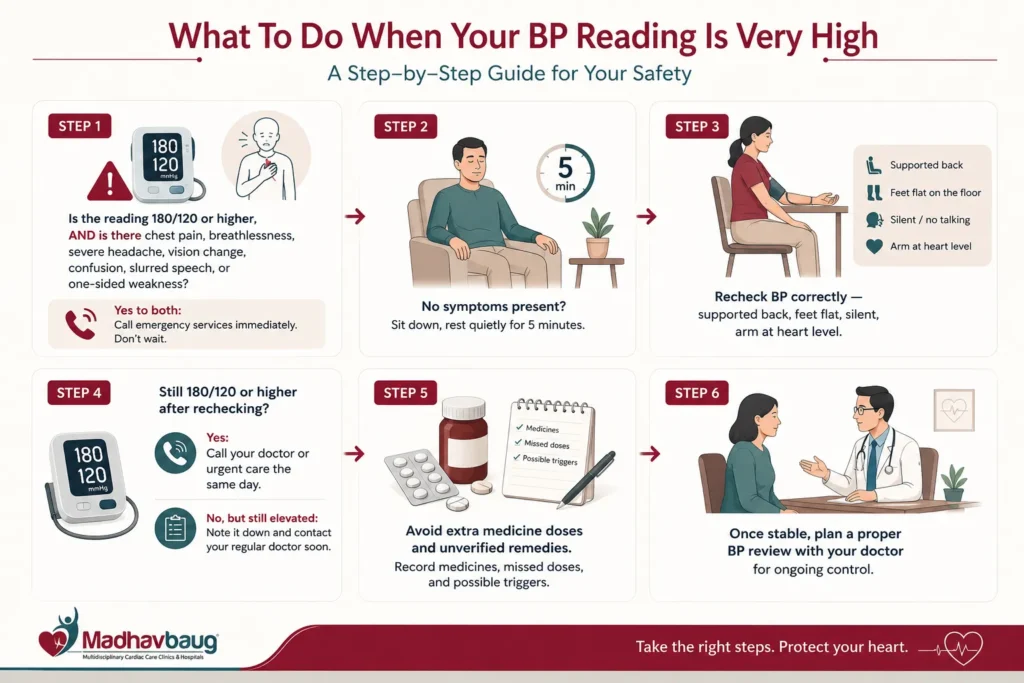
Immediate Steps High BP
Use this simple checklist the next time you see a high home BP reading
Final Word
A high BP reading at home can feel frightening, but most of the time, calm, correct action makes all the difference. Sit, rest, recheck, and know exactly which symptoms mean it’s time to call for help. If you’d like ongoing, doctor-supervised support for long-term blood pressure control, the team at your nearest Madhavbaug clinic is here to help you build a plan that goes beyond just managing today’s number.
One high BP reading does not tell the whole story. If your readings remain elevated or you need support with long-term BP management, a personalised, doctor-guided assessment can help you understand your BP pattern and next steps.
Frequently Asked Questions
- How can I lower blood pressure quickly at home?
The safest approach isn’t a quick fix by sitting down, resting for 5 minutes, and rechecking your BP correctly. If it’s still 180/120 or higher, or you have any emergency symptoms, this needs medical attention, not a home remedy. - What should I do when blood pressure is high but I feel fine?
Rest quietly for 5 minutes, then recheck using the correct technique. If the repeat reading is still very high, contact your doctor the same day even without symptoms. - What are the immediate steps for high BP at home?
Sit and rest, recheck the reading correctly after 5 minutes, avoid extra medicine doses or unverified remedies, note down medicines and possible triggers, and call your doctor if the reading stays at 180/120 or above. - What are the symptoms of a hypertensive crisis I should never ignore?
Chest pain, breathlessness, sudden severe headache, vision changes, confusion, slurred speech, or one-sided weakness alongside a reading of 180/120 or higher which mean emergency care right away, not a wait-and-watch approach. - Can I take an extra BP tablet if my reading is very high?
No. Don’t take an extra or unprescribed dose on your own. It can drop your pressure too fast and cause its own emergency. Speak to a doctor before changing any dose.
References
- Bentley, T.G., D’Andrea-Penna, G., Rakic, M., Arce, N., LaFaille, M., Berman, R., Cooley, K. and Sprimont, P., 2023. Breathing practices for stress and anxiety reduction: Conceptual framework of implementation guidelines based on a systematic review of the published literature. Brain sciences, 13(12), p.1612.
- Pickering, T.G., Miller, N.H., Ogedegbe, G., Krakoff, L.R., Artinian, N.T. and Goff, D., 2008. Call to action on use and reimbursement for home blood pressure monitoring: a joint scientific statement from the American Heart Association, American Society of Hypertension, and Preventive Cardiovascular Nurses Association. Hypertension, 52(1), pp.10-29.


 Locate a Centre
