


Key Takeaways
|
If you’ve been told you have a metabolic condition like type 2 diabetes, hypertension, obesity, or heart disease, you may have noticed that the same advice doesn’t work the same way for everyone. Two people with an identical diagnosis can respond very differently to the same diet or exercise plan. Ayurveda addresses this through Prakriti assessment, a way of understanding your individual constitution before deciding how to manage your condition. Here’s what Prakriti actually means, how it differs from Vikriti, why it’s relevant to metabolic health, and where its limits lie.
What Is Prakriti?
Prakriti is the unique physical and mental constitution you’re born with. In Ayurveda, it’s determined by the relative balance of three doshas, Vata, Pitta, and Kapha, and it stays largely the same throughout your life. Think of it as your baseline, the pattern your body naturally tends toward when everything is functioning as it should.
Your Prakriti influences things like your build, digestion, metabolism, sleep pattern, and even how you tend to respond to stress. No single dosha exists in isolation. Most people have one or two doshas that are more dominant, and this combination is what your Ayurvedic doctor is identifying when they assess your Prakriti.
“Prakriti tells us what is normal for you specifically, not what is normal in general. Without that starting point, it’s difficult to know whether a symptom reflects your body moving out of its own balance or whether it’s simply how you’ve always been.”
— Dr. Cinni Vijay Pandey, Regional Medical Head, Madhavbaug
Prakriti Assessment for Metabolic Health
Metabolic conditions like diabetes, hypertension, obesity, and heart disease don’t develop identically in every person, and Ayurveda’s view is that Prakriti plays a role in this variation.
Emerging research has started to examine whether specific Prakriti types correlate with measurable metabolic markers. 2025 research has pointed to associations between Kapha-dominant and Vata-Kapha constitutions and higher rates of diabetes, hypertension, dyslipidaemia, and insulin resistance (Akashlal et al., 2025). Separately, another research found that Kapha-type individuals showed higher levels of markers linked to lipid metabolism, including triglycerides, cholesterol, and LDL, consistent with a tendency toward metabolic slowdown. (Shirolkar et al., 2018)
This doesn’t mean your Prakriti alone predicts your metabolic risk, and it isn’t used as a diagnostic test. What it does is give your doctor useful context. Two patients with the same HbA1c reading may need different dietary emphasis, different pacing for lifestyle change, and different follow-up frequency, and Prakriti is one of the factors that helps shape those decisions.
| Prakriti Tendency | Common Metabolic Pattern Ayurveda Associates With It |
| Kapha-dominant | Slower metabolism, tendency toward weight gain and fluid retention |
| Pitta-dominant | Efficient metabolism, but prone to inflammation-linked imbalances |
| Vata-dominant | Irregular digestion and appetite, tendency toward fluctuating energy |
If you’re managing a metabolic condition and want a treatment plan built around your individual constitution rather than a generic protocol, a Prakriti assessment is a good place to start.
Prakriti vs Vikriti
Prakriti and Vikriti are often confused, but the difference matters for how your treatment plan is built. Prakriti is who you are constitutionally and has a specific ayurvedic body type. Vikriti is what’s happening in your body right now, including any imbalance driving your current symptoms or diagnosis.
| Prakriti | Vikriti | |
| What it means | Your inborn, baseline constitution | Your current state of dosha imbalance |
| Does it change? | Stays largely stable throughout life | Shifts with diet, stress, season, illness |
| What it reflects | Your natural tendencies | What’s currently driving your symptoms? |
| Why it’s assessed | To personalise recommendations to your baseline | To identify what needs correcting right now |
Imagine your Prakriti might be Kapha-dominant, giving you a naturally sturdy build and steady digestion. But if your current lifestyle has pushed your Kapha further out of balance, your Vikriti may show up as weight gain, sluggish digestion, or elevated blood sugar.
Your doctor needs both pieces of information, where your body naturally sits and where it currently stands, to know what’s actually gone off track and how far it’s shifted from your own normal.
How Prakriti Assessment Shapes Your Diet
Your diet is shaped by your body type (Vata, Pitta or Kapha) through a Prakriti assessment of your physical and mental characteristics. This evaluation allows you to find the best diet plan by matching food qualities like temperature and taste (rasa) to balance your natural strengths and weaknesses, maintaining your metabolism and preventing illness.
| Prakriti | Common Focus | Diet Approach |
| Kapha-dominant | Obesity / Prediabetes | Choose light, warm foods and limit heavy, oily, fried and sweet foods. |
| Pitta-dominant | Hypertension | Choose cooling foods and limit spicy, fried and acidic foods. |
| Vata-dominant | Irregular Blood Sugar | Choose warm, grounding foods and maintain regular meal timings. |
None of this replaces the standard dietary restrictions your condition requires, such as sodium limits for hypertension or carbohydrate monitoring for diabetes. Prakriti-based advice sits on top of those fundamentals, adjusting how they’re applied to your specific constitution.
How Prakriti Assessment Shapes Your Daily Routine
Ayurveda places real weight on Dinacharya, or daily routine, as a tool for keeping doshas in balance, and this is another area where Prakriti assessment changes the advice you’re given. Sleep timing, exercise intensity, and even the time of day you eat your largest meal can be adjusted based on your constitution.
| Prakriti | Lifestyle Approach |
| Kapha-dominant | Wake up early and stay physically active to overcome sluggishness and maintain energy. |
| Pitta-dominant | Avoid excessive exertion, especially during peak heat, and include enough rest and relaxation. |
| Vata-dominant | Follow a steady and predictable routine with regular sleep, meals and daily activities. |
For someone managing a metabolic condition, these adjustments aren’t just lifestyle preferences. Sleep quality, stress patterns, and activity timing are all recognised drivers of blood sugar and blood pressure control, which is why they’re built into the plan.
| Clinical Insight “Patients coming in for hypertension have usually already cut back on salt, but very few have addressed their sleep quality, which is often the bigger driver of their blood pressure not settling.” Dr. Pravin Jayram Ghadigaonkar, BAMS, MD, PhD (Scholar) – Preventive Cardiology 20+ Years of Clinical Experience, Head Medical Operations & Patient Improvement, Madhavbaug |
Limitations of Prakriti Assessment
Prakriti assessment can provide useful insights into an individual’s natural physical and mental characteristics, but it also has some limitations. Traditionally, an Ayurvedic Prakriti assessment is based on the doctor’s clinical observation, detailed questions and an understanding of the person’s long-term patterns. This means the assessment can depend to some extent on the doctor’s experience and the method used during the consultation. It should therefore be considered as one part of a broader early detection health assessment, instead of a standalone diagnostic test.
A review of Prakriti assessment methods in 2025 found that while researchers have developed more structured, questionnaire-based tools in recent years, there is a lot of variation in how different practitioners score the same physical and behavioural traits (Venkatesh et al., 2025).
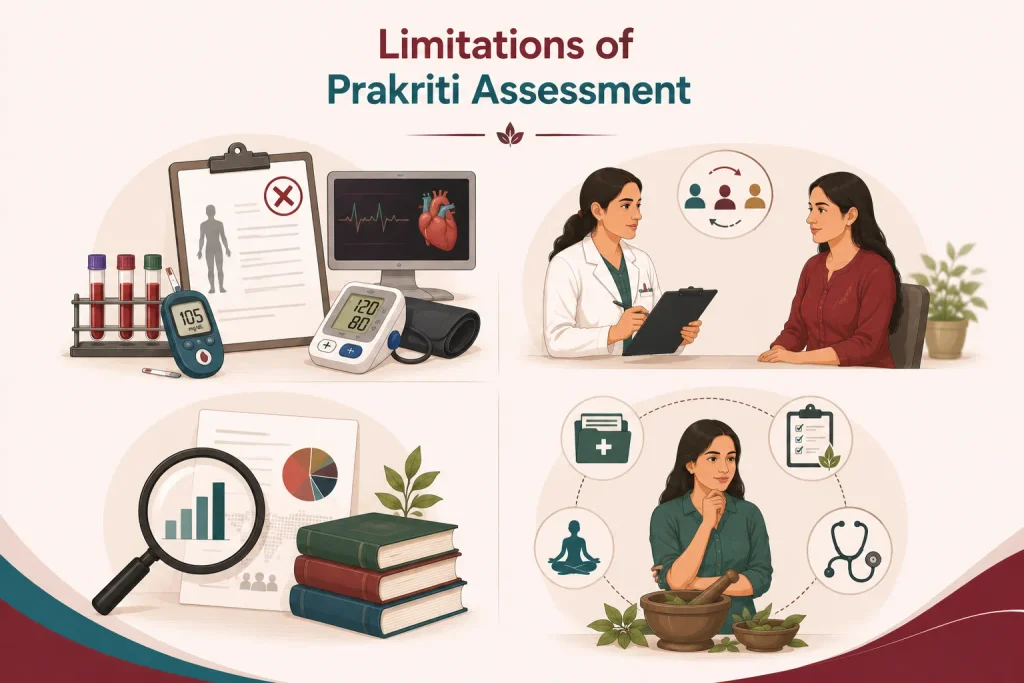
This means that a Prakriti assessment may have the following limitations:
- Prakriti assessment is not a diagnostic test. It doesn’t replace blood sugar readings (continuous glucose monitoring), blood pressure monitoring, lipid panels, or cardiac tests, all of which remain essential for managing a metabolic condition.
- Results can vary between practitioners to some degree, particularly for people with a fairly even mix of two or three doshas.
- The research base connecting specific Prakriti types to specific metabolic outcomes is still developing. Current studies are promising but limited in sample size, and more large-scale research is needed before firm clinical claims can be made.
- Prakriti assessment works best as one input among several, alongside your medical history, current test results, and your doctor’s clinical judgement, not as a standalone basis for treatment decisions.
How Prakriti Assessment Actually Happens in a Consultation
In practice, Prakriti assessment isn’t a separate appointment. It’s built into your first consultation alongside your health history and any diagnostic tests relevant to your condition. Here’s how it typically flows:
| Book a Consultation ↓ Health history & current diagnosis reviewed ↓ Physical build, digestion, sleep and stress patterns assessed ↓ Prakriti identified (dominant dosha or combination) ↓ Current imbalance, or Vikriti, evaluated against test results ↓ Diet and lifestyle recommendations are personalised accordingly. ↓ The plan was reviewed and adjusted at follow-up visits |
Your doctor will typically ask about your body build and weight history, your digestion and appetite patterns, your sleep quality and duration, how you tend to respond to stress, and how your body has historically reacted to different foods, seasons, and temperatures. Combined with your diagnostic results for diabetes, hypertension, obesity, or heart disease, this gives your doctor a fuller picture of both your baseline constitution and your current state, which is what your treatment plan is ultimately built around.
If you’re managing a metabolic condition and want to understand how a personalised, constitution-based approach could fit into your care, the next step is a consultation with an Ayurvedic doctor at your nearest clinic, who can assess both your Prakriti and your current health status together.
Book a Consultation at Madhavbaug
At Madhavbaug, your consultation begins with understanding you, not just your condition. Our Ayurvedic doctors assess your Prakriti, current symptoms, lifestyle, diet, medical history and relevant health reports to understand the factors that may be contributing to your health concerns. This personalised assessment is combined with condition-specific evaluation to help develop a care plan suited to your individual needs.
While advising a treatment plan for diabetes, high blood pressure, obesity, heart disease or other chronic health concerns, the aim is to understand your current health status and provide guidance based on your individual requirements. Your progress can also be reviewed during follow-up consultations, allowing the plan to be adjusted as needed.
Book a consultation at Madhavbaug to understand your Prakriti and explore a personalised approach to managing your health.
Understanding your individual constitution is the first step toward a treatment plan built for your body, not a generic one. Book a consultation to get your Prakriti and current health status assessed together.
Frequently Asked Questions
What is Prakriti in Ayurveda, and why is it assessed?
Prakriti is your inborn body constitution, determined by the relative balance of Vata, Pitta, and Kapha doshas. It’s assessed because it helps a doctor personalise diet, routine, and treatment recommendations to your individual body instead of applying the same advice to everyone with the same diagnosis.
What’s the difference between Prakriti and Vikriti?
Prakriti is your fixed, baseline constitution from birth. Vikriti is your current state of dosha imbalance, which is what actually shows up as symptoms or a diagnosis like diabetes or hypertension. Your doctor looks at both to understand your natural tendencies and what has currently shifted out of balance.
Can Prakriti assessment predict my risk of diabetes or heart disease?
Not on its own. Research has found associations between certain Prakriti types and metabolic markers like insulin resistance and cholesterol levels, but Prakriti assessment is not a diagnostic tool. It’s used alongside standard tests, not as a replacement for them.
Is Prakriti assessment scientifically validated?
Prakriti assessment has traditionally relied on clinical observation, and researchers are still working to standardise objective assessment tools. Some structured, questionnaire-based methods now exist, but variation between practitioners can still occur, so it’s best understood as a personalisation tool.
Does my Prakriti change over time?
No, your Prakriti is considered fixed from birth. What changes is your Vikriti, or current state of imbalance, which is influenced by diet, stress, season, and lifestyle, and which your treatment plan is designed to correct.
Related reading
- Gut Microbiome, Ayurveda and Metabolic Health
- Early Detection and Prevention
- AI in Ayurveda and Personalised Metabolic Metabolic Care
- Evidence-Based Ayurveda: Metabolic Health Metrics
References
Akashlal, M., Ahmad, A., A, A., Raj, L.S., M, M., Tripathi, A., Debnath, S.K., Rao, B.C.S., Srikanth, N. and Acharya, R. (2025) ‘Prevalence of metabolic syndrome and noncommunicable disease risk factors in Andaman and Nicobar Islands, India, and their association with Ayurvedic psychosomatic constitution (Prakriti) and socioeconomic status: protocol for a cross-sectional study‘, JMIR Research Protocols, 14, article e81329.
Shirolkar, A., Chakraborty, S., Mandal, T. and Dabur, R. (2018) ‘Plasma metabolomics reveal the correlation of metabolic pathways and Prakritis of humans‘, Journal of Ayurveda and Integrative Medicine.
Venkatesh, A., Johansson, L., Sivanandan, P.V., Gopakumar, S.P., Sankaranarayanan, K., Kessler, C.S., Ravani, S. and Puthiyedath, R. (2025) ‘Prakriti (constitutional typology) in Ayurveda: a critical review of Prakriti assessment tools and their scientific validity‘, Frontiers in Medicine, 12, article 1656249.




 Locate a Centre
