
Key Takeaways
|
Ashtavidha Pariksha is an eight-fold Ayurvedic examination used to assess a person’s health and disease state. It includes examination of the pulse, urine, stool, tongue, voice, touch, eyes and physical appearance. These observations are considered together with the person’s symptoms, health history and other clinical findings to understand their overall condition.
A review of Ashtavidha Pariksha described Nadi, Mutra, Mala, Jihva, Shabda, Sparsha, Drik and Akriti as the eight components of this examination and discussed their role in diagnosis and prognosis (Singtan et al., 2020).
What Is Ashtavidha Pariksha in Ayurveda?
The word Ashtavidha means eight-fold, while Pariksha means examination or assessment.
Ashtavidha Pariksha is a classical Ayurvedic approach to examining a patient through eight different observations. The physician looks at several aspects of the person’s health, including the pulse, urine, stool, tongue, voice, touch, eyes and physical appearance.
Classical Ayurvedic texts describe different approaches to patient examination, including Trividha Pariksha, Dashvidha Pariksha and Ashtavidha Pariksha. A review of Ayurvedic examination methods also discusses these different frameworks as approaches to Rogi Pariksha, or examination of the patient (Tiwari & Dhakad, 2022).
How Does Ashtavidha Pariksha Help With Ayurvedic Diagnosis?
These observations help the Ayurvedic physician understand the person’s Prakriti, current health condition, symptoms and Dosha-related patterns. The findings from the examination are considered along with the person’s health history, lifestyle and other relevant clinical information.
Nadi Pariksha is one component of Ashtavidha Pariksha. It focuses on examination of the pulse and has its own principles within Ayurvedic assessment. A complete Ashtavidha Pariksha includes the other seven forms of examination as well.
Looking for an Ayurvedic Diagnosis With Ashtavidha Pariksha?
What Are the 8 Parts of Ashtavidha Pariksha?
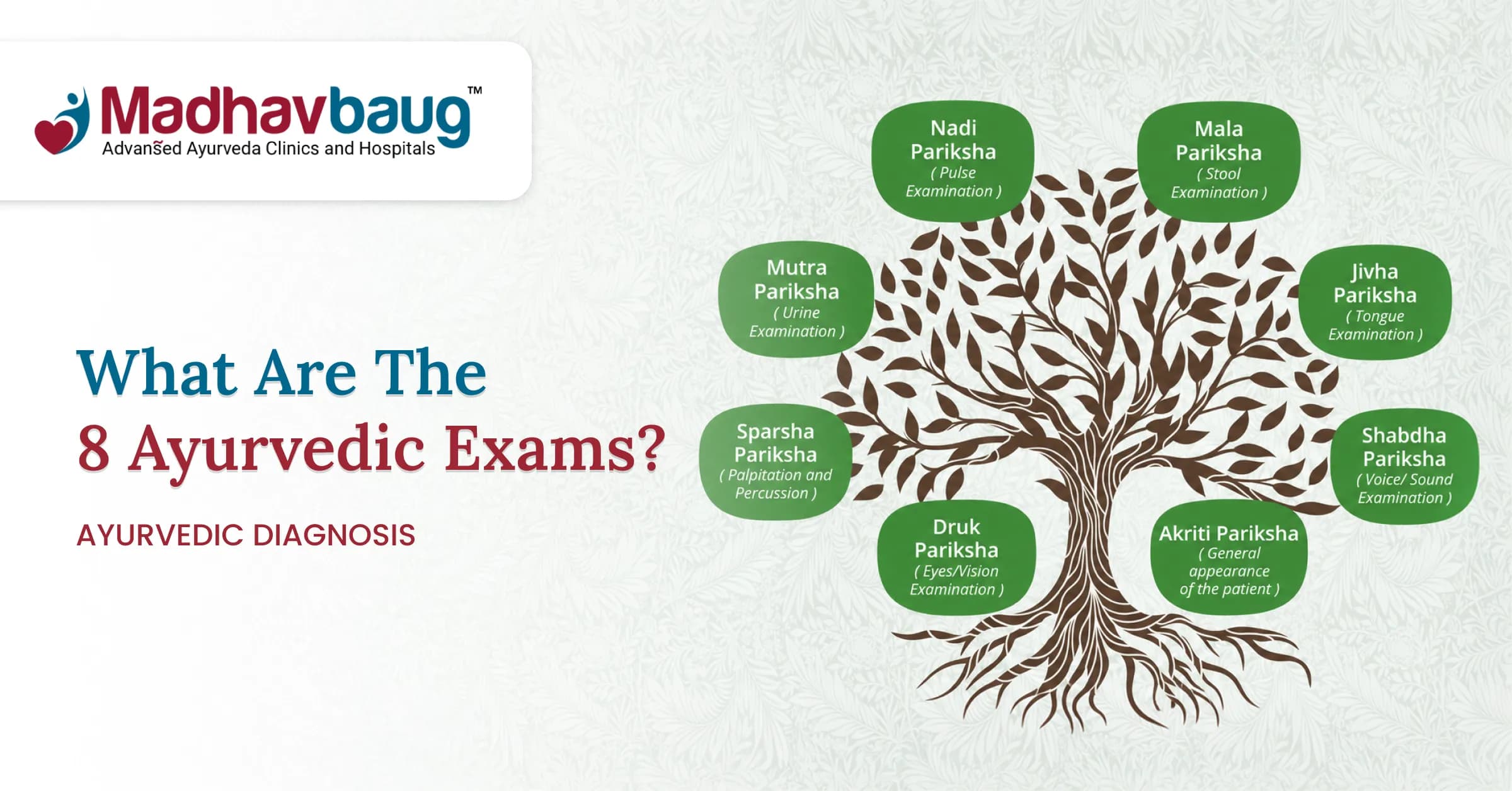
The 8 parts of Ashtavidha Pariksha are Nadi, Mutra, Mala, Jihva, Shabda, Sparsha, Drik and Akriti Pariksha. They examine the pulse, urine, stool, tongue, voice, touch, eyes and physical appearance respectively.
| Part | Examines |
| Nadi Pariksha | Pulse |
| Mutra Pariksha | Urine |
| Mala Pariksha | Stool |
| Jihva Pariksha | Tongue |
| Shabda Pariksha | Voice and speech |
| Sparsha Pariksha | Touch and physical features |
| Drik Pariksha | Eyes |
| Akriti Pariksha | Physical appearance and body build |
During an Ayurvedic consultation, you may notice that your doctor looks at several small details that you may not have considered part of a health examination. They may ask about your bowel movements, observe your tongue, examine your pulse or notice changes in your voice and physical appearance.
Each observation gives the physician another piece of information about your health. For example, Nadi Pariksha focuses on the pulse, while Jihva Pariksha looks at the tongue. Mala Pariksha gives information about bowel habits and Akriti Pariksha considers physical characteristics.
These findings are discussed with your symptoms, diet, daily routine, health history and other clinical information. Understanding each of these eight examinations in detail can help you see how an Ayurvedic physician approaches your health assessment.
1. Nadi Pariksha
Nadi Pariksha is an Ayurvedic examination of the pulse and one of the eight parts of Ashtavidha Pariksha. It is one of the best-known methods of Ayurvedic assessment.
During Nadi Pariksha, your Ayurvedic physician examines your pulse through touch and observes its characteristics. Traditional Ayurvedic practice associates different pulse qualities with Vata, Pitta and Kapha.
Nadi Pariksha forms one part of a wider clinical assessment. Your physician considers the pulse findings along with your symptoms, health history and other examination findings when assessing your health.
2. Mutra Pariksha
Mutra Pariksha is the Ayurvedic examination of urine and one of the eight parts of Ashtavidha Pariksha. It looks at changes in urine that can give your doctor useful information about your health.
Your doctor may ask how often you pass urine, how much urine you pass and whether you have noticed any change in its colour, smell or appearance. These are simple things you may already notice in your daily life, especially when you have diabetes, urinary problems or changes in your fluid intake.
| Ayurvedic Diagnosis and Urine Ayurveda described different urine patterns in conditions grouped under Prameha. Descriptions such as Ikshumeha and Sandrameha show that Ayurvedic physicians observed specific changes in urine while assessing disease. These observations were part of a structured examination of the patient. |
During your consultation, your doctor considers these urine findings along with your symptoms, health history, diet and lifestyle. This urine examination becomes one part of the wider Ayurvedic diagnosis and health assessment. If your condition requires further evaluation, laboratory tests can also provide measurable information about your urine and metabolic health, giving your doctor a clearer picture for the overall diagnosis.
3. Mala Pariksha
Your bowel movements can tell your doctor a lot about your digestion. Mala Pariksha is the Ayurvedic examination of stool and bowel function, and it forms one part of Ashtavidha Pariksha.
During your consultation, your doctor may ask how often you pass stool, whether it is hard, loose or sticky, whether you have difficulty passing it and whether you have noticed any change. Ayurveda also pays attention to the stool’s colour, consistency, smell and overall appearance.
| What Your Stool Says About Your Health According to Ayurveda Ayurveda describes Sama and Nirama Lakshana when assessing stool and digestion. In simple terms, Sama refers to stool showing features associated with poorly digested material, such as heaviness, stickiness, an unusual smell or a coating-like appearance. Nirama refers to stool where these features are absent. Classical Ayurvedic examination also considers whether stool floats or sinks in water. Floating stool is described in association with Sama, while stool that sinks is associated with Nirama. |
These observations show how closely Ayurvedic physicians examined physical changes in the body while assessing disease. They remain relevant to Ayurvedic assessment because they give the physician observable information about stool, digestion and bowel function. Your doctor considers these findings along with your appetite, digestion, diet, symptoms and daily routine to build a clearer picture of your health and guide the Ayurvedic diagnosis.
4. Jihva Pariksha
Jihva Pariksha is the examination of the tongue in Ayurveda.
Have you ever looked at your tongue and noticed a white coating on it? Your Ayurvedic doctor may pay attention to the same change during a health assessment.
The doctor may look at the colour, coating, moisture and texture of your tongue. Ayurveda describes a white-coated tongue as a ‘Sama’ feature. A tongue with little or no coating is associated with ‘Nirama’. In simple terms, these observations help the doctor understand signs related to digestion.
Your tongue can also change for everyday reasons. Food, poor oral hygiene and dehydration can affect its appearance. Your doctor looks at these changes along with your digestion, symptoms and other health findings as part of the Ayurvedic diagnosis.
5. Shabda Pariksha
Shabda Pariksha looks at the sounds produced by the body, including changes in the voice, speech and breathing. Classical Ayurvedic texts describe these sounds in detail and use them as clinical findings while assessing a person’s condition.
| Auscultation in Ayurveda For example, in Shwasa Roga, Ayurveda describes different patterns of breathing and the sounds that may accompany them. Ghurghuraka is described in Tamaka Shwasa as a wheezing or rattling sound during breathing. Classical descriptions also mention changes such as a choked or altered voice and difficulty speaking during severe episodes. |
These descriptions show how closely Ayurveda observed the sound of breathing. A physician was expected to notice whether the breathing was smooth, interrupted, forceful, noisy or associated with a change in voice. Such details could add another clinical finding to the examination.
You may also come across classical descriptions that compare abnormal sounds with familiar sounds from everyday life. These comparisons helped physicians describe what they heard in a way that could be recognised during examination.
Today, your Ayurvedic doctor may listen to your voice and breathing while also asking about your symptoms and health history. Shabda Pariksha therefore forms one part of the wider Ayurvedic diagnosis, where different observations are brought together to understand your health condition.
6. Sparsha Pariksha
Sparsha Pariksha is the examination of the body through touch. Classical Ayurvedic texts give detailed examples of how touch was used to identify changes in swelling, temperature, tenderness, softness, firmness and the movement of fluid.
A clear example appears in Sushruta Samhita which describes the examination of Shopha in its different stages. In Pakva Shopha, Sushruta describes features such as reduced pain, changes in the swelling and Mardava, or softness. The text also describes the swelling becoming depressed when pressed by the finger and then rising again, along with movement of fluid resembling water inside a bladder. These are direct examples of findings obtained through touch which is also a part of Trividha Pariksha.
A similar tactile description appears in Jalodara, described under Udara Roga in Charaka Samhita. Charaka describes the abdomen in Jalodara as having Udaka-purna Druti-sankshobha-samsparsha, referring to a fluid-filled abdomen in which movement of fluid can be felt. The text further describes the abdomen as having a feel comparable to a leather bag filled with water.
Today, this kind of physical examination has parallels with techniques used in modern clinical examination. Percussion, for example, involves tapping the body and interpreting the sound and sensation produced by the underlying tissues. The classical Ayurvedic descriptions of pressing a swelling, assessing its softness and observing the movement of fluid show a similar emphasis on gaining information through physical examination. The techniques are not identical, but both demonstrate how examination through touch can provide useful information about what is happening beneath the surface.
7. Drik Pariksha
Drik Pariksha is the visual examination of the eyes and other visible features of the body. Ayurveda gives considerable importance to what can be understood through direct observation, including colour, shape, complexion, lustre and visible changes.
Sushruta gives particularly detailed descriptions of the eye. In Uttara Tantra, he describes the different Mandala of the eye and discusses the Shukla Mandala, Krishna Mandala and Drishti while explaining the structure and appearance of the eye.
The classical descriptions become even more specific when discussing eye disorders. For example, in Pittaja Adhimantha, Sushruta describes redness of the eye, yellowish appearance and yellow discharge. In Raktaja Adhimantha, the eye is described as markedly bloodshot, with redness extending through the eye.
These descriptions show that Drik Pariksha was a detailed observation-based examination. Your doctor looks at visible changes in the eyes and body and considers them with your symptoms, history and other examination findings. This forms part of the wider Ayurvedic diagnosis and helps the physician understand the condition being assessed.
| Clinical Insight “In my 19 years of clinical experience, I have found that the eyes often tell us more than patients realise. A change in colour, brightness or appearance may be a small finding on its own, but when I see it along with the patient’s symptoms and other examination findings, it can help me understand the condition better.” Dr. Gurudatta Amin, BAMS, MD, PGDEMS, 19+ Years of Clinical Experience, CMO, Madhavbaug |
8. Akriti Pariksha
Akriti Pariksha is the examination of your physical form, body build and overall appearance. Ayurveda looks at the way your body is structured and developed as part of understanding your constitution and present health.
Classical Ayurvedic texts describe several physical features that contribute to this assessment. Pramana refers to body measurements and proportions, while Samhanana describes the compactness and proper development of the body’s structures. Sara considers the quality of different body tissues, and Prakriti describes the individual’s natural constitution.
Akriti Pariksha therefore goes beyond simply looking at whether you are thin, medium-built or overweight. Your body structure, proportions, strength, complexion and overall physical appearance are considered along with your age, constitution, symptoms, diet and daily routine.
How Is Ashtavidha Pariksha Performed?
The exact examination depends on the person and the reason for consultation.
An Ayurvedic physician may first discuss your symptoms, health history, diet, daily routine, sleep, digestion, bowel habits, physical activity and existing health conditions.
| What Does the Ayurvedic Physician Examine? The physician may examine your pulse, urine, stool, tongue, voice, touch, eyes and physical appearance. The findings are considered along with your symptoms and health history to understand your overall health pattern. |
The findings are considered together.
This helps the physician understand not only what symptoms you have but also how they fit into your overall health pattern.
How Ashtavidha Pariksha Fits Into Ayurvedic Diagnosis
Ashtavidha Pariksha is one of the classical methods used in Ayurvedic diagnosis to examine the patient through eight specific observations. These include the pulse, urine, stool, tongue, voice, touch, eyes and physical appearance.
When you consult an Ayurvedic doctor, these eight examinations are considered along with your symptoms, health history, diet, sleep, digestion and daily routine. This gives the doctor information about your current condition from different aspects of your health.
Ayurveda also describes Trividha Pariksha and Dashavidha Pariksha as other methods of examining the patient.
Nidana Panchaka has a different focus. It looks at the cause of disease, early signs, symptoms, progression and Samprapti, or the process through which a disease develops.
Each method therefore answers a different clinical question. Ashtavidha Pariksha focuses on what can be observed through the eight examinations, while the other frameworks add information about the patient and the disease process.
How Ashtavidha Pariksha Supports Ayurvedic Diagnosis
During your consultation, your doctor can bring these observations together to understand your health more clearly. Your pulse, tongue, bowel habits, physical appearance and other findings are considered along with your symptoms and health history.
This gives the Ayurvedic physician a structured assessment of you as the patient and the condition being assessed, which can then help guide an individualised care plan.
Ashtavidha Pariksha and Modern Medical Tests
Ashtavidha Pariksha provides an Ayurvedic clinical assessment. It does not mean that laboratory tests, imaging or other medical investigations are unnecessary.
Depending on your symptoms and health condition, an Ayurvedic physician may recommend appropriate investigations.
For chronic conditions such as diabetes, heart disease, obesity or thyroid disorders, medical tests can provide measurable information about the person’s health and help track changes over time.
An Ayurvedic assessment can therefore be considered alongside relevant modern diagnostic information when appropriate.
“An Ayurvedic assessment gives us a detailed understanding of the patient. When we consider it along with appropriate blood tests, scans and other clinical findings, we get a clearer picture of the patient’s health and can plan care accordingly.”
Dr. Cinni Vijay Pandey, Regional Medical Head, Madhavbaug
Ayurvedic Diagnosis Starts With Understanding the Individual
Ashtavidha Pariksha reflects an important principle of Ayurvedic assessment. The person is examined along with the disease. The eight examinations provide different observations about the body. When these are combined with the person’s health history, symptoms, lifestyle and relevant clinical information, they can help the physician develop a clearer understanding of the individual’s health.
If you have been living with a chronic health concern and want to understand your condition better, a Madhavbaug clinic visit can be a practical first step. Our Ayurvedic doctors take time to understand your symptoms, health history, daily habits and clinical findings before making an Ayurvedic diagnosis and planning your care.
Visit your nearest Madhavbaug clinic for a doctor-led health assessment and discuss the right approach for your individual health needs.
Want to Understand Your Health Through Ayurvedic Diagnosis?
Frequently Asked Questions
What is Ashtavidha Pariksha in Ayurveda?
Ashtavidha Pariksha is an eight-fold Ayurvedic examination used to assess a person’s health and disease state. It includes examination of the pulse, urine, stool, tongue, voice, touch, eyes and physical appearance.
What are the 8 types of Ashtavidha Pariksha?
The eight types are Nadi Pariksha, Mutra Pariksha, Mala Pariksha, Jihva Pariksha, Shabda Pariksha, Sparsha Pariksha, Drik Pariksha and Akriti Pariksha.
Is Nadi Pariksha the same as Ashtavidha Pariksha?
No. Nadi Pariksha is one part of Ashtavidha Pariksha. Ashtavidha Pariksha includes eight different forms of patient examination.
What is the purpose of Ashtavidha Pariksha?
It helps an Ayurvedic physician collect different observations about a person’s health, symptoms and current condition as part of Ayurvedic assessment.
Can an Ayurvedic doctor diagnose disease using Ashtavidha Pariksha?
Ashtavidha Pariksha is one part of Ayurvedic clinical assessment. The physician also considers symptoms, health history, physical examination and relevant investigations when required.
What is Jihva Pariksha?
Jihva Pariksha is the Ayurvedic examination of the tongue. The physician may observe its colour, coating, texture, moisture and overall appearance.
What is the difference between Ashtavidha and Dashavidha Pariksha?
Ashtavidha Pariksha is an eight-fold examination, while Dashavidha Pariksha is a broader ten-fold framework for assessing the patient. Both are described within Ayurvedic approaches to patient examination.
What is Nidana Panchaka in Ayurveda?
Nidana Panchaka is an Ayurvedic framework for understanding disease through factors such as its cause, early signs, symptoms, progression and Samprapti. It complements patient examination by focusing on how the disease develops.
Why is Nadi Pariksha important in Ayurveda?
Nadi Pariksha is traditionally used to examine the pulse and understand patterns associated with Vata, Pitta and Kapha. It is one component of the wider Ayurvedic examination.
References
Singtan, K., Rasotra, M., Kumari, A. and Manglesh, R. (2020). Role of Ashtavidha Pariksha in the diagnosis and prognosis of diseases. International Journal of Pharmaceutical and Phytopharmacological Research, 9(3), 150–154.
Tiwari, Y. and Dhakad, H.S. (2022). Nadi Pariksha: An ancient Ayurvedic method of diagnosis and prediction. Journal of Ayurveda and Integrated Medical Sciences, 7(3).
Giri Kumar, P.V., Deshpande, S. and Nagendra, H.R. (2019). Traditional practices and recent advances in Nadi Pariksha: A comprehensive review. Journal of Ayurveda and Integrative Medicine, 10(4), 308–315




 Locate a Centre

