


Key Takeaways
|
If you’re managing more than one chronic condition like diabetes and heart disease or hormonal disorders alongside obesity, your Ayurvedic consultation needs to work differently than it would for a single diagnosis, which is why Ayurveda for multiple health conditions is important. This guide covers what your doctor needs to know about your conditions, medicines, tests, and history, how treatment goals are set, the added risk factors that come with multiple conditions, and how monitoring changes as a result.
Why Does Having Multiple Conditions Change Ayurveda Treatment?
Managing more than one chronic condition at once, known medically as multimorbidity, is common, not unusual. Research on chronic disease in India has found prevalence estimates for multimorbidity in older adults ranging from 24% to 83%, depending on the population studied (Varanasi et al., 2024).
When you have more than one condition, your treatment plan can’t be built around just one of them. A diet that helps your HbA1c might need adjusting for your blood pressure. A herbal formulation considered for one condition might need review against a medicine you’re taking for another. This is exactly why your Ayurvedic doctor needs the complete picture upfront.
“Patients sometimes lead with the condition bothering them most and leave out the others just because that’s what’s front of mind. But we can’t build a safe, effective plan around half the picture. We need to know about every condition and every medicine, even the ones that feel unrelated to why you’ve come in.”
— Dr. Priyadarshini Bhalekar, Zonal Medical Head, Madhavbaug
If you’re managing more than one chronic condition, a consultation can help build one coordinated plan instead of separate, disconnected advice.
What Medicines Does Your Ayurvedic Doctor Need to Know About?
Your Ayurvedic doctor needs a complete list of every medicine you’re currently taking, including the dosage, for every condition, not just the one you’re consulting about. Evidence-based Ayurveda states that this is one of the most important, and most commonly incomplete, pieces of information patients bring in.
This should include prescription medicines for each condition, any supplements or vitamins you’re taking, and any other complementary remedies, even ones that feel unrelated or minor. A large survey of patients with chronic conditions found that many don’t disclose complementary remedies to their doctor, often simply because they weren’t asked (Foley et al., 2021).
The same logic applies to prescription medicines when you’re seeing an Ayurvedic doctor. An incomplete list means your doctor can’t properly check for interactions or plan treatment around your full medicine regimen.
Which Tests Should You Bring or Expect?
You should bring recent test results relevant to each of your conditions and expect your doctor to review or order tests covering all of the lifestyle diseases together. This gives your doctor an accurate, current baseline across everything you’re managing.
| Condition | Relevant Tests to Bring or Expect |
| Diabetes | Blood sugar, HbA1c |
| Hypertension | Recent blood pressure readings or monitoring |
| Heart Disease | ECG, relevant heart blockage tests |
| Obesity | Weight, waist circumference (waist-to-height ratio), lipid profile |
If you’re managing several of these together, your doctor will typically want current results across all relevant categories.
| Clinical Insight “We often see patients who’ve had a recent HbA1c but haven’t checked their blood pressure in months, or the other way around. When you’re managing multiple conditions, we really need current readings of all diseases, since treating one condition can genuinely affect another.” Dr. Pravin Jayram Ghadigaonkar, BAMS, MD, PhD (Scholar) – Preventive Cardiology 20+ Years of Clinical Experience, Head Medical Operations & Patient Improvement, Madhavbaug |
How Does Ayurveda Treatment for Multiple Diseases Work?
When you have multiple diseases, the ayurvedic treatment goals are set by looking at how they interact, not by treating each one as a separate, unrelated problem. This is a genuinely different approach from managing a single diagnosis.
Research specifically looking at multimorbidity among patients attending AYUSH (Ayurveda, Yoga, Unani, Siddha, Homoeopathy) primary care settings in India found that multimorbidity was common among these patients too, reinforcing why an integrated approach matters in Ayurvedic practice. (Varanasi et al., 2023).
When a person is managing more than one chronic condition, treating each diagnosis in isolation may not address the factors they have in common. Ayurvedic treatment for multiple diseases at Madhavbaug begins with a broader assessment of the person’s health.
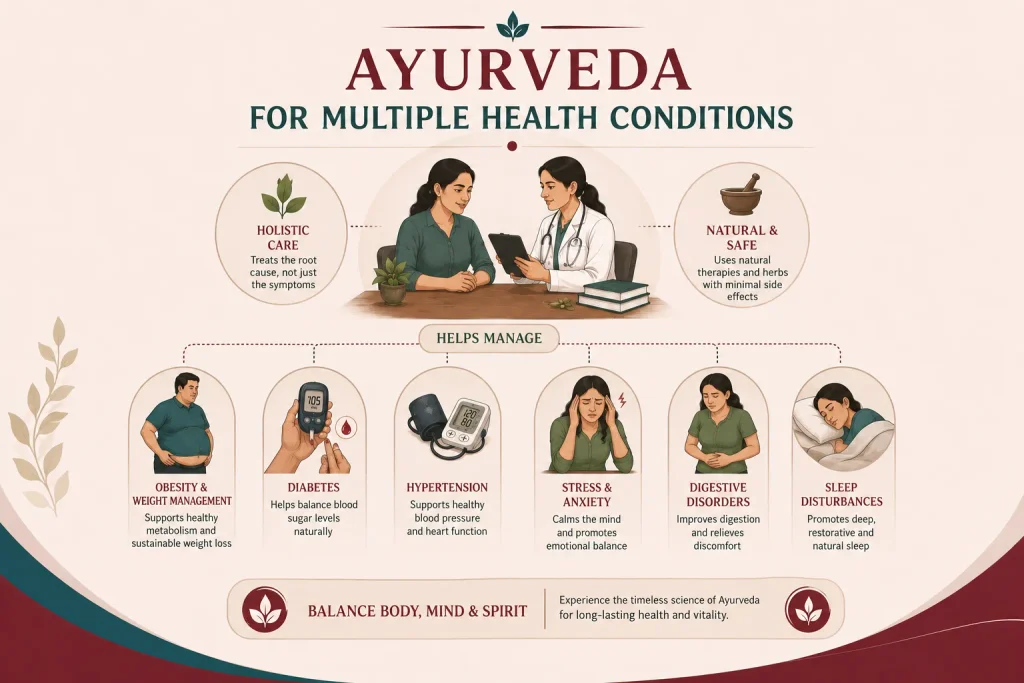
A Madhavbaug doctor reviews the patient’s medical history, current medicines, symptoms, lifestyle, diet and relevant diagnostic reports before deciding how the conditions should be addressed together. The Ayurvedic assessment also considers Prakriti (individual constitution) and Vikriti (current imbalance) to help guide personalised recommendations.
For example, a person may have diabetes along with hypertension, obesity and heart disease. Instead of creating four completely separate plans, the treatment approach may prioritise areas that can influence several concerns at the same time, such as:
- Diet and meal patterns that support healthier blood sugar, weight and lipid levels
- Physical activity and daily routine appropriate for the person’s health status
- Stress and poor sleep management, particularly when these affect weight, blood pressure or metabolic health
- Ayurvedic therapies, including Panchakarma where clinically appropriate
- Herbal products, selected according to the individual’s condition and treatment plan
- Regular monitoring of relevant markers such as blood sugar, HbA1c, blood pressure, weight and lipid levels
The treatment plan is not necessarily the same for two people with the same combination of conditions. A person’s age, existing medicines, test results, symptoms, lifestyle and overall health can all influence what is appropriate.
How Madhavbaug Brings the Different Aspects Together
At Madhavbaug, the aim is to create a coordinated care plan for the person’s overall health while keeping each diagnosed condition and its specific requirements in view.
The process generally involves:
| Medical history & existing treatment ↓ Relevant diagnostic tests and health measurements ↓ Prakriti & Vikriti assessment ↓ Identification of common lifestyle and metabolic factors ↓ Personalised Ayurvedic treatment and lifestyle plan ↓ Regular monitoring of individual conditions ↓ Treatment adjustments based on progress |
This approach is particularly relevant for people living with diabetes, hypertension, obesity, high cholesterol and heart-related conditions, which frequently occur together. The goal is not to assume that one treatment can address every condition but to identify where the conditions overlap and where individual treatment is still required.
Ayurvedic care can be used alongside conventional medical management. If you are already taking prescription medicines, they should not be stopped or changed without guidance from the doctor.
What Extra Risk Factors Come With Multiple Conditions?
Having multiple chronic conditions adds risk factors beyond any single diagnosis, which include:
- Medicine interactions become more likely
- Chronic diseases need continuous monitoring that covers more ground
- A change made for one condition can unintentionally affect another
This is exactly why coordinated, doctor-led care matters more when you’re managing several conditions.
This is also why any Ayurvedic formulation or therapy considered for one condition needs to be checked against everything else you’re managing, including medicines for unrelated conditions. A doctor who only knows about the condition you led with can’t fully account for this. Being upfront about your complete health picture at the start is what allows your doctor to actually manage these added risks.
How Is Monitoring Different With Multiple Conditions?
Monitoring for multiple conditions covers every relevant marker together, at coordinated checkpoints, instead of tracking each condition on a separate, disconnected schedule. Here’s what that typically looks like:
| Baseline testing across all conditions ↓ Coordinated treatment plan addressing shared and individual goals ↓ Reassessment across all markers at set checkpoints ↓ The plan is adjusted based on how conditions are interacting. ↓ Ongoing coordinated monitoring |
This coordinated approach is what lets your doctor see the full picture at each check-in, instead of separately monitoring BP and glucose.
Book a Consultation
When you are managing multiple chronic conditions, the treatment plan needs to account for the whole picture, which includes your diagnoses, diet plans, medicines, symptoms, lifestyle, exercise guides and recent test results. A consultation allows your doctor to review these factors together and determine which concerns need immediate attention, which factors may be contributing to more than one condition, and how your care can be monitored over time.
At Madhavbaug, our doctors provide personalised care for chronic conditions, including diabetes, obesity, hypertension and heart disease. With 350+ clinics and hospitals across India, patients can access Ayurvedic consultations supported by relevant health assessments and diagnostic monitoring.
If you are living with more than one chronic condition, a personalised consultation can help you understand how your health concerns fit together and what a supervised care plan may look like. Book a consultation at Madhavbaug to take the next step towards more coordinated care.
If you’re managing multiple chronic conditions, a consultation is the clearest way to build one coordinated plan that accounts for all of them together.
Frequently Asked Questions
Can Ayurveda treat multiple health conditions at the same time?
Ayurvedic treatment for multiple conditions is typically coordinated, looking at how conditions like diabetes, hypertension, and obesity interact, instead of treating each one in isolation. This requires your doctor to have complete information about every condition, medicine, and test result, not just the one you’re most focused on.
What information does an Ayurvedic doctor need if I have several chronic conditions?
Your doctor needs a complete list of every diagnosed condition, all current medicines and dosages, recent test results relevant to each condition, and your full health history. Bringing this information to your first consultation leads to a safer and more accurate treatment plan.
Is Ayurveda safe for people with multiple chronic conditions?
It can be when your doctor has your complete health picture and coordinates treatment across all your conditions and medicines. The main risk comes from incomplete information, such as an undisclosed medicine or condition, which can lead to interactions or a plan that doesn’t account for everything you’re managing.
How common is it to have more than one chronic condition?
It’s common. Research on chronic disease in India has found multimorbidity prevalence among older adults ranging from 24% to 83%, depending on the population studied, and multimorbidity has also been found to be common among patients specifically attending AYUSH (Ayurveda and related) primary care settings.
Should I tell my Ayurvedic doctor about medicines for conditions unrelated to why I’m consulting them?
Yes. Your doctor needs a complete list of every medicine you’re taking, for every condition, to properly check for interactions and build a safe treatment plan. Leaving out medicines for conditions that feel unrelated is one of the most common gaps in the information doctors receive.
How is monitoring different when managing multiple lifestyle diseases with Ayurveda?
Monitoring typically covers every relevant marker for each of your conditions together, at coordinated checkpoints, rather than tracking each condition separately. This allows your doctor to see how your conditions and treatments are interacting, not just how each one is progressing on its own.
Related Reading
- Prediabetes and Ayurveda: A 90-Day Lifestyle Action Plan
- Ayurvedic Treatment for Weight Loss: Programme Guide
- Managing Hypertension Naturally with Ayurveda
- Daily Routine to Control Obesity, Diabetes and Blood …
- Can Ayurveda Cure The Epidemic Of Heart Disease?
References
Varanasi, R., Sinha, A., Bhatia, M., Nayak, D., Manchanda, R.K., Janardhanan, R., Lee, J.T., Tandon, S. and Pati, S. (2024) ‘Epidemiology and impact of chronic disease multimorbidity in India: a systematic review and meta-analysis’, Journal of Multimorbidity and Comorbidity, 14, article 26335565241258851.
Varanasi, R., Sinha, A., Nayak, D., Manchanda, R.K., Janardhanan, R., Tandon, S. and Pati, S. (2023) ‘Prevalence and correlates of multimorbidity among patients attending AYUSH primary care settings in Delhi-National Capital Region, India‘, BMC Complementary Medicine and Therapies, 23(1), article 429.
Foley, H., Steel, A., McIntyre, E., Harnett, J., Sibbritt, D. and Adams, J. (2021) ‘Disclosure of conventional and complementary medicine use to medical doctors and complementary medicine practitioners: a survey of rates and reasons amongst those with chronic conditions‘, PLoS ONE, 16(11), e0258901.





 Locate a Centre
