

 Add to Preferred Sources
Key Takeaways
|
Sitaphal reaches the markets with the first winter breeze and many families bring a few home without a second thought. For a person with diabetes the question comes at once, whether this soft and sweet fruit will lead to a sugar spike or not.
The honest answer is not a plain yes or no. Custard apple is a nourishing fruit with fibre, vitamin C and potassium yet its pulp carries a good amount of natural sugar. A 2025 review of the research on custard apple found that most claims about blood sugar come from experiments on cells and animals and that well designed studies in people are still missing (Qi et al., 2025). Knowing the right portion and the right time is therefore very important.
In this blog we explain what custard apple contains, its benefits, its sugar content and glycaemic index, what the research says about custard apple for diabetes, how much you can eat, its side effects, who should be careful and how Madhavbaug can support you with diet and lifestyle guidance.
Worried about your sugar readings this winter?
What Is Custard Apple?
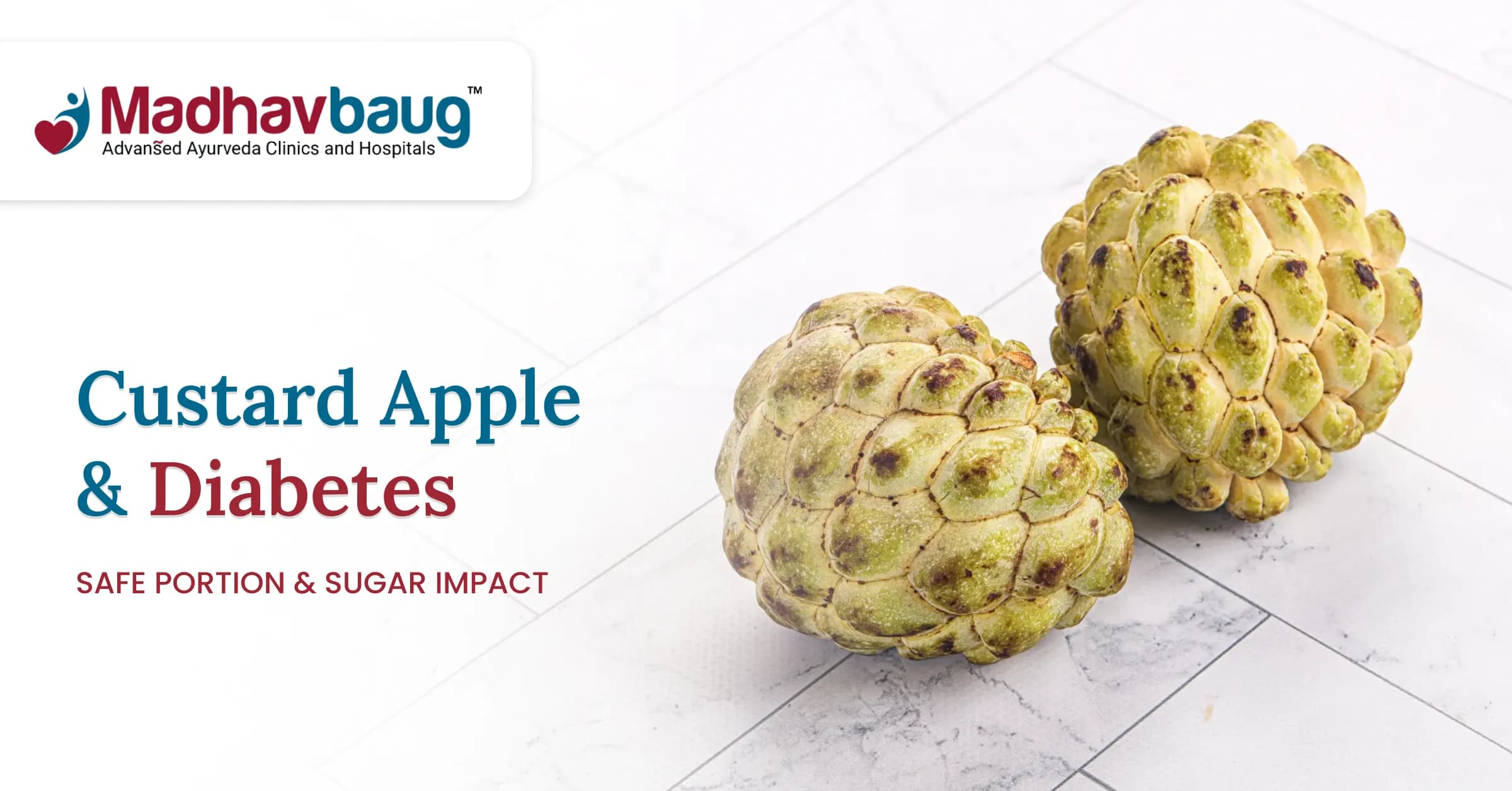
Custard apple is the fruit of Annona squamosa and it is called sitaphal in Hindi and Marathi and sitafal in Gujarati. It grows widely across India and the soft white pulp surrounds many black seeds. The pulp provides fibre along with vitamin C, vitamin B6, potassium and magnesium (Qi et al., 2025).
Custard Apple Benefits for People With Diabetes
Eaten in the right portion, custard apple offers more than sweetness. These are the custard apple benefits that matter most if you have diabetes (Qi et al., 2025).
- Fibre: about 2 to 3 g in 100 g of pulp, which slows sugar absorption a little and supports digestion
- Vitamin C: an antioxidant nutrient that adds value to your diet during the winter months
- Potassium and magnesium: these support healthy blood pressure and muscle function, which matters because high blood pressure is common in people with diabetes
- Vitamin B6: helps the body use energy from food and supports nerve health
- A whole fruit sweet: a small portion can satisfy a sweet craving in place of mithai or desserts made with added sugar
Custard Apple Sugar Content and Glycemic Index
Custard apple pulp tastes sweet because most of its carbohydrate is soluble sugar. Analyses of the pulp report about 17 to 24 g of carbohydrate in 100 g depending on the variety and the ripeness of the fruit (Qi et al., 2025). Glycaemic index values reported in food tables are about 54 to 59 which falls in the low to medium range.
Glycaemic index tells you how fast a food raises the sugar but it does not tell you how much sugar the portion carries. A large bowl of a medium glycemic index fruit can still raise your sugar a lot. Following table puts the numbers together.
| What | Approximate value | What it means for you |
| Carbohydrate in 100 g of pulp | About 17 to 24 g | A fair carbohydrate load so the portion matters |
| Fibre in 100 g of pulp | About 2 to 3 g | Helps a little in slowing absorption |
| Glycaemic index | Reported at about 54 to 59 | Low to medium and not a free pass |
| Potassium | High compared with many fruits | Useful for blood pressure but needs care in kidney disease |
The values differ with the variety and the ripeness so these are only a guide.
Is Custard Apple Good for Diabetes? What the Research Says
Several laboratory and animal studies have looked at custard apple. A leaf extract stimulated insulin release from pancreatic cells in the laboratory and improved glucose tolerance in rats fed a high fat diet (Ansari et al., 2022). Peel and leaf extracts have also lowered sugar in diabetic rats in other experiments (Qi et al., 2025).
These findings are interesting but they do not show that eating the fruit lowers blood sugar in people. The leaves and the peel are not what we eat and the doses used in animals were concentrated extracts. So custard apple is best treated as a fruit that has sugar and not as a remedy for diabetes. Where it does help is as a source of fibre, vitamin C and potassium in a balanced diet when it replaces a less nourishing sweet.
How Much Custard Apple Can You Eat With Diabetes?
There is no single safe amount because it depends on your sugar control, your medicines, your weight and what else is on the plate. As a general starting point many people with diabetes can manage about 100 g of pulp (roughly one small fruit) at one time and not necessarily every day of the season. Fruit can be a part of a balanced Indian diet when the portion is controlled (ICMR-NIN, 2024). Following table gives simple pointers that your doctor can adjust.
| Your situation | General approach |
| Sugar well controlled | Up to one small fruit after a meal a few times a week and on most days only if your readings stay in target |
| Sugar running high | Hold back until the readings settle and speak to your doctor |
| Trying to lose weight | Keep to half a fruit and count it as your fruit for the day |
| On insulin or sugar lowering tablets | Eat it with a meal and not alone and ask your doctor how to fit it into your plan |
| Kidney disease or a potassium limit | Ask your doctor before eating it |
These simple habits make it safer.
- Have it after a meal and not on an empty stomach or as a stand alone snack
- Pair it with a handful of nuts or a protein food which may help sugar rise more slowly
- Choose the whole fruit over milkshake, ice cream, rabri or juice
- Remove every seed before you eat
- Check your sugar about two hours after the first few servings to learn how your own body reacts
Custard Apple Side Effects: Who Should Be Careful?
For most people with diabetes, the main side effect of custard apple is a sugar spike when the portion is too large. If your last HbA1c was above your target, it is wise to limit custard apple until your readings settle. People with kidney disease and those who take medicines that raise potassium, such as some blood pressure tablets and certain water pills, should check with their doctor before eating custard apple regularly.
The seeds contain toxic compounds and crushed seed that gets into the eyes can injure the cornea (Qi et al., 2025). Children should be given only the cleaned pulp.
Custard apple is rich in potassium and low in sodium which suits a blood pressure friendly diet. It does not treat high blood pressure and it does not replace your medicines. If you have both diabetes and high blood pressure the safest approach is to follow the portion advice above and review it with your doctor.
| Clinical Insight “From my experience of over 19 years in clinical practice, I advise people with diabetes not to avoid seasonal fruits completely but to pay attention to how much they eat and how their blood sugar responds. Custard apple contains natural sugars along with fibre and nutrients, so the portion matters. If your blood sugar is well controlled, you may be able to include a small serving occasionally as part of your meal. Avoid eating it in the form of milkshakes or desserts because these can add extra sugar and calories. If you take insulin or diabetes medicines, keep your meal timings consistent and discuss your fruit portions with your doctor. Your blood sugar readings and overall diet should guide how often you eat it.” Dr Gurudatta Amin, BAMS, MD, PGDEMS 19+ Years of Clinical Experience, CMO, Madhavbaug |
How Madhavbaug Can Help You With Diet and Sugar Control
Food advice works best when it is built around you. At Madhavbaug the doctor looks at your reports such as the HbA1c and the fasting blood sugar along with your medicines, weight, prakriti and daily routine before planning diet and lifestyle guidance. Seasonal fruits like sitaphal can then be fitted into the plan in a portion that suits you.
Our Ayurvedic therapies and diet guidance are meant to work along with the treatment you are already taking and not to replace it. Your readings and progress can be followed through the mibPULSE app so that your doctor stays aware of how you are doing. For more details, speak to a doctor at your nearest centre.
Want a diet plan that suits your sugar readings?
Frequently Asked Questions
Is custard apple (sitaphal) good for diabetes?
Most people with diabetes can eat a small portion but it is not a treatment. The pulp has natural sugar so the portion and your own readings matter.
What is the sugar content of custard apple?
The pulp has about 17 to 24 g of carbohydrate in 100 g and most of it is natural sugar. The exact amount depends on the variety and the ripeness.
What is the glycemic index of custard apple?
Reported values are about 54 to 59 which is low to medium. A large portion can still raise blood sugar.
How much custard apple can a diabetic eat in a day?
Many people can manage about 100 g of pulp which is one small fruit after a meal. Your doctor can fine tune this according to your sugar control.
Can diabetics eat custard apple every day?
Not necessarily. Eat it daily only if your readings two hours after eating stay in your target. Otherwise keep it to a few times a week.
Is custard apple good for blood pressure?
It has potassium and very little sodium which suits a blood pressure friendly diet. It is not a treatment and people with kidney disease should ask their doctor first.
Is custard apple milkshake safe for diabetes?
It is better to avoid it. Added sugar or ice cream and a large glass can raise sugar quickly. Eat the whole fruit in a small portion instead.
Are custard apple seeds safe?
No. The seeds are toxic and should never be chewed or swallowed. Remove them before you eat the fruit.
What are the side effects of custard apple?
A large portion can raise blood sugar and add extra calories. The seeds are toxic, and people with kidney disease or a potassium limit should check with their doctor before eating it regularly.
Is custard apple leaf tea good for diabetes?
Leaf extracts have shown effects only in animal and laboratory studies. There is not enough proof in people so please do not use it in place of your medicine.
References
Ansari, P., Hannan, J.M.A., Seidel, V. et al. (2022) ‘Polyphenol rich leaf of Annona squamosa stimulates insulin release from BRIN-BD11 cells and isolated mouse islets and improves glucose tolerance in high fat fed rats’, Metabolites, 12(10), p. 995.
Indian Council of Medical Research and National Institute of Nutrition (2024) Dietary guidelines for Indians. Hyderabad. ICMR-NIN.
Qi, N., Gong, X., Luo, Y., Zhang, C., Chen, J. and Chen, T. (2025) ‘A review of nutrition, bioactivities and health benefits of custard apple (Annona squamosa)’, Foods, 14(19), p. 3413.


 Locate a Centre

