

Key Takeaways
|
Dry fruits are an easy snack to reach for, especially in winter. A few almonds with breakfast, walnuts in the evening or a handful of roasted peanuts can feel like simple, healthy choices.
If you have diabetes, you may wonder whether these foods are actually good for your blood sugar or whether you need to limit them.
The answer depends on which dry fruit or nut you are eating and how much you are eating.
A handful of plain peanuts is very different from peanut chikki. Almonds are also very different from raisins, even if all are called “dry fruits” in everyday conversation.
Understanding that difference makes it much easier to decide what can fit into your diet.
Are Dry Fruits Good for Diabetes?
Some dry fruits can fit well into a diabetes-friendly eating pattern, but they should not all be treated the same way.
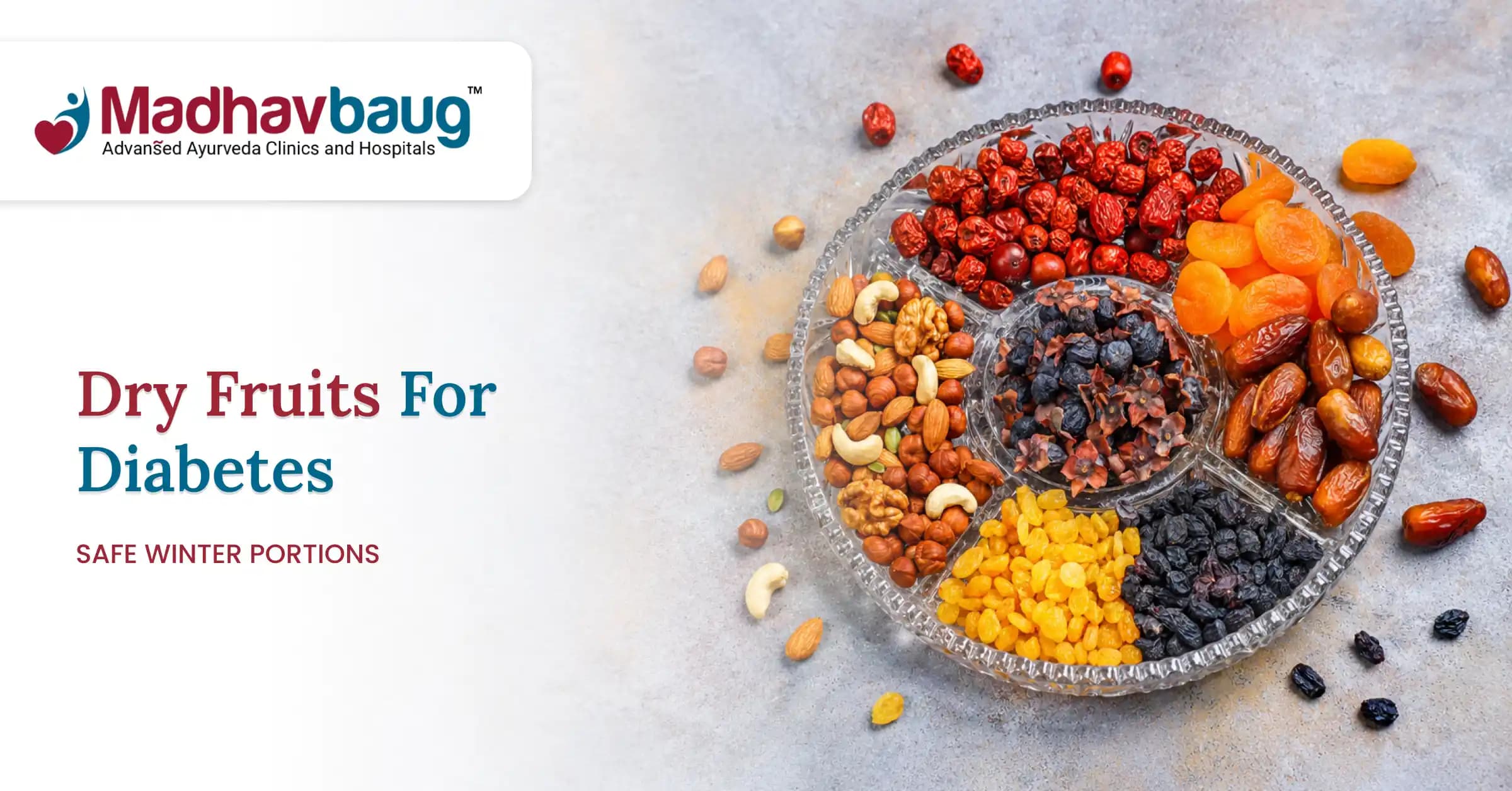
In Indian households, the term “dry fruits” is used quite broadly. It may include almonds, walnuts, peanuts, dates, raisins and dried figs. Nutritionally, these foods belong to very different groups.
Almonds and walnuts are nuts. Peanuts are legumes, although they are eaten much like nuts. These foods provide protein, fibre and healthy fats, with relatively little available carbohydrate.
Dates, raisins and dried figs are different. They are dried fruits. Once water is removed during drying, their natural sugars and carbohydrates become more concentrated in a smaller portion.
This means a handful of almonds will not affect your meal in the same way as a handful of raisins.
That is why it is more useful to look at the type of food, portion and preparation rather than assuming that all dry fruits are either good or bad for diabetes.
If you are trying to fit nuts into the rest of your meals, an Indian diabetes diet chart can help you understand portions across the whole day.
Not sure how nuts and dried fruits fit into your diabetes diet?
Which Dry Fruits Are Better Choices for Diabetes?
If you enjoy almonds, walnuts or peanuts, you do not need to pick one as the “best” option for diabetes.
All three contain relatively little carbohydrate compared with many common snacks. Their nutritional strengths are slightly different, so you can choose based on what you enjoy, what is easily available and what fits your budget.
You can also look at a broader list of foods for diabetics when planning the rest of your meals.
Almonds for Diabetes
Almonds can work well as a snack or as part of breakfast. They provide fibre, protein and mainly unsaturated fats.
Research on almonds and blood sugar has shown mixed results. Some studies have reported improvements in HbA1c, while systematic reviews have not found a clear effect on fasting glucose or HbA1c across all studies (Asbaghi et al., 2022).
So almonds are a nutritious choice, but they should not be treated as a food that lowers blood sugar on its own.
A small portion of plain almonds is very different from sugar-coated almonds or almonds added to a sweet.
Walnuts for Diabetes
Walnuts are another good option when you want some variety.
They contain mostly unsaturated fats and are one of the better plant sources of alpha-linolenic acid, a type of omega-3 fat.
Their effect on blood sugar should not be overstated. A recent review of 32 trials did not find a significant reduction in fasting glucose or HbA1c from walnut intake (Hadi et al., 2025).
That does not make walnuts less useful. It simply means their value comes from their overall nutrient profile rather than from expecting them to reduce your glucose readings.
Peanuts for Diabetes
Peanuts are a practical and affordable option if you have diabetes.
They provide protein, fibre and unsaturated fats, with relatively little carbohydrate in a usual serving.
A small trial in people with type 2 diabetes compared peanuts with almonds as part of a lower-carbohydrate diet. Fasting and post-meal glucose improved in both groups, with no significant difference between peanuts and almonds (Hou et al., 2018).
The study was small, so peanuts should not be described as a treatment for high blood sugar. The useful point is that they can fit just as well as almonds when used in the right portion.
Plain or dry-roasted peanuts are a better everyday choice than peanut chikki, sugar-coated peanuts or heavily fried versions.
| Clinical Insight “For someone with diabetes, choosing a nut is only one part of the decision. Kidney function, lipid levels, body weight and current treatment can also affect which foods and portions are appropriate. This is why the same serving may not suit every patient, even when the food itself is nutritious.” Dr. Pravin Jayram Ghadigaonkar, BAMS, MD, PhD (Scholar) – Preventive Cardiology 20+ Years of Clinical Experience, Head Medical Operations & Patient Improvement, Madhavbaug |
How Do Almonds, Walnuts and Peanuts Affect Blood Sugar?
Almonds, walnuts and peanuts usually have a smaller immediate effect on blood sugar than foods such as biscuits, sweets or refined snacks.
That is because a usual portion contains relatively less carbohydrate. These foods also provide fat, protein and fibre, which can slow digestion and make the snack more filling.
But that does not mean the portion stops mattering. This is also why portion size appears repeatedly in a diabetes meal plan.
A few almonds added to breakfast are different from a large bowl of mixed nuts eaten through the evening. The same applies to peanuts. Plain roasted peanuts and peanut chikki may start with the same ingredient, but the added jaggery changes the carbohydrate load.
It is also useful to look at what the nuts are replacing.
If you swap part of a refined snack for nuts, the overall meal changes. If you simply add nuts to the same snack, you may not get the same benefit.
| Study Highlight What does broader research say about nuts and blood sugar? A systematic review and meta-analysis included 40 randomised trials with 2,832 adults. The studies looked at tree nuts and peanuts and their effect on different measures of glucose control. Nut intake was linked with small improvements in fasting insulin and insulin resistance. However, there was no significant improvement in fasting blood glucose or HbA1c (Tindall et al., 2019). So nuts can be part of a healthy eating pattern, but the evidence does not support treating them as a food that lowers blood sugar on its own. This fits with the wider principle that diabetes food choices need to be judged as part of the full diet. |
Does the Glycemic Index Matter for Nuts?
Glycemic index, or GI, tells you how quickly a carbohydrate-containing food may raise blood sugar.
For almonds, walnuts and peanuts, GI is less useful than it is for foods such as rice, bread or sweets because nuts contain relatively little available carbohydrate in a usual portion.
So instead of choosing a nut because it has a “low GI”, look at the portion, preparation and what you eat it with.
For example, plain peanuts and peanut chikki may contain the same nut, but the added jaggery changes the overall carbohydrate load considerably.
How Much Dry Fruit Can You Eat With Diabetes?
You do not need a separate portion of almonds, walnuts and peanuts every day.
A practical serving for nuts is around 20 to 30 g, roughly one small handful. This is a serving guide, not a fixed daily allowance for everyone with diabetes
The total matters more than the number of varieties.
For example, having a few almonds in the morning, walnuts with breakfast and a large handful of peanuts in the evening may look like three small choices. Together, they can become a much larger nut intake than you realise.
This becomes especially relevant in winter, when nuts and peanuts may appear more often through the day.
| Portion Perspective Think of 20 to 30 g as the total nut portion, not 20 to 30 g of each type. That may look roughly like: 15 to 20 almonds 8 to 12 walnut halves A small handful of peanuts Or a small mixed portion using two or three types You do not have to count every nut each time. Once you know what a small handful looks like, portioning becomes much easier. |
If you are also eating dates, raisins or other dried fruits, count them separately. They contribute more carbohydrate than almonds, walnuts or peanuts and should not simply be added to the same portion. Your ideal portion can still vary with your meals, weight goals and medical needs.
What Is the Best Way to Eat Dry Fruits in Winter?
Winter usually brings more nuts into the diet. You may have roasted peanuts in the evening, almonds in the morning or walnuts with breakfast.
The easiest choice is to keep them simple.
Plain almonds, walnuts and dry-roasted peanuts are easier to portion and do not bring in extra sugar. If you prefer masala peanuts, check how much oil and salt has been added.
The form matters much more once nuts are used in sweets.
Peanut chikki contains jaggery or sugar. Dry-fruit laddoos may include dates, jaggery, sugar or ghee. Honey-roasted nuts and chocolate-coated almonds also add more sugar than plain nuts.
So the nut itself may fit well into your diet, while the preparation may need a smaller portion.
| Remember Do not judge a sweet by the healthiest ingredient in it. Peanuts in chikki do not cancel the jaggery. Almonds in a laddoo do not make the whole laddoo low in carbohydrates. Look at the complete food before deciding how much fits into your diet. |
Almonds, Walnuts or Peanuts: Which Should You Choose?
There is no single nut that is best for everyone with diabetes.
You can choose based on what you enjoy, what is available, and how it fits into your usual meals. You can also rotate between them instead of eating the same one every day.
| Choice | Why you may choose it | Better everyday form | What to watch for |
| Almonds | Easy to carry and add to breakfast or snacks | Plain or lightly roasted | Sugar-coated almonds and large portions |
| Walnuts | Provide plant-based omega-3 fat and add variety | Plain walnuts | Large portions and walnuts used in sweets |
| Peanuts | Affordable, filling and widely available | Plain or dry-roasted | Chikki, fried peanuts and heavily salted versions |
You do not need to buy expensive nuts simply because you have diabetes. Plain peanuts can be just as practical as almonds when the portion and preparation are suitable.
A mixed portion can work too. Just keep the total quantity in mind rather than taking a full serving of each nut.
| Who Should Be More Careful With Dry Fruits? You may need to be more careful with the type or portion of nuts if: You have kidney disease and have been advised to watch potassium or phosphorus intake. You are trying to lose weight and tend to eat nuts in large or repeated portions through the day. You have high blood pressure or heart disease and usually choose heavily salted nuts. You have a peanut or tree-nut allergy. You are treating low blood sugar, because nuts are not the best first choice for hypoglycaemia. Their fat and protein slow digestion. If any of these apply to you, the right portion may depend on your overall diet, blood test results and treatment plan. |
How Can You Tell If a Portion Works for Your Blood Sugar?
Your blood sugar response can change depending on what you eat with them, the size of the portion and your current diabetes treatment.
If you already monitor your glucose at home, look for patterns rather than judging one reading. If you use a glucose sensor, continuous glucose monitoring can also help show how readings change through the day.
For example:
- Keep the nut portion similar when you compare your readings.
- Notice what else you ate with the nuts.
- Compare the result with your usual post-meal readings.
- Look at more than one occasion before drawing a conclusion.
If your glucose is repeatedly higher than expected after a particular snack, look at the complete snack rather than blaming one ingredient.
Your fasting glucose, post-meal glucose and HbA1c also tell you different things about your diabetes control. Looking at them together gives a clearer picture than relying on one number.
| “In diabetes care, we look at the person’s daily food habits and glucose readings together. Changing one ingredient may help in a small way, but the overall meal pattern usually tells us much more about where dietary changes are needed.” Dr. Bipin Gond, Zonal Medical Head, Madhavbaug |
How Madhavbaug Can Help With Diabetes Diet Planning
Dry fruits are only one part of your diabetes diet. The portion that works for you also depends on your blood sugar pattern, current treatment and usual meals.
At Madhavbaug, your diabetes care can include a review of fasting sugar, post-meal readings and HbA1c along with your food habits and current medicines. This helps your doctor look at the wider pattern instead of focusing on one food alone.
Regular diabetes health checks can also help identify other concerns that may affect your diet. Your lipid profile gives information about cholesterol and triglycerides, while creatinine and other kidney tests can help assess kidney health.
Based on this wider assessment, food advice can be adjusted around what you actually eat at home. A personalised diet plan may also be useful when diabetes occurs along with excess weight, high blood pressure or abnormal cholesterol.
If you already have recent blood sugar reports or other test results, carry them to your consultation. Looking at these results alongside your daily food routine can help make the advice more relevant to your health needs.
Not sure how much dry fruit fits into your diabetes diet?
Frequently Asked Questions
1. Which dry fruit is best for diabetes?
There is no single best dry fruit for diabetes. Plain almonds, walnuts and peanuts can all fit into a balanced diet in sensible portions. What matters more is the total portion, preparation and what you eat them with.
2. Is peanut good for diabetes?
Yes. Plain or dry-roasted peanuts can be a practical and affordable option for people with diabetes. They provide protein, fibre and unsaturated fats. Peanut chikki, sugar-coated peanuts and heavily fried versions are different because they add sugar, oil or both.
3. How many almonds can a person with diabetes eat in a day?
No fixed number suits everyone. If almonds are your main nut choice, around 15 to 20 almonds may roughly fit within a small 20 to 30 g nut portion. Your needs may differ based on the rest of your diet, weight goals and health conditions.
4. Are walnuts good for diabetes?
Walnuts can be included in a diabetes-friendly eating pattern. They provide unsaturated fats and alpha-linolenic acid, a plant-based omega-3 fat. However, they should not be expected to lower blood sugar on their own.
5. Are soaked almonds better for diabetes?
You can eat almonds soaked or unsoaked. Soaking may make them softer, but research has not shown that soaking nuts provides a special blood sugar benefit or meaningfully improves mineral availability.
6. Can people with diabetes eat dates and raisins?
Dates and raisins can sometimes fit into a diabetes diet, but their portions need more attention than almonds, walnuts or peanuts. They are dried fruits, so their carbohydrate and natural sugars are concentrated into a smaller amount.
7. Can you eat nuts at night if you have diabetes?
You can, but the timing is usually less important than the portion and the rest of your day. A small planned portion is different from repeatedly snacking on nuts after dinner when you are not hungry.
8. Can almonds, walnuts or peanuts treat low blood sugar?
No. Nuts contain fat, protein and fibre, so they do not raise glucose quickly enough to be the first choice for hypoglycaemia. Fast-acting carbohydrate is recommended for treating low blood sugar.
References
American Diabetes Association (2026) ‘Low blood glucose (hypoglycemia)’.
Asbaghi, O., Moodi, V., Neisi, A., Shirinbakhshmasoleh, M., Abedi, S., Hosseini Oskouie, F., Eslampour, E., Ghaedi, E. and Miraghajani, M. (2022) ‘The effect of almond intake on glycemic control: A systematic review and dose-response meta-analysis of randomized controlled trials’, Phytotherapy Research, 36(1), pp. 395–414.
Hadi, A., Zeinali Khosroshahi, M., Zwamel, A.H., Asbaghi, O., Naeini, F., Miraghajani, M., Nouri, M. and Ghaedi, E. (2025) ‘Impact of walnut consumption on glycemic control and anthropometric indices: A systematic review and meta-analysis of randomized controlled trials’, Journal of Diabetes & Metabolic Disorders, 24(1), article 62.
Hou, Y.Y., Ojo, O., Wang, L.L., Wang, Q., Jiang, Q., Shao, X.Y. and Wang, X.H. (2018) ‘A randomized controlled trial to compare the effect of peanuts and almonds on the cardio-metabolic and inflammatory parameters in patients with type 2 diabetes mellitus’, Nutrients, 10(11), article 1565.
Kumari, S., Gray, A.R., Webster, K., Bailey, K., Reid, M., Kelvin, K.A.H., Tey, S.L., Chisholm, A. and Brown, R.C. (2020) ‘Does “activating” nuts affect nutrient bioavailability?’, Food Chemistry, 319, article 126529. doi: 10.1016/j.foodchem.2020.126529.
National Kidney Foundation (n.d.) ‘Nuts and seeds’.
Tindall, A.M., Johnston, E.A., Kris-Etherton, P.M. and Petersen, K.S. (2019) ‘The effect of nuts on markers of glycemic control: A systematic review and meta-analysis of randomized controlled trials’, The American Journal of Clinical Nutrition, 109(2), pp. 297–314.




 Locate a Centre

