

Overthinking does not directly cause high blood pressure on its own, but it triggers short-term, temporary blood pressure spikes. Your body reacts to mental stress the same way it reacts to physical danger by releasing stress hormones that speed up your heart and tighten your blood vessels. This causes a real, temporary rise in BP.
What matters more for your long-term health is whether this keeps happening every day. Over time, it can lead to high blood pressure (hypertension).
Let’s slow down and go through understanding if stress and overthinking can cause high blood pressure so you know exactly what’s happening in your body, how to check it correctly, and when it’s genuinely time to see a doctor.
Can Stress Cause High Blood Pressure?
Yes, stress can temporarily raise your blood pressure. When you are stressed, your body goes into a “fight or flight” mode. It releases hormones like adrenaline and cortisol, which make your heart beat faster and your blood vessels tighten. This can cause your blood pressure to rise quickly.
This is a normal body response that has helped humans deal with danger for a long time. Your body can react the same way to stress from a work deadline, family argument, or worrying thoughts at night.
Research backs this up clearly. Reviews of the science confirm that sudden stress reliably produces a short-term jump in blood pressure through this fight-or-flight pathway (Elsaid et al., 2021).
The important detail is what happens next.
In a healthy stress response, your body is supposed to calm back down once the stressful moment passes, and your BP should return to its normal baseline (Spruill et al., 2019).
Temporary High BP Due to Stress vs. Long-Term Hypertension: What’s the Difference?
Stress can cause a temporary rise in blood pressure. It usually comes down once you relax and the stress passes. Long-term high blood pressure (hypertension) is different. It stays high over time and can damage your blood vessels and organs, even when you feel calm.
To understand this better:
| Temporary Stress Spike | Ongoing Hypertension |
| Your BP goes up during or right after a stressful, overthinking-heavy episode and then comes back down to normal once you’ve calmed down, usually within a short while. This is your body doing exactly what it’s designed to do. | This is when your BP stays elevated even when you’re not particularly stressed, on repeated readings over days and weeks. Research shows that it’s not the occasional spike that causes lasting harm; it’s when stress becomes constant or repeated so often that your body never fully gets the chance to return to its resting state (Elsaid et al., 2021; Spruill et al., 2019). Over time, this repeated strain can affect your blood vessels and heart and contribute to genuine, lasting high blood pressure. |
So one anxious evening with a high reading is not the same thing as having hypertension. But if this keeps happening, or your resting readings are consistently high even on calm days, that’s a different conversation and one worth having with a doctor for which Madhavbaug provides comprehensive care. To know more, visit your nearest Madhavbaug clinic.
An occasional BP spike during stress does not necessarily mean you have hypertension. But if your readings remain high or keep recurring, a proper assessment can help you understand whether stress is contributing or whether there is an underlying BP concern.
Common Mistakes That Make a BP Reading Look Higher Than It Is
Common mistakes that artificially increase blood pressure readings include failing to rest before the test, having a full bladder, crossing your legs, talking or texting, using a cuff over clothing or of the wrong size, and letting your arm hang unsupported below heart level.
Before you panic over a high number, it’s worth checking whether the reading itself was accurate. A surprising number of “scary” readings are actually measurement errors, not real medical emergencies. Common mistakes include:
- Checking your BP immediately after an argument, a stressful phone call, or a bout of overthinking, without resting first
- Talking while the cuff is inflating
- Using a cuff that doesn’t fit your arm properly
- Measuring with your arm unsupported, below heart level, or with legs crossed
- Having just had coffee, tea, or a cigarette
- Sitting in an uncomfortable position or rushing through the reading
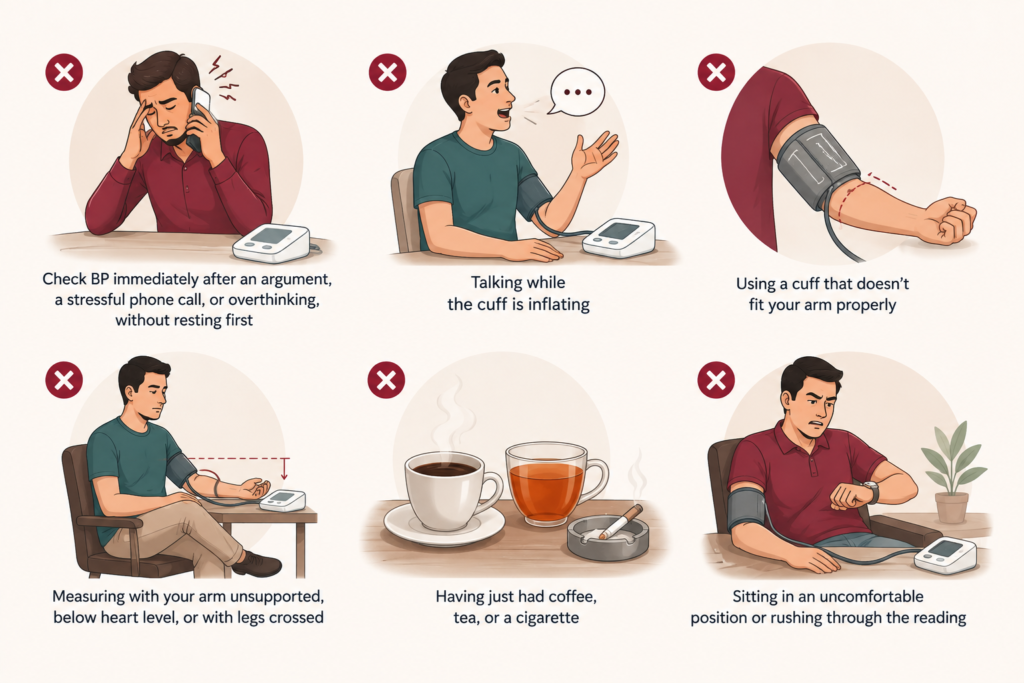
If any of these sound familiar, your “high” reading might simply be a snapshot of a stressed, unrested body, not your true baseline BP.
For a deeper explanation of what your numbers actually mean and how to read them correctly, take a look at our guide on why blood pressure rises and how to keep it in check.
How to Repeat a BP Reading the Right Way
To repeat a blood pressure reading correctly, wait 1 to 2 minutes between measurements. Leave the cuff on or loosen it slightly during the break, remain seated quietly without talking or using your phone, and then take the second reading on the same arm. Average the two numbers for accuracy
Here is a step-by-step guide for the same:
- Sit down somewhere quiet and stop whatever caused the stress, at least for a few minutes
- Rest for 5 minutes before measuring, without talking, scrolling your phone, or moving around
- Sit with your back supported, feet flat on the floor, legs uncrossed
- Rest your arm on a table so the cuff sits roughly level with your heart
- Stay silent during the measurement itself
- Take a second reading a minute or two later, and compare the two
If both readings are still high after you’ve genuinely calmed down and rested, that’s more meaningful information than a single number caught in the middle of a stressful moment.
Stress, Sleep and Stimulants: The Everyday Triggers
Stress, poor sleep, and stimulants can make each other worse. Together, they can keep your body and nervous system in a constant state of high alert, making it harder to relax and recover.
When daily stressors result in high levels of cortisol, people often seek out stimulants such as caffeine or nicotine to combat the resulting daytime fatigue.
Overthinking rarely happens in isolation. It’s often tangled up with a few everyday habits that also affect your blood pressure:
| Factor | How It Can Affect Blood Pressure |
| Poor Sleep | Poor sleep keeps your stress hormones elevated for longer, making it harder for your BP to settle back down. |
| Caffeine (Tea, Coffee, Energy Drinks) | Caffeine (tea, coffee, and energy drinks) can cause its own short-term BP rise, especially on top of an already stressful day. |
| Skipped Meals and Low Blood Sugar | Skipped meals and low blood sugar can add to feelings of anxiety and physical restlessness. |
| Late-Night Screen Time | Late-night screen time and overthinking loops often go hand in hand, keeping your nervous system switched on well past bedtime. |
| Emotional Eating | Emotional eating during stressful periods is another common pattern worth noticing. Emotional eating and stress in Ayurveda have a deep connection as well. |
Morning readings deserve a special mention too, since BP naturally tends to be higher shortly after waking, even without any stress involved. If your high readings tend to happen first thing in the day, our guide on the morning blood pressure surge explains why this happens and what’s considered normal.
Your 7-Day BP-and-Trigger Log
A 7-day blood pressure and trigger log includes taking 2 readings in the morning and 2 in the evening for 7 consecutive days. To share with your doctor, write down the systolic and diastolic numbers, pulse, and possible triggers such as stress, caffeine, or salt intake.
If stress-related spikes keep happening, the most useful thing you can do isn’t to keep re-checking anxiously. It’s to track it properly for a week. Keep a simple daily note of:
- Time of reading and the actual BP number
- What you were doing or thinking about just before checking
- Sleep the night before (roughly how many hours, and how restful it felt)
- Caffeine or stimulants consumed that day
- How you felt on a simple scale, whether calm, mildly stressed, or very anxious
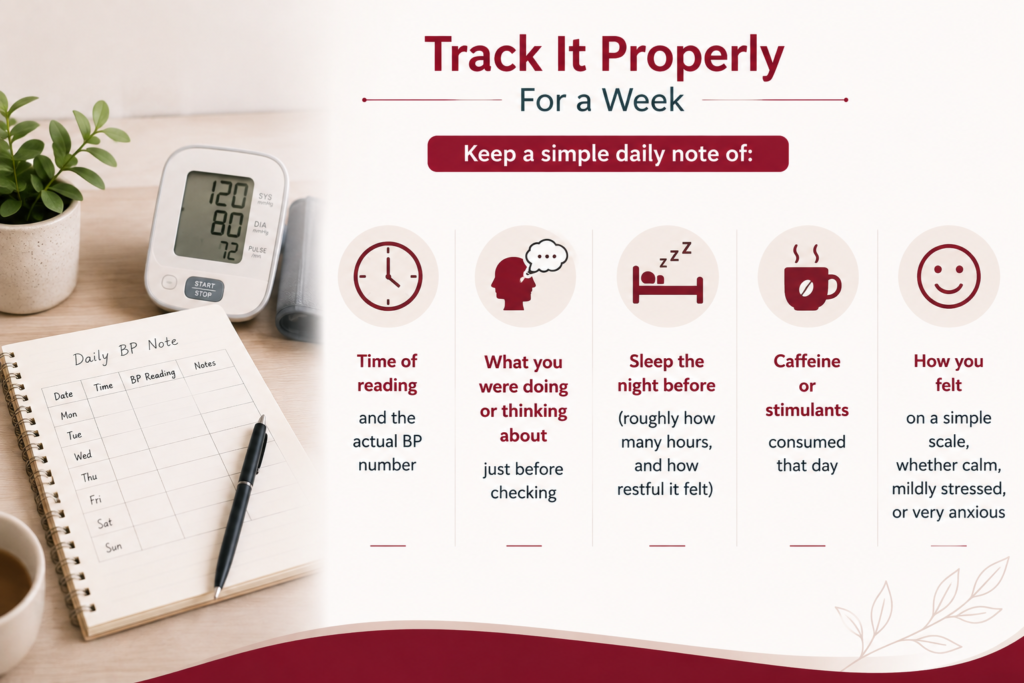
After a week, patterns tend to become obvious, whether it’s a certain time of day or night, a certain type of stress, or a link with poor sleep. This kind of record is also far more useful to a doctor than a single alarming number, since it shows your true pattern rather than one moment in time.
When High Blood Pressure Needs Medical Assistance
A reading of 180/120 mm Hg or higher is a severe emergency. If it does, let it rest for five minutes and check it again. If it remains high or you have warning signs such as chest pain or trouble speaking, call local emergency services immediately.
Most stress-related spikes settle down on their own and don’t need urgent action. But it’s time to involve a doctor, not just recheck anxiously again and again, if:
- Your BP stays high across multiple readings, taken correctly, on different calm days
- You notice symptoms alongside a high reading, like chest discomfort, breathlessness, severe headache, vision changes, or unusual dizziness
- Your 7-day log shows a consistent pattern of elevated readings, even on days that didn’t feel particularly stressful
- You already have a diagnosis of high blood pressure, and stress seems to be making your usual readings noticeably worse
Constantly monitoring your BP out of worry can actually feed the anxiety-and-spike cycle, since the anxiety of checking becomes its own stressor. If this cycle feels familiar, it’s worth having an honest conversation with a doctor rather than continuing to self-monitor in a loop.
Next Steps
At Madhavbaug, our approach focuses on managing hypertension naturally by looking at both sides of this picture together, the physical BP numbers and the stress patterns behind them, combining doctor-supervised monitoring with Ayurvedic therapies and lifestyle changes.
You can read more about our detailed treatment for high blood pressure, on Ayurvedic treatment for high and low blood pressure, or find your nearest clinic through our clinic and hospital locator if you’d like a proper, personalised review of your readings.
If your readings keep spiking around stress, or you’re simply unsure whether what you’re seeing is normal, find your nearest Madhavbaug clinic for a proper, doctor-guided review.
If your BP readings keep fluctuating with stress or you’re unsure what they mean, don’t rely on occasional readings alone. Get a personalised review of your BP pattern, lifestyle and overall health with doctor-guided care.
Frequently Asked Questions
- Does overthinking cause high blood pressure?
Yes, overthinking and stress trigger your body’s fight or flight response, which raises blood pressure temporarily. This is usually short-lived and settles once you calm down, but frequent or constant stress can contribute to longer-term high blood pressure over time. - Can stress cause high blood pressure permanently?
A single stressful moment doesn’t cause permanent high blood pressure. However, chronic stress, where your body doesn’t get enough time to return to its resting state, may contribute to the development of ongoing hypertension. - What do anxiety and blood pressure spikes feel like?
Anxiety-related BP spikes often come with a racing heartbeat, a feeling of restlessness, sweating, or a knot in your stomach, alongside a higher than usual reading. Once the anxious moment passes and you rest, the reading typically comes back down. - How long does temporary high BP due to stress last?
For most people, a stress-related BP spike settles within minutes to a couple of hours once the stressful situation ends and the body calms down. If your reading stays high well beyond this, especially across multiple calm-day readings, it’s worth getting checked properly. - Should I take my BP again if I just had a stressful moment?
It’s best to sit down, rest quietly for about 5 minutes, and then recheck using the correct technique. Checking immediately during or right after a stressful episode often gives an inflated, less accurate picture of your true baseline BP.
References
- Elsaid, N., Saied, A., Kandil, H., Soliman, A., Taher, F., Hadi, M., Giridharan, G., Jennings, R., Casanova, M., Keynton, R. and El-Baz, A., 2021. Impact of stress and hypertension on the cerebrovasculature. Frontiers in Bioscience-Landmark, 26(12), pp.1643–1652.
- Spruill, T.M., Butler, M.J., Thomas, S.J., Tajeu, G.S., Kalinowski, J., Castañeda, S.F., Langford, A.T., Abdalla, M., Blackshear, C., Allison, M. and Ogedegbe, G., 2019. Association between high perceived stress over time and incident hypertension in Black adults: findings from the Jackson Heart Study. Journal of the American Heart Association, 8(21), p.e012139.
- Walther, L.M. and Wirtz, P.H., 2023. Physiological reactivity to acute mental stress in essential hypertension: a systematic review. Frontiers in Cardiovascular Medicine, 10, p.1215710.




 Locate a Centre
