

Have you ever been in a situation where you are stuck between your or your loved one’s angiogram report and a cardiologist’s waiting room wondering if surgery is the only option? Heart blockage treatment without surgery may be a simple thought for you, but in reality, it is not completely impossible!
The non-surgical treatment for heart blockage is possible but includes a systematic, lifestyle-orientated transformation. It includes Panchakarma, diet, exercise, physiotherapy and much more, catering to a holistic approach. Madhavbaug brings one such research-backed approach, integrating the traditional ayurvedic treatment along with modern diagnostics, resulting in many success stories and helping patients build a healthier tomorrow.
The Direct Answer and Its Limits
So, can heart blockage be treated without surgery? For a lot of people with stable, non-emergency coronary artery disease, yes, genuinely.
This is more or less exactly the clinical space. Madhavbaug’s heart blockage programme was built for patients with stable coronary artery disease who want to actively work on reversing their risk factors and improving heart function, under proper medical supervision, instead of defaulting straight to a procedure (Madhavbaug Cardiac Care Outcomes, 2022).
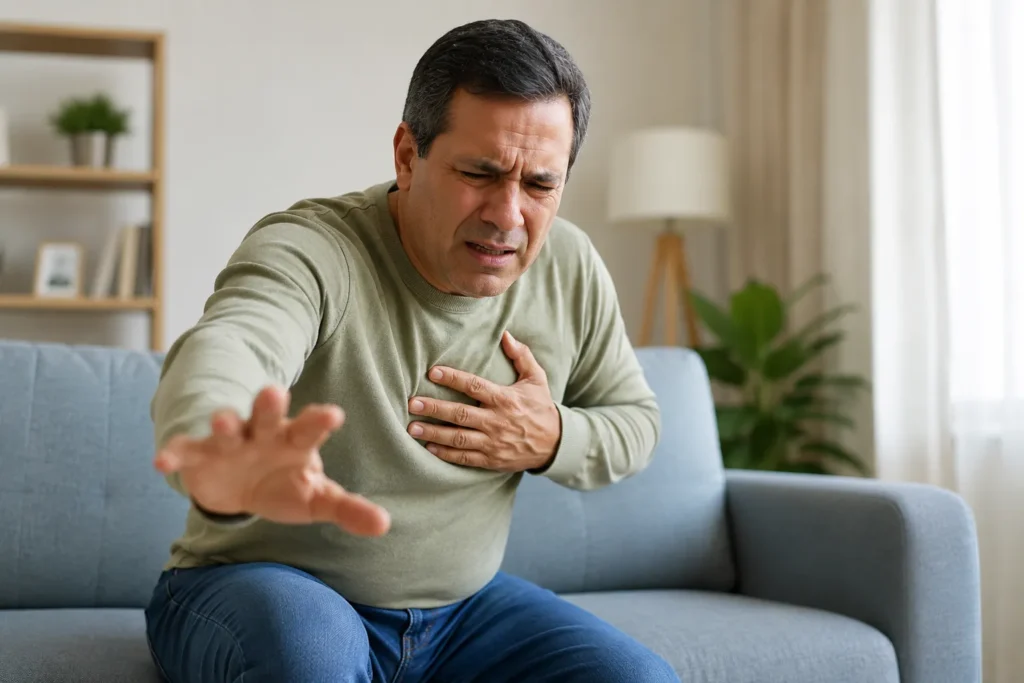
Emergency Symptoms First, Don’t Wait to Read Further
Before anything else, if you or someone with you is currently having any of the following early signs or symptoms:
- Chest pain or pressure that doesn’t ease with rest
- Pain spreading to the jaw, arm or back
- Sudden breathlessness
- Cold sweat, or fainting
Call for emergency medical help right away. These are emergency symptoms which need immediate attention. Heart blockage treatment without surgery or with surgery may be a question to be discussed later, but immediate medical guidance is required if you are suffering from all these. Madhavbaug is a comprehensive solution for which you can book a consultation at your nearest centre.
How Blockage Severity Is Actually Assessed
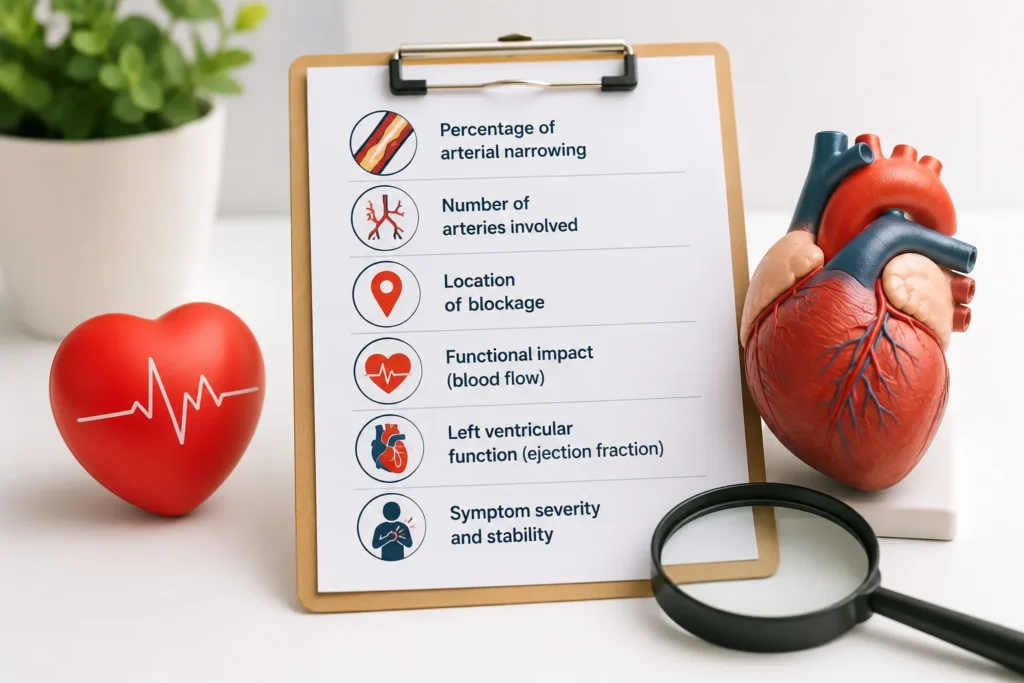
Not every blockage gets treated the same way, and severity isn’t judged by a single percentage on a report. Alternatives to angioplasty for heart blockage may be decided based upon the following factors:
| Factors | Description |
| Percentage of arterial narrowing | Seen on angiography or CT coronary angiography |
| Number of arteries involved | Single-vessel versus multi-vessel disease |
| Location | Blockages in the left main artery are treated far more cautiously than those in smaller branches |
| Functional impact | Whether the blockage is actually restricting blood flow enough to cause ischaemia, often checked through a stress test, nuclear imaging, or fractional flow reserve |
| Left ventricular function (ejection fraction) | A weaker pumping heart changes the whole risk calculation |
| Symptom severity and stability | Stable, predictable angina is managed very differently from symptoms that are unstable or worsening quickly |
Madhavbaug’s non-surgical treatment for heart blockage includes this assessment stage, advanced cardiac diagnostics, including 2D echo, ECG and treadmill testing, not as a formality before treatment begins.
It’s the foundation the entire programme sits on. It’s what lets the treating doctor confirm whether someone is a genuine candidate for a structured nonsurgical treatment for heart blockage, and it’s what sets the personalised baseline that progress gets measured against later.
Madhavbaug’s Non-Surgical Treatment for Heart Blockage
This is really the core of what a structured non-surgical programme looks like in practice at Madhavbaug, and it’s exactly why it’s built as a full programme rather than one isolated therapy:
- Diagnosis for every patient starts with a 2D echo, ECG and treadmill test evaluation, so treatment is based on confirmed arterial health, heart function and exercise tolerance, not guesswork
- Ayurvedic Panchakarma therapies are used to help clear metabolic waste (Ama) and unhealthy fat accumulation (Medo Dhatu), which Ayurveda associates with Hridroga, the classical concept that closely corresponds to coronary artery disease, supporting lipid metabolism and calming systemic inflammation
- Personalised Ayurvedic medicines are prescribed around each person’s individual constitution and the specific metabolic and cardiac risk factors picked up during assessment
- Structured diet correction provided by going after the metabolic drivers, unhealthy cholesterol patterns, insulin resistance, and inflammation that Madhavbaug’s clinical approach treats as root causes of blockage progression rather than symptoms to simply manage.
- Cardiac-rehab-style monitored activity, including supervised exercise and follow-up, run in a way that’s consistent with the structured cardiac rehabilitation model shown to improve outcomes in coronary heart disease patients (Dibben et al., 2021)
To read more about the treatment in detail, read here.
The goal is not to answer the question, “Can heart blockage be treated without surgery?” It is to work towards to root cause of blockage, meaningful symptom relief, better exercise tolerance and lower long-term cardiac risk, personalised to each patient’s metabolic status and whatever else is going on alongside it, diabetes, hypertension, fatty liver disease, which very often show up together with coronary artery disease and genuinely need to be treated holistically rather than in isolation. (Madhavbaug Patient Outcome Data, 2023).
Madhavbaug’s treatment coordination works alongside these medicines, not as a replacement for them. Any tapering of allopathic medication happens gradually and only under a doctor’s supervision, based on how a patient’s monitored parameters are actually responding over time (Madhavbaug Clinical Protocols, 2023).
A Real Example, Non-Surgical Recovery in Practice
To see how all of this actually plays out, there are many case studies that have testified to having excellent results by consulting Madhavbaug and opting for a non-surgical treatment for heart blockage.
100% Heart Blockage… Emergency Open Heart Surgery Advised! Then THIS Happened!”
It walks through the assessment, the personalised care plan, and what was tracked along the way. As with any individual case, results vary from person to person, so it’s best read as an illustration of the process rather than a promise of the same outcome.
Talk to Madhavbaug’s Cardiac Care Team Before Deciding
A blockage diagnosis brings a lot of decisions at once, and honestly, the right path depends entirely on your specific reports, symptoms and risk profile, not a generic rule of thumb.
If you’d like to understand whether Madhavbaug’s structured, doctor-supervised non-surgical treatment for heart blockage could work for you, it’s worth reading more about our Ayurvedic reversal treatment for heart blockage, our detailed guide on managing heart blockages, and what a 70-80% heart blockage diagnosis actually means.
When you’re ready for a personal assessment, find your nearest Madhavbaug clinic and book a consultation with our cardiac care team, who can go through your actual reports and guide the right next step for you.
Frequently Asked Questions
- Can heart blockage be treated without surgery?
For a lot of people with stable coronary artery disease, yes. Research shows optimal medical therapy alone can be just as effective as adding angioplasty when it comes to reducing death and heart attack risk in this specific group (Boden et al., 2007; Maron et al., 2020).
- What does Madhavbaug’s non-surgical heart blockage treatment actually include?
It combines diagnostic assessment (2D echo, ECG, treadmill test), Ayurvedic Panchakarma therapies, personalised Ayurvedic medicines, structured diet correction and supervised cardiac-rehab-style activity, all coordinated with your cardiologist’s ongoing monitoring.
- Are there real alternatives to angioplasty for heart blockage?
Yes, for stable coronary artery disease. Optimal medical therapy plus structured cardiac rehabilitation is a recognised alternative pathway, and non-invasive options like EECP may help specific patients who aren’t suitable candidates for angioplasty or bypass (Jan et al., 2020).
- How do doctors decide if I need angioplasty instead of a non-surgical programme?
It comes down to blockage location and severity, the number of arteries involved, ejection fraction, symptom stability, and how someone responds to an adequate trial of medical therapy, not the blockage percentage on its own.
- Is non-surgical heart blockage treatment safe for everyone?
No. It’s generally not suitable for left main disease, unstable or worsening angina, active heart attacks, and severely reduced heart function. These situations usually call for prompt angioplasty or surgery instead, and a responsible non-surgical programme should be screening for exactly this before enrolling anyone.
References
- Boden, W.E., O’Rourke, R.A., Teo, K.K., Hartigan, P.M., Maron, D.J., Kostuk, W.J., Knudtson, M., Dada, M., Casperson, P., Harris, C.L., Chaitman, B.R., Shaw, L., Gosselin, G., Nawaz, S., Title, L.M., Gau, G., Blaustein, A.S., Booth, D.C., Bates, E.R., Spertus, J.A., Berman, D.S., Mancini, G.B.J. and Weintraub, W.S. (2007) ‘Optimal Medical Therapy with or without PCI for Stable Coronary Disease’, New England Journal of Medicine, 356(15), pp.1503-1516.
- Dibben, G., Faulkner, J., Oldridge, N., Zwisler, A.D., Rees, K., Mola, A., Kranenburg, N., Hicks, T. and Taylor, R.S. (2021) ‘Exercise-based cardiac rehabilitation for coronary heart disease’, Cochrane Database of Systematic Reviews, Issue 11, CD001800.
- Jan, R., Khan, A., Zahid, S., Sami, A., Owais, S.M., Khan, F., Asjad, S.J., Jan, M.H. and Awan, Z.A. (2020) ‘The Effect of Enhanced External Counterpulsation (EECP) on Quality of Life in Patients with Coronary Artery Disease Not Amenable to PCI or CABG’, Cureus, 12(5), e7987.
- Madhavbaug (2022) Cardiac Care Outcomes: Structured Non-Surgical Programme Data. Madhavbaug Clinical Records.
- Madhavbaug (2023) Clinical Protocols for Ayurvedic Panchakarma and Coordinated Cardiac Care. Madhavbaug Clinical Records.
- Madhavbaug (2023) Patient Outcome Data: Metabolic Comorbidity Management in Coronary Artery Disease. Madhavbaug Clinical Records.
- Maron, D.J., Hochman, J.S., Reynolds, H.R., Bangalore, S., O’Brien, S.M., Boden, W.E., Chaitman, B.R., Senior, R., Lopez-Sendon, J., Alexander, K.P. et al. (2020) ‘Initial Invasive or Conservative Strategy for Stable Coronary Disease’, New England Journal of Medicine, 382, pp.1395-1407.


 Locate a Centre
